
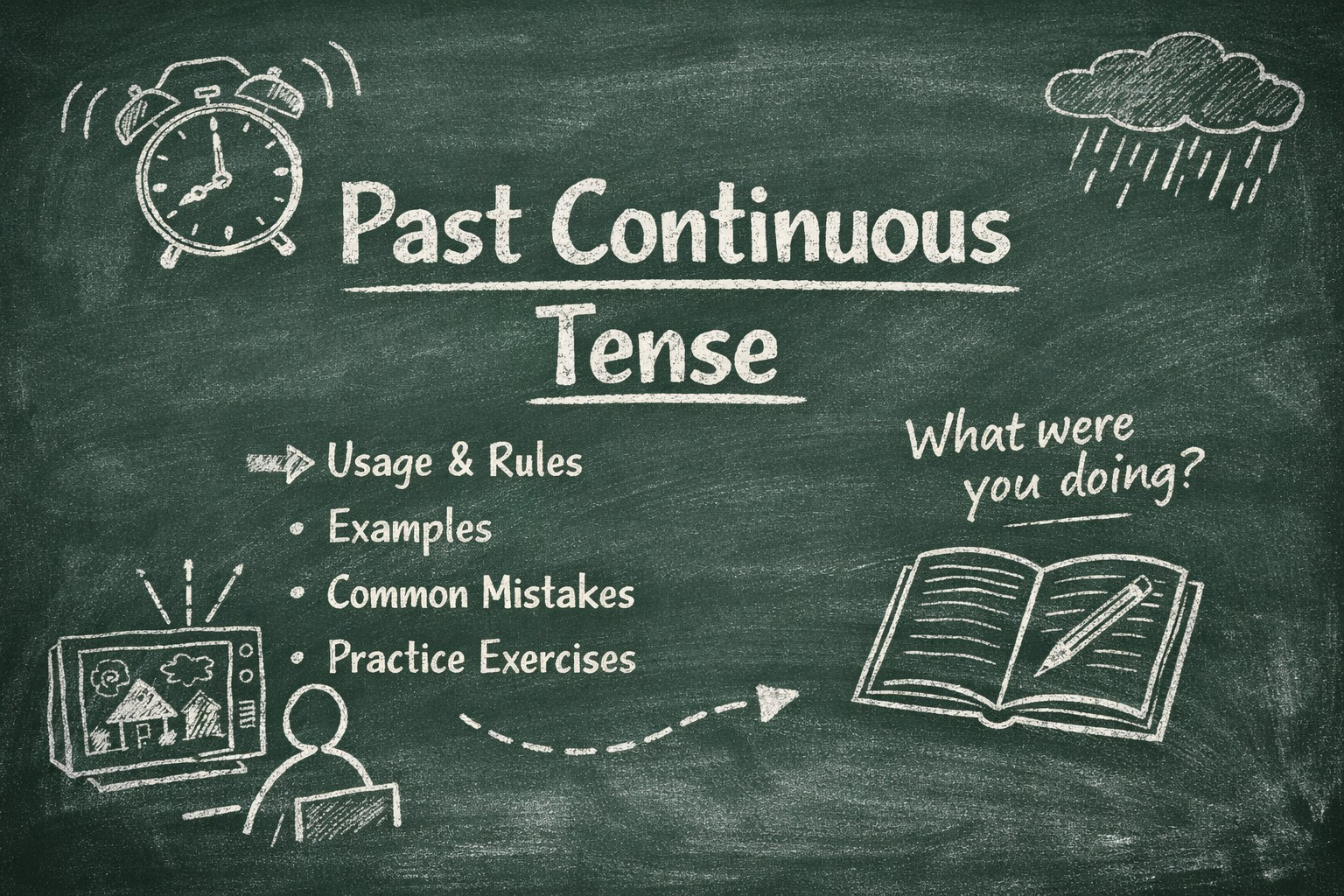
The past continuous tense (also called the past progressive) describes actions that were in progress at a specific time in the past.
It is commonly used to:
- Describe background actions in stories
- Show an action interrupted by another action
- Emphasize duration in the past
- Describe two simultaneous actions
This guide explains the form, uses, examples, signal words, and common mistakes.
1️⃣ Structure of the Past Continuous
Affirmative Statements in the Past Continuous
Structure:
Subject + was/were + verb (-ing)
| Subject | Be Verb | Main Verb (-ing) |
|---|---|---|
| I | was | working |
| You | were | studying |
| He / She / It | was | sleeping |
| Singular Subjects (e.g., the teacher, my friend) | was | working / studying / sleeping |
| We | were | talking |
| They | were | playing |
| Plural Subjects (e.g., the students, my parents) | were | talking / playing / working |
Negative Statements in the Past Continuous
Structure:
Subject + was/were + not + verb (-ing)
Examples:
- I was not (wasn’t) sleeping.
- They were not (weren’t) listening.
- He wasn’t working yesterday afternoon.
Questions in the Past Continuous
To form questions in the past continuous, we change the position of the verb was/were and the subject.
Yes / No Questions in the Past Continuous
Structure:
Was / Were + subject + verb (-ing)?
Examples:
- Was she studying at the library last night?
- Were they working last weekend?
- Was it raining yesterday?
- Were you listening to music during class?
Short Answers:
- Yes, she was.
- No, they weren’t.
- Yes, it was.
- No, I wasn’t.
Wh- Questions in the Past Continuous
When we need more information, we add a Wh- word before was/were.
Structure:
Wh-word + was / were + subject + verb (-ing)?
Examples:
- What were you doing at 8 PM?
- Where was she going after class?
- Why were they laughing?
- Who was talking during the exam?
If the question word is the subject, we do NOT change the order:
Why were they laughing? (Normal change)
Subject question (no change needed):
Who was calling? She was calling. (The subject in the answer is the ‘who?’)
Who was driving? Diego was driving. (The subject in the answer is the ‘who?’)
What was making that noise? The cat was making that noise. (The subject in the answer is the ‘what?’)
There is no extra subject after the question word.
Incorrect:
❌ Who was he calling? (This changes the meaning — now “he” is the subject.)
Correct subject question:
✅ Who was calling?
2️⃣ When Do We Use the Past Continuous?
We can use the past continuous in the following situations:
A. Action in Progress at a Specific Time
We use the past continuous to show an action happening at a particular moment in the past.
Examples:
- At 9 PM, I was studying.
- This time last year, we were living in Mexico.
- Yesterday at 5 o’clock, she was driving home.
👉 The action was not finished at that moment.
I was studying when he called.
✅ Review the full guide here:
The Simple Past Tense in English: Rules, Examples & Practice
B. Interrupted Action (Past Continuous + Simple Past)
We use:
- Past continuous for the longer background action
- Simple past for the shorter interrupting action
Structure:
While + past continuous, simple past
Past continuous + when + simple past
Examples:
- While I was traveling in Colombia, my sister graduated high school.
- While she was studying, her friend called.
- I was cooking when the phone rang.
- They were walking when it started to rain.
C. Two Actions Happening at the Same Time
We use the past continuous to describe simultaneous actions.
Examples:
- I was watching TV while my brother was playing video games.
- She was listening to music while she was cleaning.
D. Background Description in Stories
The past continuous sets the scene in storytelling.
Example:
- It was raining, the wind was blowing, and people were running inside.
Then we often switch to simple past for the main action:
- Suddenly, a tree fell.
E. Temporary Situations in the Past
A temporary situation in the past describes a condition or activity that was true for a limited period of time and was not permanent.
Examples:
- I was living with my parents at that time.
- She was working at a café during college.
- I was studying at the Tec in Querétaro.
3️⃣ Stative Verbs and the Past Continuous
Not all verbs can be used in the continuous form.
Some verbs describe states, not actions. These are called stative verbs (or non-action verbs).
Stative verbs describe:
- Thoughts
- Feelings
- Possession
- Senses
- Opinions
Because they describe a condition — not an activity in progress — they usually do NOT use -ing forms, even in the past.
| Category | Common Stative Verbs |
|---|---|
| Mental States | know, believe, understand, remember, forget |
| Emotions | like, love, hate, want, prefer |
| Possession | have (possession), own, belong |
| Senses / Perception | see, hear, smell, taste |
4️⃣ Important Exceptions: Some Verbs Change Meaning
Some verbs can be stative OR dynamic depending on meaning.
A. Have
Possession (stative)
✅ I had a car. ❌ NOT “I was having a car.”
Activity (dynamic)
✅ I was having dinner.
B. Think
Opinion (stative)
- I thought it was good.
Mental activity (dynamic)
- I was thinking about you.
C. See
Perception (stative)
- I saw him yesterday.
Meeting (dynamic)
- I was seeing a doctor at that time.
Quick Rule for Students
Ask:
Is this an action I can physically see happening?
If yes → Past continuous may be correct.
If no (it’s a state, feeling, belief, or possession) → Use simple past.
Common mistakes students make with structure and usage
1️⃣ Structure Errors
❌ She studying when I arrived.
✅ She was studying when I arrived.
(Don’t forget was/were.)
❌ They was working.
✅ They were working.
(Use were with you/we/they.)
❌ I was study last night.
✅ I was studying last night.
(The main verb must be in the -ing form.)
2️⃣ Action in Progress at a Specific Time
❌ At 8 PM, I watched TV.
✅ At 8 PM, I was watching TV.
(Use past continuous for actions in progress at a specific moment.)
❌ This time yesterday, she worked.
✅ This time yesterday, she was working.
3️⃣ Interrupted Actions
❌ I was cooking when the phone was ringing.
✅ I was cooking when the phone rang.
(The shorter interrupting action uses simple past.)
❌ While I studied, he called.
✅ While I was studying, he called.
(The longer background action uses past continuous.)
4️⃣ Two Actions at the Same Time
❌ I was watching TV while my brother played video games.
✅ I was watching TV while my brother was playing video games.
(Use past continuous for both simultaneous actions.)
5️⃣ Background in Stories
❌ It rained and people ran inside.
✅ It was raining, and people were running inside.
(Use past continuous to describe the scene.)
❌ Suddenly, a tree was falling.
✅ Suddenly, a tree fell.
(Main events usually use simple past.)
6️⃣ Temporary Situations
❌ In 2020, I lived in Texas (temporary situation).
✅ In 2020, I was living in Texas.
(Use past continuous to emphasize temporary background situations.)
❌ I was living there for five years (completed period).
✅ I lived there for five years.
(Use simple past for finished time periods.)
7️⃣ Stative Verbs (Do NOT Use -ing)
❌ I was knowing the answer.
✅ I knew the answer.
❌ She was wanting coffee.
✅ She wanted coffee.
❌ They were having a new car.
✅ They had a new car.
(Stative verbs like know, want, and have for possession do not use the continuous form.)
5️⃣ Common Mistakes for Spanish Speakers
❌ When I arrived, she cooked.
✅ When I arrived, she was cooking.
(Spanish imperfect = English past continuous for background actions.)
❌ At that moment, I studied.
✅ At that moment, I was studying.
(“En ese momento” usually requires past continuous in English.)
❌ I was knowing the answer.
✅ I knew the answer.
(Spanish imperfect allows sabía, but English does not use -ing with stative verbs.)
❌ I studied during three hours.
✅ I studied for three hours.
(“Durante” ≠ “during” + time period. Use for + duration.)
❌ I was living in Texas for five years (completed period).
✅ I lived in Guadalajara for five years.
(Use simple past for finished time periods.)
Let’s Practice the Past Continuous
Exercise A
Choose the correct answer.
-
At 8 PM last night, I ______ dinner.
- ate
- am eating
- have eaten
- was eating
-
She ______ when the phone rang.
- slept
- is sleeping
- was sleeping
- sleeps
-
While they ______ TV, it started to rain.
- watched
- watch
- are watching
- were watching
-
I ______ in Mexico at that time.
- was living
- am living
- lived
- have lived
-
What ______ you ______ at 6 PM yesterday?
- did / do
- was / doing
- are / doing
- were / doing
-
They ______ when the teacher walked into the room.
- have talked
- talked
- were talking
- are talking
-
I was cooking while my brother ______ the table.
- sets
- was setting
- set
- is setting
-
She ______ the answer.
- was knowing
- knows
- knew
- was know
-
Suddenly, the lights ______ off.
- went
- were going
- go
- are going
-
This time last year, we ______ in Texas.
- lived
- live
- have lived
- were living
- At 9 PM last night, I watched TV when you called.
- She were studying when the lights went out.
- While they played soccer, it was starting to rain.
- I was knowing the answer during the test.
- This time last year, we lived in Spain.
- What was you doing at 6 PM yesterday?
- The students was talking while the teacher was explaining the lesson.
- Suddenly, the car was crashing into the wall.
- I was living in Mexico for five years before I moved to Texas.
- While I was cooking dinner, the phone was ringing.
Exercise B
Each sentence has one mistake. Rewrite the sentence correctly.
Scoring & Feedback
🔵 17 – 20 Correct
Excellent work! 🎉 You really understand how to use the past continuous. Keep using it in your everyday conversations and writing.
🟢 14 – 16 Correct
Great job! ✅ You have a good understanding of the past continuous. Review the ones you missed.
🟡 12 – 13 Correct
Good effort! 💪You’re learning, and that’s what matters. Take a moment to review the examples and do the quiz again.
🔴 0 – 11 Correct
No worries! 🌱 The past continuous can be tricky at first. Go back and review the examples in the lesson.
Conclusion
The past continuous is an essential tense for describing actions that were in progress at a specific moment in the past. It allows you to explain what was happening, set the background in a story, describe temporary situations, and show how one action interrupted another. By using was/were + verb (-ing), you make it clear that the action was ongoing — not completed — at that time.
Understanding how the past continuous works together with the simple past is especially important. The past continuous usually describes the longer or background action, while the simple past introduces the shorter, completed event. Mastering this contrast will help you tell clearer stories, write more naturally, and communicate events in the correct sequence.
Remember! Learning a language is not about perfection—it’s about progress. Keep practicing, stay curious, and trust the process. You are moving beyond English to more opportunities, connections, and self-expression!