
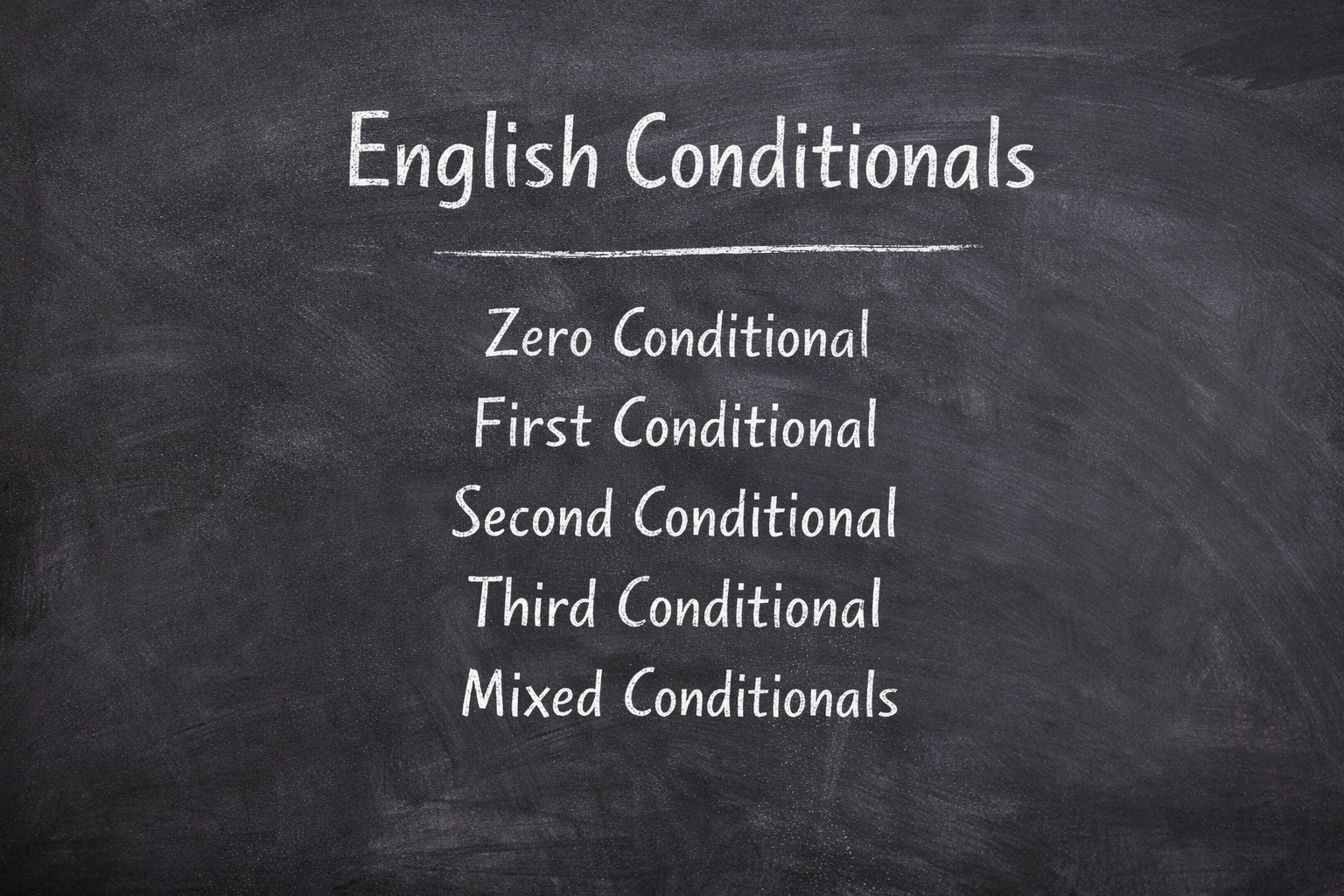
What Are Conditionals in English?
Conditionals are essential for expressing possibility, speculation, and alternative realities in English. This guide will help you move beyond simple “if” sentences and work with more complex ideas—describing imaginary situations, past regrets, and subtle cause-and-effect relationships. You’ll explore how English speakers talk about real situations, hypothetical scenarios, alternative past outcomes, and implied conditions. The goal is not just to learn the forms, but to understand how conditionals are used to communicate meaning clearly and naturally in both spoken and written English.
Real Conditionals
Real conditionals describe situations that are true, possible, or realistically expected. They are used to explain how one situation leads to another in everyday life.
Real Conditionals (Zero Conditional)
Use this form to express general truths and scientific facts—situations where the result happens every time the condition is met.
If you eat a lot of processed food, you aren’t healthy.
Water boils if you heat it to 212 degrees Fahrenheit.
Use the present tense in both the ‘if’ clause and the main clause.
When the condition (the ‘if’ clause) happens à the result (the main clause) happens every time.
🔹Structure
If + present tense, present tense
🔹 Punctuation
When the if clause comes first → use a comma
When the main clause comes first → no comma
Future Real Conditionals (First Conditional)
Use this form to talk about future results that depend on a possible condition. The focus is on what is likely to happen if the condition is met.
If the students study for the final, they will pass the class.
I will move to Mexico next year if I save money.
The if clause expresses the condition, and the main clause expresses the result.
The result clause shows a likely or predictable future outcome, not absolute certainty.
🔹 Structure
If + present simple, will + base verb
Modals for Possibility
You can also use ‘can, might, or may’ instead of ‘will’ in the result clause. This expresses possibility rather than a likely or predictable future outcome. The main clause still uses the present tense.
If Alejandra trains for two months, she can run in the marathon.
President Trump might lose popular support if the war in Iran doesn’t end soon.
🔹 Key Point
will = strong prediction
may / might / can = possibility
The “if” clause does not change.
Using “When” for Regular Results
Use “when” instead of if to describe results that are expected or habitual, not just possible.
Use the simple present in both clauses.
When I exercise in the morning, I always feel better.
Jonesy barks and pulls on his leash when he sees an ardilla.
🔹 Structure
When + present tense, present tense
🔹 Key Point
If = possible condition
When = expected / habitual result
Common Mistakes with Real Conditionals
❌ Using “will” in the if clause
If the students will study, they will pass.
✔ If the students study, they will pass.
❌ Mixing general truths with future forms
If you eat a lot of sugar, you will be unhealthy.
✔ If you eat a lot of sugar, you are unhealthy.
❌ Using “would” instead of “will”
If I save enough money, I would travel.
✔ If I save enough money, I will travel.
❌ Forgetting subject–verb agreement
If she study every day, she will improve.
✔ If she studies every day, she will improve.
❌ Confusing “if” and “when”
When it rains tomorrow, we will stay home.
✔ If it rains tomorrow, we will stay home.
Spanish Speaker Focus
❗ Future tense after “if”
Spanish allows future tense after si, but English does not.
❌ If I will study, I will pass.
✔ If I study, I will pass.
❗ “If” vs. “when” confusion
Spanish cuando can mean both “if” and “when.”
✔ Use if for possible situations
✔ Use when for regular or certain situations
❗ Missing subjects
Spanish often drops subjects, but English requires them.
❌ If study hard, will pass.
✔ If I study hard, I will pass.
Unreal Conditionals
Unreal conditionals describe situations that are not true or not likely to happen. They allow the speaker to imagine different realities and their possible results.
Present and Future Unreal Conditionals (Second Conditional)
This form focuses on hypothetical situations in the present or future. It shows what would happen if reality were different.
If I won the lottery, I would marry Ana de Armas. Humanity could travel to Mars if we solved the challenges of long-duration space travel.
Use the past tense in the ‘if’ clause and ‘would’ or ‘could’ + the base form of the verb in the main clause.
🔹 Structure
If + simple past, would/could + base verb
Using ‘Were’ in Unreal Conditionals
In this form, English uses a special verb pattern to show distance from reality, especially with the verb be.
If I were rich, Ana de Armas would marry me.
History could be altered if time travel were possible.
If aliens weren’t afraid of humans, they would reveal themselves.
In unreal conditionals, the correct form of ‘be’ is ‘were’ for all subjects.
This is a special form (subjunctive) and does not follow normal subject–verb agreement.
🔹 Structure
If + were, would/could
🔹Key Idea
Even though we use the simple past, the meaning is about the present or future, not the past.
🔹Real Past vs. Unreal Present: “Was” vs. “Were”
Use was for real past situations, but use were in unreal conditionals to express hypothetical or imaginary situations.
(real past tense subject-verb agreement)
I was rich until the stock market crash of 2008.
She was a good student.
(All subjects – including singular – use ‘were’ in the ‘if’ clause)
If I were a student, I would study for the final exam.
If she were younger, she would make different decisions.
Common Mistakes with the Second Conditional
❌ Using present tense instead of past in the if clause
If I have more time, I would travel.
✔ If I had more time, I would travel.
❌ Using “will” instead of “would”
If I had more time, I will travel.
✔ If I had more time, I would travel.
❌ Confusing real and unreal conditionals
If I study more, I would pass the exam.
✔ If I study more, I will pass the exam. (real)
✔ If I studied more, I would pass the exam. (unreal)
❌ Incorrect use of “was” instead of “were”
If I was rich, I would travel the world.
✔ If I were rich, I would travel the world.
❌ Using “would” in both clauses
If I would have more time, I would travel.
✔ If I had more time, I would travel.
Spanish Speaker Focus
❗ Difficulty with past tense for unreal meaning
Spanish uses imperfect subjunctive, not past tense logic.
❌ If I have more money, I would travel.
✔ If I had more money, I would travel.
❗ Overusing “would” in the if clause
Spanish “-ría” forms can cause confusion.
❌ If I would have time, I would go.
✔ If I had time, I would go.
❗ Avoiding or misunderstanding “were”
The subjunctive form does not exist in the same way in Spanish.
❌ If I was you, I would leave.
✔ If I were you, I would leave.
Past Unreal Conditionals (Third Conditional)
So far, we’ve focused on imaginary situations in the present or future.
But what if you want to talk about a situation that didn’t happen in the past—and imagine a different result?
This is where the past unreal conditional (third conditional) comes in.
Instead of changing the present, you are now imagining a different past and a different outcome.
- Second conditional → unreal present/future
- Third conditional → unreal past
In the next section, you’ll learn how to describe missed opportunities, regrets, and alternative past outcomes using the third conditional.
How to Form the Third Conditional
Use the past perfect in the if clause and would have / could have in the main clause.
If I had been born in Spain, I would have spoken Spanish with a lisp.
Humans would have colonized Mars already if Elon Musk had lived in the 1700s.
🔹 Structure
If + past perfect, would/could have + past participle
🔹 Key Idea
The third conditional describes a different past and a different result. The real situation is the opposite.
Using the Third Conditional to Express Regret
This form is often used to reflect on mistakes, missed opportunities, or outcomes we wish had been different.
If the students had studied, they would have passed the exam.
I would have been happy now if I hadn’t gotten married.
Common Mistakes with the Third Conditional
❌ Using simple past instead of past perfect
If I studied, I would have passed.
✔ If I had studied, I would have passed.
❌ Forgetting “have” in the result clause
If she had left earlier, she would caught the train.
✔ If she had left earlier, she would have caught the train.
❌ Using “would” in the if clause
If I would have known, I would have helped.
✔ If I had known, I would have helped.
❌ Mixing third and second conditional forms
If I had studied, I would pass the exam.
✔ If I had studied, I would have passed the exam. (third)
✔ If I studied, I would pass the exam. (second)
❌ Incorrect past participle form
If they had went, they would have enjoyed it.
✔ If they had gone, they would have enjoyed it.
Spanish Speaker Focus (Third Conditional)
❗ “Would have” in the if clause
Spanish habría can lead to overusing “would have.”
❌ If I would have known, I would have helped.
✔ If I had known, I would have helped.
❗ Past participle confusion
Irregular participles often cause errors.
❌ If they had went, they would have enjoyed it.
✔ If they had gone, they would have enjoyed it.
❗ Using present/past instead of past perfect
Spanish uses different verb forms; English requires had + past participle.
❌ If I studied, I would have passed.
✔ If I had studied, I would have passed.
Mixed Conditionals in English
Sometimes, the condition and result refer to different points in time, creating a link between past situations and present consequences (or vice versa).
They are used when a past situation affects a present result, or when a present situation explains a past outcome.
Past Condition → Present Result (Most Common)
A past condition creates a present result.
If I had studied medicine, I would be a rich doctor now.
She could be living in New York if she had taken that job.
🔹 Structure
If + past perfect, would + base verb
Present Condition → Past Result (Less Common)
A present condition explains a different past result.
If I were more organized, I wouldn’t have missed the deadline.
He wouldn’t have caused the accident if he were a better driver.
If they were more careful, they wouldn’t have made that mistake.
🔹 Structure
If + past simple, would have + past participle
🔹 Key Idea
Mixed conditionals show how time is connected:
- A past action can affect the present
- A present situation can explain the past
They are especially useful for expressing regret, criticism, and reflection with more detail.
🔍 Conditional Comparison (0, 1st, 2nd, 3rd)
Zero Conditional (Facts / General Truths)
✔ If + present, present
✔ Used for things that are always true
Example: If you heat water, it boils.
First Conditional (Real Future)
✔ If + present, will + base verb
✔ Used for possible and realistic future situations
Example: If you study, you will pass the exam.
Second Conditional (Unreal Present/Future)
✔ If + past, would + base verb
✔ Used for imaginary or hypothetical situations now or in the future
Example: If I had more time, I would travel.
Third Conditional (Unreal Past)
✔ If + past perfect, would have + past participle
✔ Used for imaginary past situations and different results
Example: If I had studied, I would have passed the exam.
🔑 Key Differences
• Zero = always true
• First = real possibility (future)
• Second = unreal now/future
• Third = unreal past
Implied Conditionals (Without “if”)
Implied conditionals express a condition and result without using “if.”
The meaning is the same as real, unreal, or past conditionals. The condition is understood from context.
Without your help, I would have failed.
(= If I hadn’t had your help, I would have failed.)Hurry up, or you’ll miss the bus.
(= If you don’t hurry up, you’ll miss the bus.)With more practice, she would improve.
(= If she practiced more, she would improve quickly.)
Common Forms
- without → negative condition
- or (else) → consequence
- with → positive condition
- otherwise → negative result
🔹 Key Idea
Implied conditionals are common in spoken and natural English.
They show that conditionals are about relationships between ideas, not just grammar patterns.
Test Your Knowledge of Conditionals
Choose the correct answer to complete the sentence or question.
1. If you ______ , I would have brought my friends to your house to watch the game on TV.
a. hadn’t been studying
b. hadn’t studied
c. didn’t study
2. If I ______ about the traffic, I would have left earlier.
a. had known
b. knew
c. would know
3. If someone new ______ into the class, please smile and welcome them.
a. came
b. comes
c. would come
4. She would have passed the exam if she ______ more time to study.
a. had
b. had had
c. would have
5. “Here’s my phone number.”
“Thanks, I’ll give you a call if I ______ some help.
a. need
b. will need
c. would need
6. If he had taken that job in New York, he ______ in a completely different career now.
a. is
b. would be
c. would have been
7. If my candidate had won the election, I ______ happy now. It’s too bad she lost.
a. was
b. am
c. would be
8. Please be quiet during this test. If you ______ or scroll TikTok videos, you will have to leave and miss the test.
a. talked
b. talk
c. will talk
9. If I ______ more free time, I would travel more often.
a. have
b. had
c. will have
10. If I could only find Rob’s phone number, I ______ him about our change in plans!
a. will call
b. had called
c. would call
Answer Key and Explanations
1. a. hadn’t been studying
This is a third conditional. Use if + past perfect (simple or continuous) and would have + past participle. The progressive form emphasizes an action in progress before the past result.
2. a. had known
This is a third conditional. The sentence describes an unreal past situation, so the if-clause requires the past perfect.
3. b. comes
This is a real (first) conditional. After if, use the simple present to describe a real future possibility.
4. b. had had
This is a third conditional. The structure requires the past perfect, and the verb is have, so “had had” is correct.
5. a. need
This is a first conditional. Use the simple present after if, even when the result clause uses will.
6. b. would be
This is a mixed conditional (past → present). The past condition leads to a present result, so use would + base verb.
7. c. would be
This is also a mixed conditional (past → present). The unreal past event affects the speaker’s imagined present state.
8. b. talk
This is a first conditional. The if-clause uses the simple present, not will or past forms.
9. b. had
This is a second conditional. Use if + past simple and would + base verb for unreal present situations.
10. c. would call
This is a second conditional. The sentence describes an unreal present situation, so the result uses would + base verb.
Your Score
9–10 correct: Excellent work! You have strong control of real, unreal, and mixed conditionals. Keep pushing yourself to use these forms naturally in speaking and writing.
7–8 correct: Good job! You understand most conditional structures, but review the differences between second, third, and mixed conditionals to improve accuracy.
5–6 correct: You’re making progress. Focus on the structure of each conditional type, especially verb forms in the if-clause and result clause.
0–4 correct: Keep going—you’re building the foundation. Review the basic patterns (first, second, and third conditionals) and try the exercise again.
Tip: Don’t just memorize the rules—practice creating your own examples. That’s how you make conditionals automatic.
Related Post
Want to build more advanced sentences in English? Read Master Noun Clauses in English: Practical Rules, Examples, and Practice .
Conclusion
Conditionals allow you to move beyond basic communication and express ideas about possibility, imagination, and alternate realities. By understanding the differences between real, unreal, and mixed conditionals, you can describe situations with greater precision and flexibility.
Focus on the patterns, but more importantly, focus on use. The goal is not just to recognize the structure, but to apply it naturally in speaking and writing. With consistent practice, these forms will become automatic—and your English will sound more accurate and more advanced.
Remember! Learning a language is not about perfection—it’s about progress. Keep practicing, stay curious, and trust the process. You are moving beyond English to more opportunities, connections, and self-expression!
Want to explore more English grammar topics? Visit the Cambridge Grammar Guide for additional explanations and examples.
👉 Explore the Cambridge Grammar Guide