
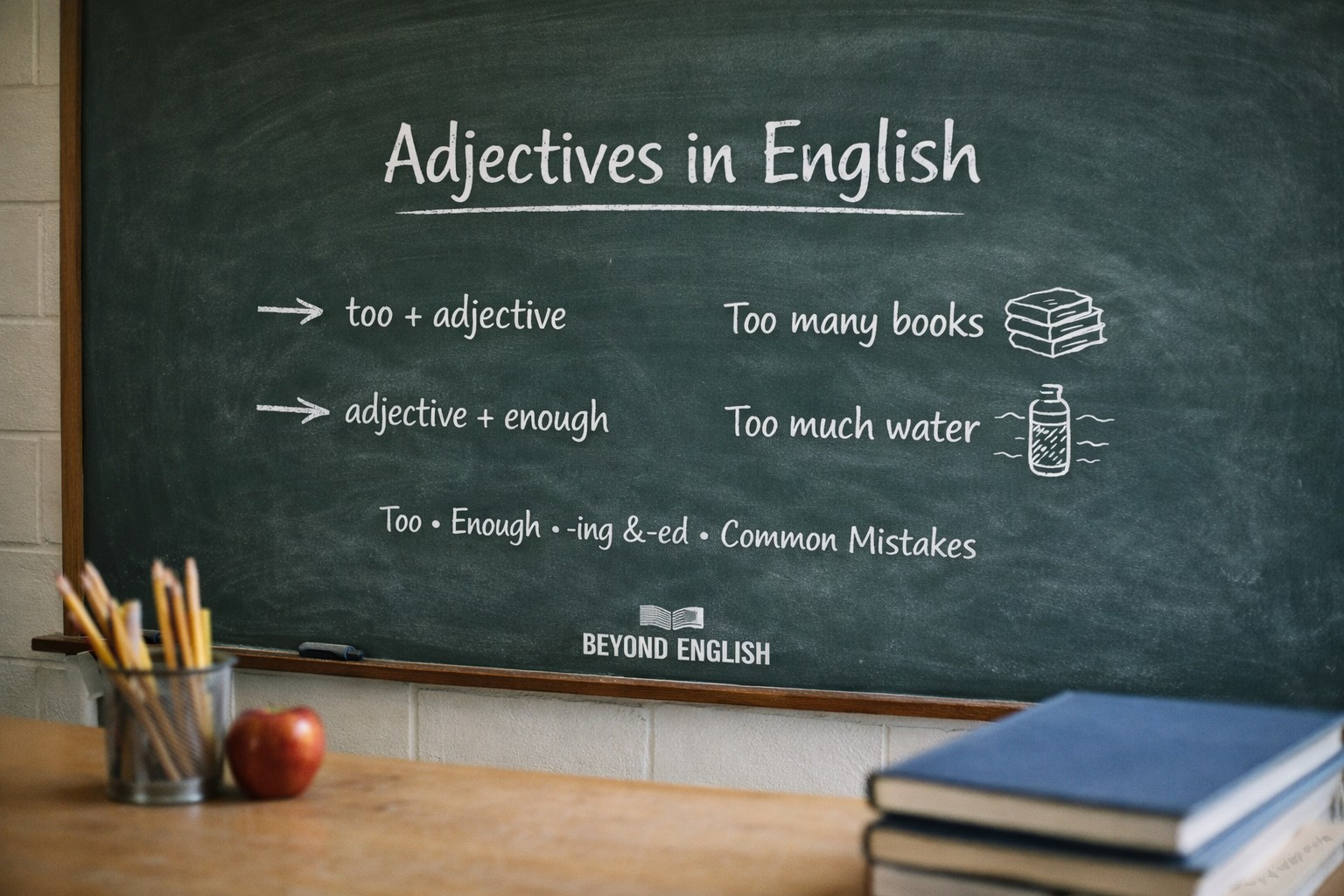
Adjectives in English are words that describe people, places, and things. They give more information about a noun.
What Is an Adjective?
An adjective describes or modifies a noun. They provide more information about a noun.
Examples:
- a small apartment
- a friendly teacher
- a difficult test
- an interesting movie
Adjectives answer questions like:
- What kind?
- How big?
- How old?
- How many?
2. Adjectives Before Nouns
Most adjectives come before the noun.
Structure
Adjective + Noun
Examples:
- She has a new car.
- It’s a beautiful city.
- I bought an expensive phone.
3. Adjectives After a Verb “Be”
Adjectives can also come after the verb Be (am / is / are / was / were).
Structure
Subject + Be (am, is, are, was, were) + Adjective
Examples:
- The movie is boring.
- They are happy.
- The students were excited.
🔄 Adjectives Ending in -ing and -ed
Some adjectives end in -ing and -ed. Don’t confuse these for the present continuous or simple past tense.
- The movie is boring. ✅ (The adjective ‘boring’ describes the movie)
- The movie is boring the audience. (The present continuous use of ‘boring’ describes an action occurring right now)
- The students are excited to learn grammar. ✅ (The adjective ‘excited’ describes the students)
- Grammar excited the students. (The simple past tense use of ‘excited’ describes an action in the past)
4. Using More Than One Adjective
Sometimes we use two adjectives together.
Examples
- a big old house
- a small red bag
- a nice Italian restaurant
Usually, opinion comes before fact:
- a beautiful small garden (‘beautiful’ is an opinion while ‘small’ is a fact)
- a delicious hot soup (‘delicious’ is an opinion while ‘hot’ is a fact)
5. Using Too with Adjectives
Too + adjective means “more than necessary” or “more than we want.”
Structure
too + Adjective
- The coffee is too hot.
- This bag is too heavy.
- The test is too difficult.
It means there is a problem.
6. Using Too Much and Too Many
We use:
- too much → with noncount nouns
- too many → with count nouns
Too Much (noncount)
- too much water
- too much sugar
- too much noise
Examples:
- There is too much traffic.
- I drank too much coffee.
- Teacher gives too much homework!
Too Many (count)
- too many people
- too many problems
- too many emails
Examples:
- There are too many students in the class.
- She has too many bags.
- There are too many presentations.
✅ Review here: Unlock the Secrets of Count and Noncount Nouns in English
7. Using Enough with Adjectives
Enough means the correct amount.
Enough After Adjectives
Structure
Adjective + enough
- warm enough
- old enough
- fast enough
Examples:
- The room is big enough.
- She is old enough to drive.
- This car isn’t fast enough.
Enough Before Nouns
Structure
enough + Noun
- enough money
- enough time
- enough food
Examples:
- We don’t have enough time.
- Do you have enough information?
- There is enough food for everyone.
✅ Continue here: Adverbs in English: Practical Rules, Examples, & Practice
⭐ English vs. Spanish: Important Differences
If your first language is Spanish, adjectives work a little differently in English. Here are the key differences:
1. Position of Adjectives
In Spanish, adjectives usually come after the noun:
- una casa grande
- un carro nuevo
In English, adjectives usually come before the noun:
- a big house
- a new car
❗ This is one of the most common mistakes Spanish speakers make.
2. Adjectives Do NOT Change for Gender or Number
In Spanish, adjectives change form:
- un chico alto
- una chica alta
- chicos altos
In English, adjectives never change:
- a tall boy
- a tall girl
- tall boys
The adjective stays the same.
3. Using “Too Much” and “Too Many”
Spanish uses mucho / mucha / muchos / muchas, and the form changes.
In English:
- too much → noncount nouns
- too many → count nouns
Examples:
- demasiado tráfico → too much traffic
- demasiadas personas → too many people
English does not change the form of “much.”
4. Word Order with “Enough”
In Spanish:
- suficientemente alto
- suficiente dinero
In English:
- tall enough
- enough money
The position changes depending on what comes next.
1. Using an Adverb Instead of an Adjective
❌ She is beautifully.
✅ She is beautiful.
2. Wrong Position of Adjectives (Spanish Interference)
❌ The house big is new.
✅ The big house is new.
3. Wrong Word Order with “Enough”
❌ She is enough tall.
✅ She is tall enough.
❌ We have money enough.
✅ We have enough money.
4. Using “Too Much” with Count Nouns
❌ There are too much students.
✅ There are too many students.
5. Using “Too Many” with Noncount Nouns
❌ I have too many homework.
✅ I have too much homework.
6. Confusing -ing and -ed Adjectives
❌ I am boring.
✅ I am bored.
❌ The movie is bored.
✅ The movie is boring.
7. Confusing Adjectives with Verb Tenses
❌ She is bored the class.
✅ She bored the class. (verb)
❌ The movie is bored me.
✅ The movie bored me. (verb)
✅ Review here: Comparatives and Superlatives in English: Rules and Examples
Let’s Practice!!
Exercise A
Choose the best answer.
- She has a ____ . (A. house big B. big house C. house is big)
- The movie is ____ . (A. interesting B. interest C. interestingly)
- They bought a ____ . car (A. red new B. new red C. red is new)
- The students are ____ . (A. tiredly B. tiring C. tired)
- We live in a ____ . (A. apartment small B. small apartment C. apartment is small)
- The food was ____ . (A. deliciously B. delicious C. delicious food)
- Teach Alan is an ____ . (A. excellent teacher B. teacher excellent C. teacher is excellent)
- The test is ____ (A. easy B. easily C. como papitas)
- He has a ____ dog. (A. brown small B. brown is small C. small brown)
- The children are ____ . (A. happily B. happy C. happiness)
Exercise B
Each sentence has one mistake. Rewrite the sentence correctly.
- She has a house big.
- The movie was bored.
- There are too much people in the room.
- I have too many homework in grammar class.
- She is enough tall to reach the shelf.
- The movie is interesting very.
- He is very tiring after work.
- We don’t have time enough to finish the test.
- They bought a fast car red.
- There is too many traffic today.
Scoring & Feedback
🔵 17 – 20 Correct
Excellent work! 🎉 You really understand how to use adjectives. Keep using it in your everyday conversations and writing.
🟢 14 – 16 Correct
Great job! ✅ You have a good understanding of adjectives. Review the ones you missed.
🟡 12 – 13 Correct
Good effort! 💪You’re learning, and that’s what matters. Take a moment to review the examples and do the quiz again.
🔴 0 – 11 Correct
No worries! 🌱 Adjectives can be tricky at first. Go back and review the examples in the lesson.
Conclusion
Adjectives are essential in English because they help us describe people, places, and things clearly. At the A2 level, it is important to understand:
- Adjectives usually come before nouns.
- After the verb be, we use an adjective (not an adverb).
- Too shows a problem.
- Too much is for uncountable nouns.
- Too many is for countable nouns.
- Enough comes after adjectives but before nouns.
- -ing adjectives describe things.
- -ed adjectives describe feelings.
Many common mistakes happen because students translate directly from their first language. Pay attention to word order and structure, and practice using adjectives in full sentences.
The more you use adjectives correctly, the more natural and confident your English will sound.
Remember! Learning a language is not about perfection—it’s about progress. Keep practicing, stay curious, and trust the process. You are moving beyond English to more opportunities, connections, and self-expression!
Leave a Reply