
White text-logo on blue background.

Category: English Grammar

  • Adjectives in English: Practical Rules, Examples, and Practice

    Adjectives in English: Practical Rules, Examples, and Practice

    Adjectives in English are words that describe people, places, and things. They give more information about a noun.

    What Is an Adjective?

    An adjective describes or modifies a noun. They provide more information about a noun.

    Examples:

    • a small apartment
    • a friendly teacher
    • a difficult test
    • an interesting movie

    Adjectives answer questions like:

    • What kind?
    • How big?
    • How old?
    • How many?

    2. Adjectives Before Nouns

    Most adjectives come before the noun.

    Structure

    Adjective + Noun

    Examples:

    • She has a new car.
    • It’s a beautiful city.
    • I bought an expensive phone.

    3. Adjectives After a Verb “Be”

    Adjectives can also come after the verb Be (am / is / are / was / were).

    🔁 Quick Review: If you need to review how Be verbs work in the present tense, start here before continuing: How to Use Be Verbs in the Present Tense

    Structure

    Subject + Be (am, is, are, was, were) + Adjective

    Examples:

    • The movie is boring.
    • They are happy.
    • The students were excited.

    🔄 Adjectives Ending in -ing and -ed

    Some adjectives end in -ing and -ed. Don’t confuse these for the present continuous or simple past tense.

    • The movie is boring. ✅ (The adjective ‘boring’ describes the movie)
    • The movie is boring the audience. (The present continuous use of ‘boring’ describes an action occurring right now)
    • The students are excited to learn grammar. ✅ (The adjective ‘excited’ describes the students)
    • Grammar excited the students. (The simple past tense use of ‘excited’ describes an action in the past)

    4. Using More Than One Adjective

    Sometimes we use two adjectives together.

    Examples

    • a big old house
    • a small red bag
    • a nice Italian restaurant

    Usually, opinion comes before fact:

    • a beautiful small garden (‘beautiful’ is an opinion while ‘small’ is a fact)
    • a delicious hot soup (‘delicious’ is an opinion while ‘hot’ is a fact)

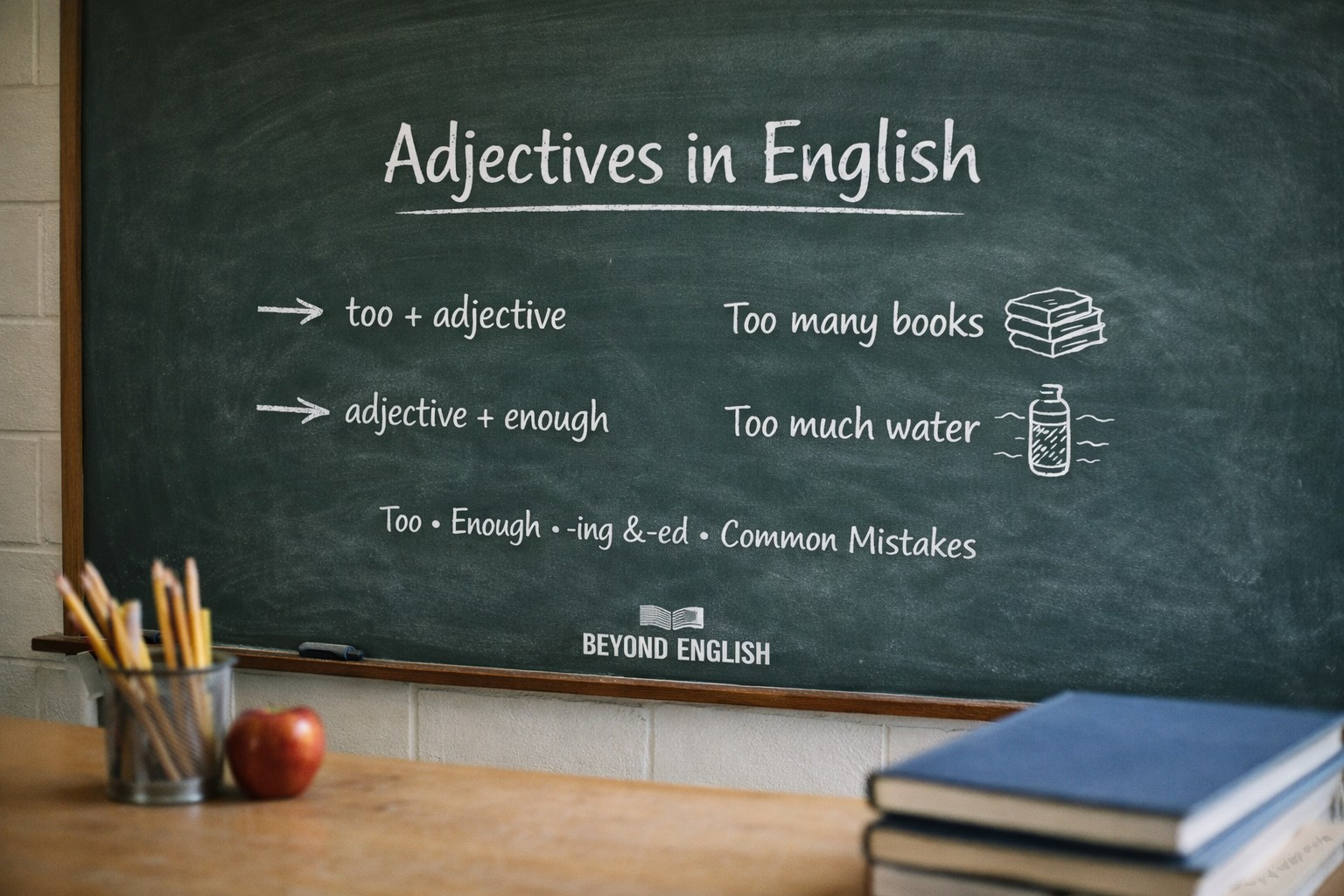
    5. Using Too with Adjectives

    Too + adjective means “more than necessary” or “more than we want.”

    Structure

    too + Adjective

    • The coffee is too hot.
    • This bag is too heavy.
    • The test is too difficult.

    It means there is a problem.

    6. Using Too Much and Too Many

    We use:

    • too much → with noncount nouns
    • too many → with count nouns

    Too Much (noncount)

    • too much water
    • too much sugar
    • too much noise

    Examples:

    • There is too much traffic.
    • I drank too much coffee.
    • Teacher gives too much homework!

    Too Many (count)

    • too many people
    • too many problems
    • too many emails

    Examples:

    • There are too many students in the class.
    • She has too many bags.
    • There are too many presentations.
    🔁 Quick Review: Adjectives often appear with quantity words like too much, too many, and enough. To use these correctly, you need to understand count nouns and noncount nouns.

    ✅ Review here: Unlock the Secrets of Count and Noncount Nouns in English

    7. Using Enough with Adjectives

    Enough means the correct amount.

    Enough After Adjectives

    Structure

    Adjective + enough

    • warm enough
    • old enough
    • fast enough

    Examples:

    • The room is big enough.
    • She is old enough to drive.
    • This car isn’t fast enough.

    Enough Before Nouns

    Structure

    enough + Noun

    • enough money
    • enough time
    • enough food

    Examples:

    • We don’t have enough time.
    • Do you have enough information?
    • There is enough food for everyone.
    🔁 Next Step: Once you understand how adjectives describe nouns, the next step is learning how adverbs describe verbs, adjectives, and other adverbs (slow → slowly, careful → carefully).

    ✅ Continue here: Adverbs in English: Practical Rules, Examples, & Practice

    ⭐ English vs. Spanish: Important Differences

    If your first language is Spanish, adjectives work a little differently in English. Here are the key differences:

    1. Position of Adjectives

    In Spanish, adjectives usually come after the noun:

    • una casa grande
    • un carro nuevo

    In English, adjectives usually come before the noun:

    • a big house
    • a new car

    ❗ This is one of the most common mistakes Spanish speakers make.

    2. Adjectives Do NOT Change for Gender or Number

    In Spanish, adjectives change form:

    • un chico alto
    • una chica alta
    • chicos altos

    In English, adjectives never change:

    • a tall boy
    • a tall girl
    • tall boys

    The adjective stays the same.

    3. Using “Too Much” and “Too Many”

    Spanish uses mucho / mucha / muchos / muchas, and the form changes.

    In English:

    • too much → noncount nouns
    • too many → count nouns

    Examples:

    • demasiado tráfico → too much traffic
    • demasiadas personas → too many people

    English does not change the form of “much.”

    4. Word Order with “Enough”

    In Spanish:

    • suficientemente alto
    • suficiente dinero

    In English:

    • tall enough
    • enough money

    The position changes depending on what comes next.

    💡If you need a refresher on other grammar topics, check out our Blog for more lessons.
    🚫 Common Mistakes to Avoid with Adjectives

    1. Using an Adverb Instead of an Adjective

    ❌ She is beautifully.
    ✅ She is beautiful.

    2. Wrong Position of Adjectives (Spanish Interference)

    ❌ The house big is new.
    ✅ The big house is new.

    3. Wrong Word Order with “Enough”

    ❌ She is enough tall.
    ✅ She is tall enough.

    ❌ We have money enough.
    ✅ We have enough money.

    4. Using “Too Much” with Count Nouns

    ❌ There are too much students.
    ✅ There are too many students.

    5. Using “Too Many” with Noncount Nouns

    ❌ I have too many homework.
    ✅ I have too much homework.

    6. Confusing -ing and -ed Adjectives

    ❌ I am boring.
    ✅ I am bored.

    ❌ The movie is bored.
    ✅ The movie is boring.

    7. Confusing Adjectives with Verb Tenses

    ❌ She is bored the class.
    ✅ She bored the class. (verb)

    ❌ The movie is bored me.
    ✅ The movie bored me. (verb)

    🔁 Quick Review: Once you understand basic adjectives, the next step is learning how to compare things using comparatives and superlatives (bigger, more interesting, the best, etc.).

    ✅ Review here: Comparatives and Superlatives in English: Rules and Examples

    Let’s Practice!!

    Exercise A

    Choose the best answer.

    1. She has a ____ . (A. house big B. big house C. house is big)
    2. The movie is ____ . (A. interesting B. interest C. interestingly)
    3. They bought a ____ . car (A. red new B. new red C. red is new)
    4. The students are ____ . (A. tiredly B. tiring C. tired)
    5. We live in a ____ . (A. apartment small B. small apartment C. apartment is small)
    6. The food was ____ . (A. deliciously B. delicious C. delicious food)
    7. Teach Alan is an ____ . (A. excellent teacher B. teacher excellent C. teacher is excellent)
    8. The test is ____ (A. easy B. easily C. como papitas)
    9. He has a ____ dog. (A. brown small B. brown is small C. small brown)
    10. The children are ____ . (A. happily B. happy C. happiness)

    Exercise B

    Each sentence has one mistake. Rewrite the sentence correctly.

    1. She has a house big.
    2. The movie was bored.
    3. There are too much people in the room.
    4. I have too many homework in grammar class.
    5. She is enough tall to reach the shelf.
    6. The movie is interesting very.
    7. He is very tiring after work.
    8. We don’t have time enough to finish the test.
    9. They bought a fast car red.
    10. There is too many traffic today.

    Scoring & Feedback

    🔵 17 – 20 Correct

    Excellent work! 🎉 You really understand how to use adjectives. Keep using it in your everyday conversations and writing.

    🟢 14 – 16 Correct

    Great job! ✅ You have a good understanding of adjectives. Review the ones you missed.

    🟡 12 – 13 Correct

    Good effort! 💪You’re learning, and that’s what matters. Take a moment to review the examples and do the quiz again.

    🔴 0 – 11 Correct

    No worries! 🌱 Adjectives can be tricky at first. Go back and review the examples in the lesson.

    📚 Want more reading, writing, listening, and speaking practice? Check out the Essential English series on Amazon!

    Conclusion

    Adjectives are essential in English because they help us describe people, places, and things clearly. At the A2 level, it is important to understand:

    • Adjectives usually come before nouns.
    • After the verb be, we use an adjective (not an adverb).
    • Too shows a problem.
    • Too much is for uncountable nouns.
    • Too many is for countable nouns.
    • Enough comes after adjectives but before nouns.
    • -ing adjectives describe things.
    • -ed adjectives describe feelings.

    Many common mistakes happen because students translate directly from their first language. Pay attention to word order and structure, and practice using adjectives in full sentences.

    The more you use adjectives correctly, the more natural and confident your English will sound.

    Remember! Learning a language is not about perfection—it’s about progress. Keep practicing, stay curious, and trust the process. You are moving beyond English to more opportunities, connections, and self-expression!
    💡Need personalized help using these grammar structures? Explore my ESL lessons and services for individual and group support.

    Leave a comment below!

    And remember . . . Practice, Practice, Practice!!

  • Mastering Direct and Indirect Objects in English

    Mastering Direct and Indirect Objects in English

    Understanding direct and indirect objects will help you make your sentences clearer and more natural. These grammar points are very common in everyday English, especially when we talk about giving, sending, or showing something.

    In this lesson, you’ll learn:

    • What direct and indirect objects are
    • How to identify them
    • Two common sentence patterns
    • Common mistakes ESL students make

    What Is an Object?

    In English, an object comes after the verb. It tells us who or what receives the action.

    👉 She read a book.
    👉 He called his friend.

    Some sentences have one object, but others have two.

    👉 I studied grammar with my classmates.

    👉 Can you text me the link?

    What Is a Direct Object?

    The direct object is the thing that receives the action of the verb.

    Ask yourself: What? or Who?

    • She bought a gift. (She bought what? A gift).
    • They watched a movie. (They watched what? A movie).
    • I need help. (I need what? Help).

    👉 The action goes directly to the direct object.

    What Is an Indirect Object?

    The indirect object is the person (or animal) who receives the direct object.

    Ask yourself: To whom? or For whom?

    • She gave me a gift.
    • He sent his sister a message.
    • The teacher showed the students the answer.

    👉 The indirect object usually comes before the direct object.

    Sentence Patterns with Direct and Indirect Objects

    Sentence Pattern 1: Indirect Object First (No Preposition)

    Subject + Verb + Indirect Object + Direct Object

    This is very common with verbs like:
    give, send, show, tell, bring

    Examples:

    • She gave me the keys.
    • He sent his boss an email.
    • I told my friend the truth.

    ✅ No to or for is used here.

    Sentence Pattern 2: Direct Object First (With a Preposition)

    Subject + Verb + Direct Object + to / for + Indirect Object

    Which Verbs Use to or for?

    Verbs that usually use to

    • give
    • send
    • show
    • tell
    • lend

    👉 She explained the problem to the class.

    Verbs that usually use for

    • buy
    • make
    • cook
    • get

    👉 He made dinner for his family.

    🚫 Common Mistakes ESL Students Make

    ❌ She gave to me the book.
    ✅ She gave me the book.

    ❌ He bought for me a coffee.
    ✅ He bought me a coffee.

    ❌ I explained her the lesson.
    ✅ I explained the lesson to her.

    👉 Remember: You can’t always remove the preposition.

    Say and Tell

    Say and tell have a similar meaning, but we use them in different sentence patterns.

    1. Using say

    We use say to focus on the words or information, not the person.

    Pattern 1

    say + something (direct object)

    • She said her name.
    • He said the answer.

    Pattern 2

    say + something + to + person

    • She said her name to me.
    • They said goodbye to their friends.

    Pattern 3

    say (that) + statement

    • She said (that) she wanted a big wedding.
    • He said (that) he was tired.

    👉 With say, the person usually comes after to.

    💡If you need a refresher on other grammar topics, check out our Blog for more lessons.

    2. Using tell

    We use tell to focus on who receives the information.

    Pattern 1

    tell + someone + something

    • She said her name.
    • He said the answer.

    Pattern 2

    tell + someone + to + verb

    • The teacher told us to open the book.
    • He told her to wait.

    👉 Tell must have a person (indirect object).

    3. Fixed Expressions with tell

    Some common expressions use tell without another object:

    • tell the truth
    • tell a lie

    Quick Comparison

    • Say → focuses on what is said
    • Tell → focuses on who is told

    Let’s Practice Direct and Indirect Objects

    Exercise A

    Unscramble each sentence.

    1. explained / the present continuous / us / to / the teacher
    2. the author / a scary story / read
    3. me / did / the homework / send / you / ?
    4. gave / Alexander / Michelle / a gift
    5. the manager / explained / us / the rules / to
    6. him / did / the message / send / she / ?
    7. bought / a coffee / me / he
    8. showed / the answer / the students / the teacher
    9. her / cooked / dinner / he
    10. did / you / tell / the truth / me / ?

    Exercise B

    Choose the correct answer.

    1. She ___ me the truth.
    a) said
    b) told
    c) said to
    d) told to

    2. He ___ goodbye to his coworkers.
    a) told
    b) told to
    c) said
    d) said them

    3. The teacher explained the rules ___ the students.
    a) for
    b) to
    c) at
    d) with

    4. I ___ her the message yesterday.
    a) said
    b) told
    c) said to
    d) say

    5. She said ___ she was tired.
    a) to
    b) that
    c) her
    d) for

    6. He bought a gift ___ his sister.
    a) to
    b) for
    c) at
    d) with

    7. They told us ___ quiet.
    a) be
    b) to be
    c) being
    d) be to

    8. She ___ the answer to the class.
    a) told
    b) told to
    c) said
    d) say

    9. The manager sent ___ an email.
    a) to us
    b) us
    c) for us
    d) us to

    10. He said hello ___ me.
    a) at
    b) for
    c) to
    d) with

    Scoring and Feedback

    🔵 17 – 20 Correct

    Excellent work! 🎉 You really understand how to use direct and indirect objects. Keep using it in your everyday conversations and writing.

    🟢 14 – 16 Correct

    Great job! ✅ You have a good understanding of direct and indirect objects. Review the ones you missed.

    🟡 12 – 13 Correct

    Good effort! 💪You’re learning, and that’s what matters. Take a moment to review the examples and do the quiz again.

    🔴 0 – 11 Correct

    No worries! 🌱 Direct and indirect objects can be tricky at first. Go back and review the examples in the lesson.

    📚 Want more reading, writing, listening, and speaking practice? Check out the Essential English series on Amazon!

    Conclusion

    Understanding direct and indirect objects helps you build clearer and more natural English sentences. Remember that the direct object is the thing, and the indirect object is the person who receives it.

    When using say and tell, focus on the structure:

    • Say focuses on the words or information.
    • Tell focuses on the person who receives the information.

    By practicing these patterns, you will make fewer mistakes with word order and prepositions like to and for. Take your time, review the examples, and try to use these structures when you speak and write in English.

    Remember! Learning a language is not about perfection—it’s about progress. Keep practicing, stay curious, and trust the process. You are moving beyond English to more opportunities, connections, and self-expression!

    💡Need personalized help using these grammar structures? Explore my ESL lessons and services for individual and group support.

    Leave a comment below!

    And remember . . . Practice, Practice, Practice!!

  • The Simple Past Tense in English: Rules, Examples, & Practice

    The Simple Past Tense in English: Rules, Examples, & Practice

    The simple past tense is used to talk about completed actions or events that happened before now.
    It is one of the most important grammar topics for ESL beginners.

    In this guide, you’ll learn:

    • When to use the past tense
    • How to form regular and irregular verbs
    • How to make negative sentences and questions
    • Common mistakes ESL students make
    • Simple practice examples with answers
    💡If you need a refresher on the simple present tense, check out our Simple Present Tense lesson for clear explanations and practice.

    When Do We Use the Simple Past Tense?

    We use the past tense to talk about:

    • a single action completed in the past
    • a longer action completed in the past
    • repeated actions completed in the past

    A Single Action Completed in the Past

    Past Present X
    1. I ate pizza last night.
    2. She made a cup of coffee at 7:00 am.
    3. We studied grammar at the library yesterday.
    4. The students turned in their homework on Monday.

    A Longer Action Completed in the Past

    Past Present
    1. We stayed with my family for two weeks last December.
    2. I lived in Coyoacán last summer.
    3. The students spoke English with each other for two hours.
    4. The flight to Bogotá took four hours.

    Repeated Actions Completed in the Past

    Past Present X X X
    1. Alejandra cooked bacon and eggs three times last week.
    2. We visited Querétaro twice in 2018.
    3. The grammar class completed seven homework assignments.
    4. I played golf four times last week.

    The Simple Past Tense: Affirmative Statements

    We use affirmative statements in the simple past to say that an action happened and finished in the past.

    Structure

    Subject + past tense verb

    The verb form is the same for all subjects.

    Examples:

    • I drank two cups of tea last night.
    • She drank three cups of tea last night.
    • Diego and I drank one cup of tea last night.

    There is no auxiliary verb (do / does / did) in affirmative past statements

    🚫 Common Mistake with Past Tense Affirmative Statements

    Do NOT add ‘did’ to affirmative past tense sentences.

    ❌ I did worked yesterday.

    ✅ I worked yesterday.

    Why?
    In affirmative sentences, the past time is shown by the past form of the main verb. The auxiliary ‘did’ is only used in negatives and questions.

    The Simple Past Tense: Negative Sentences

    We use a negative sentence in the simple past to say that an action did not happen or was not true in the past.

    Structure:

    Subject + did not + base form of the verb

    Examples:

    • I didn’t work yesterday.
    • He didn’t go to class.
    • We didn’t travel to Mexico last summer.
    🚫 Common Mistake with Past Tense Negatives

    Do NOT use the past form of the main verb after didn’t.

    ❌ We didn’t studied yesterday.

    ✅ We didn’t study yesterday.

    Why?
    The word ‘didn’t’ already shows past time, so the main verb must stay in the base form.

    The Simple Past Tense: Questions

    We use questions in the simple past to ask if an action happened or did not happen in the past.

    Structure:

    Did + subject + base form of the verb

    Examples:

    • Did you finish the homework?
    • Did she call you last night?
    • Did they arrive on time?

    📌 The main verb always stays in the base form.

    🚫 Common Mistake with Past Tense Questions

    Do NOT use the past form of the main verb after did.

    ❌ Did Frida painted a picture yesterday?

    ✅ Did Frida paint a picture yesterday?

    Why?
    The word ‘did’ already shows past time, so the main verb must stay in its base form.

    Spelling Rules in the Simple Past Tense

    Before looking at the rules, remember:
    Most regular verbs form the simple past by adding -ed to the base form of the verb, but small spelling changes are sometimes needed to make the word easier to read and pronounce.

    Regular Verbs in the Simple Past Tense

    Most Verbs in English verbs are regular.

    1. For most regular verbs

    Simply add -ed to the base form of the verb

    Base Form of the VerbPast Tense
    workworked
    playplayed
    watchwatched
    cleancleaned

    Most verbs form the past tense by adding -ed, but there are exceptions to this rule.

    2. Regular Verbs Ending in -e

    If a verb already ends in -e, add -d (not -ed).

    • live → lived
    • like → liked
    • arrive → arrived

    3. Regular Verbs Ending in Consonant + y

    If a verb ends in a consonant + y, change y to i, then add -ed.

    • study → studied
    • carry → carried
    • try → tried

    📌 If the verb ends in vowel + y, just add -ed:

    • play → played
    • enjoy → enjoyed

    4. One-Syllable Regular Verbs Ending in a Consonant + Vowel + Consonant

    If a one-syllable verb ends in:

    • consonant + vowel + consonant

    👉 double the final consonant and add -ed.

    • stop → stopped
    • plan → planned
    • drop → dropped

    Stress Rule

    Some two-syllable verbs follow the same doubling rule only if the stress is on the final syllable.

    • prefer → preferred
    • admit → admitted
    🚫 Common Spelling Mistakes to Avoid

    studed → ✅ studied

    stoped → ✅ stopped

    planed → ✅ planned

    liveed → ✅ lived

    Tip:
    Always check the verb ending before adding -ed. Some verbs need a spelling change to make the past tense clear and easy to read.

    🔊 Pronunciation Tip:
    Spelling the past tense is only part of the challenge. Regular verbs ending in -ed have three different pronunciations, depending on the final sound of the verb.

    👉 Read the full guide here: Pronouncing -ed Endings in English (ESL Guide)

    Irregular Verbs in the Simple Past Tense

    Some verbs do not follow the -ed rule. These are called irregular verbs, and they must be memorized.

    Base VerbPast Tense
    gowent
    eatate
    seesaw
    havehad
    dodid

    📌 There is no rule for irregular verbs—practice and repetition are key.

    Need help with irregular verbs? Download this printable list of common irregular verbs (PDF) for quick reference.

    💡If you need a refresher on other grammar topics, check out our Blog for more lessons.

    Be Verbs in the Simple Past Tense

    The verb Be is irregular in the past tense.
    It has two past forms: was and were.

    🔁 Quick Review:
    Before using ‘was’ and ‘were’ in the past tense, make sure you understand how be verbs work in the present tense (am / is / are).

    👉 Review the rules and examples here: How to Use Be Verbs in the Present Tense (ESL Guide)

    The Simple Past Tense Forms of Be

    SubjectPast Form
    Iwas
    He / She / Itwas
    Singular Subjectswas
    Youwere
    Wewere
    Theywere
    Plural Subjectswere

    📌 Unlike all other verbs, Be changes based on the subject.

    Affirmative Sentences with Be (The Simple Past Tense)

    Structure:

    Subject + was / were

    Examples:

    • I was tired yesterday.
    • She was late for class.
    • They were in Colombia last summer.

    Negative Sentences with Be (The Simple Past Tense)

    Add not after was or were.

    Structure:

    Subject + was / were + not

    In spoken English, we usually use contractions:

    • was not = wasn’t
    • were not = weren’t

    Examples:

    • Alejandra wasn’t happy.
    • He wasn’t at work yesterday.
    • We weren’t studying in the library last night.

    Questions with Be (The Simple Past Tense)

    Move was or were to the beginning of the sentence.

    Structure:

    Was / Were + subject … ?

    Examples:

    • Was she sick yesterday?
    • Were you at the meeting on Monday?
    • Were they in Argentina last summer?
    🚫 Common Mistake with Be Verbs in the Past

    Do NOT use ‘did’ with be verbs.

    ❌ Did you was tired?

    Were you tired?

    Why?
    The verb Be does not use ‘did’ in the past tense. Questions with Be are formed by moving ‘was’ or ‘were’ to the beginning of the sentence.

    📚 Want more reading, writing, listening, and speaking practice? Check out the Essential English series on Amazon!

    Let’s Practice The Simple Past Tense

    Exercise A

    Find the Mistake: Simple Past Tense

    Instructions: Each sentence has one mistake. Find it and correct the sentence.

    1. Yesterday, I go to work at 8 a.m.
    2. She didn’t went to class last Friday.
    3. We was tired after the meeting.
    4. He buyed a new phone last week.
    5. They don’t finished the project on time.
    6. Last night, I watch a movie with my friends.
    7. Did you ate breakfast this morning?
    8. My parents was lived in Mexico in 2010.
    9. She didn’t studied for the test.
    10. When I was a child, I am played soccer every day.

    Exercise B

    Simple Past Tense: Fill in the Blank

    Instructions: Complete each sentence using the simple past tense of the verb in parentheses.

    1. Yesterday, I __________ to work at 8 a.m. (go)
    2. She __________ a new laptop last month. (buy)
    3. We __________ tired after the long meeting. (be)
    4. They __________ dinner at home last night. (eat)
    5. He __________ English for two years in college. (study)
    6. I __________ my keys this morning. (lose)
    7. The class __________ at 9:00 a.m. yesterday. (start)
    8. My friends __________ me after the movie. (call)
    9. She __________ late because of traffic. (arrive)
    10. We __________ a great time on our vacation. (have)

    Scoring and Feedback

    🔵 17 – 20 Correct

    Excellent work! 🎉 You really understand how to use the simple past tense. Keep using it in your everyday conversations and writing.

    🟢 14 – 16 Correct

    Great job! ✅ You have a good understanding of the simple past tense. Review the ones you missed.

    🟡 12 – 13 Correct

    Good effort! 💪You’re learning, and that’s what matters. Take a moment to review the examples and do the quiz again.

    🔴 0 – 11 Correct

    No worries! 🌱 The simple past tense can be tricky at first. Go back and review the examples in the lesson.

    Conclusion

    The simple past tense is used to talk about completed actions in the past. Once you understand the basic structure — subject + past verb, the use of did/didn’t — you can clearly describe past events, experiences, and routines.

    Remember to pay close attention to irregular verbs and to use the base form of the verb after did and didn’t. These are some of the most common mistakes ESL learners make, but with regular practice, they become much easier to avoid.

    Keep practicing by writing short sentences and talking about what you did yesterday, last week, or last year. The more you use the simple past tense in real situations, the more natural it will feel in both speaking and writing.

    Remember! Learning a language is not about perfection—it’s about progress. Keep practicing, stay curious, and trust the process. You are moving beyond English to more opportunities, connections, and self-expression!

    💡Need personalized help using these grammar structures? Explore my ESL lessons and services for individual and group support.

    Leave a comment below!

    And remember . . . Practice, Practice, Practice