White text-logo on blue background.

Category: English Grammar

  • Master Noun Clauses in English: Practical Rules, Examples, and Practice

    Master Noun Clauses in English: Practical Rules, Examples, and Practice

    Noun Clauses

    Noun clauses in English are dependent clauses that function as a noun in a sentence. In other words, it can act as the subject, object, or complement of a sentence. Remember that a clause has a subject and a verb.

    Noun clauses usually begin with one of the following words:

    that, if, whether, or a WH-word such as who, what, where, when, why, how, and how much.

    Need to Review Clauses First?

    Before learning noun clauses, make sure you understand the difference between independent and dependent clauses.

    👉 Read: Independent and Dependent Clauses in English

    Noun Clauses vs Adjective Clauses

    A noun clause functions as a noun in the sentence. It can be the subject, object, or complement.

    • She decided that she would move to Santiago.

    An adjective (relative) clause describes a noun. It gives extra information about a person, place, or thing.

    • The house where he lives is beautiful (Adjective clause –> describes house)
    Need to Review Adjective (Relative) Clauses?

    If you want to better understand the difference between noun clauses and adjective clauses, review relative clauses first.

    👉 Read: Master Relative Clauses in English

    Noun Clauses as Subject

    A noun clause can function as the subject of a sentence. When this happens, the noun clause comes at the beginning of the sentence and acts as the thing performing the action or being described.

    Examples:

    • What she said surprised everyone.
    • Why he left early remains a mystery.
    • Whether they agree does not matter.
    • How he solved the problem is impressive.
    Tip: A noun clause used as the subject is singular, so it usually takes a singular verb.

    What he said was surprising.
    What he said were surprising.

    Noun Clauses as Objects

    A noun clause can function as the object of a sentence. When this happens, it receives the action of the verb and usually follows the main verb.

    Examples:

    • I know that she is busy.
    • She explained why she was late.
    • We asked whether the store was open.
    • He remembers where he parked the car.
    Tip: Noun clauses most commonly appear as objects after verbs such as know, think, say, ask, explain, wonder, and remember.
    Need to Review Objects First?

    Understanding direct and indirect objects will help you recognize how noun clauses function as objects in sentences.

    👉 Read: Mastering Direct and Indirect Objects in English

    A noun clause commonly follows certain verbs, especially verbs related to thinking, knowing, saying, and asking.
    These noun clauses may begin with that, if, whether, or a WH-word such as who, what, where, when, why, or how.
    In spoken and informal written English, that is often omitted when the meaning remains clear.

    Common Verbs Followed by Noun Clauses

    Verb Example with Noun Clause
    knowI know that she is busy.
    thinkI think that this is a good idea.
    believeWe believe that he is honest.
    hopeShe hopes that she will pass.
    sayThey said that they were tired.
    explainHe explained why he was late.
    wonderI wonder if they are coming.
    askShe asked where I lived.
    tellHe told me that the meeting was canceled.
    understandI understand why you are upset.

    Certain adjectives can also be followed by noun clauses. These patterns are commonly used to express feelings, opinions, certainty, or awareness.

    After adjectives, noun clauses often begin with that, if, whether, or a WH-word, depending on the meaning.

    Common Adjectives Followed by Noun Clauses

    Adjective Example with Noun Clause
    sureI am not sure if he will help.
    gladWe are glad that you came.
    happyShe is happy that she passed.
    worriedThey are worried that it might rain.
    surprisedI was surprised that he knew my name.
    certainHe is certain that he made the right choice.
    awareShe is aware that the test is difficult.
    curiousI am curious why they left early.

    How to Identify a Noun Clause

    To identify a noun clause, ask:

    Is it dependent?

    Does it function like a noun?

    Can it be replaced by it?

    Examples:

    • I know where she lives (I know it).
    • I explained how to calculate derivatives (I explained it).
    • She believes that her boyfriend is honest (She believes it).
    Common Mistakes with Noun Clauses

    ❌ What he said were surprising.
    ✔ What he said was surprising.
    A noun clause used as the subject is usually treated as singular.

    ❌ She believes her boyfriend honest.
    ✔ She believes that her boyfriend is honest.
    Noun clauses need a complete clause with a subject and verb.

    ✔ I think that he is right.
    ✔ I think he is right.
    In many object noun clauses, that is optional.
    Spanish Speaker Tip

    Spanish speakers often make mistakes with noun clauses because Spanish and English use different word order patterns.

    1. Keep Statement Word Order
    In English noun clauses, do not use question word order.
    I know where is he.
    I know where he is.

    2. Include the Subject
    English noun clauses require a complete clause with both a subject and a verb.
    She believes that is honest.
    She believes that he is honest.

    Let’s Practice Noun Clauses

    Exercise A

    Complete each sentence. Unscrambel the words in parentheses.

    1. I noticed ______ . (the bride and groom / that / left / had/ the reception)
    2. I was amazed ______ . (was / fresh / so / air / that / Oaxaca / in / the)
    3. I had been sure ______ . (she / my / was / that / soulmate)
    4. I decided ______ . (would / I / that / looking / another / job / for / start)
    5. The students are happy ______ . (continued / that / studying / English / they)

    Exercise B

    Use the words in parentheses to complete each sentence with a correct noun clause.

    1. I know ________. (he / be / honest)
    2. She explained ________. (she / miss / class)
    3. We believe ________. (the project / succeed)
    4. I’m happy ________. (you / come)
    5. They are worried ________. (the weather / get worse)
    6. He asked ________. (the meeting / start)
    7. I understand ________. (you / feel frustrated)
    8. My parents think ________. (I / work too much)
    9. She is certain ________. (she / make the right decision)
    10. What he said ________. (surprise / everyone)
    Answer Key

    Exercise A

    1. I noticed that the bride and groom had left the reception.
    2. I was amazed that the air in Oaxaca was so fresh.
    3. I had been sure that she was my soulmate.
    4. I decided that I would start looking for another job.
    5. The students are happy that they continued studying English.

    Exercise B

    1. I know that he is honest.
    2. She explained why she missed class.
    3. We believe that the project will succeed.
    4. I’m happy that you came.
    5. They are worried that the weather might get worse.
    6. He asked when the meeting starts.
    7. I understand why you feel frustrated.
    8. My parents think that I work too much.
    9. She is certain that she made the right decision.
    10. What he said surprised everyone.

    Conclusion

    Noun clauses are an important part of English grammar because they allow you to express ideas, thoughts, questions, and information in more complex ways. Once you understand how noun clauses function in a sentence, you can use them naturally after verbs, adjectives, and in subject position.

    The key points to remember are:

    • A noun clause is a dependent clause that functions as a noun
    • Noun clauses often begin with that, if, whether, or a WH-word
    • Noun clauses can function as subjects or objects
    • In many cases, that is optional in object noun clauses

    Mastering noun clauses will help you write and speak with greater accuracy and sophistication in English.

    Remember! Learning a language is not about perfection—it’s about progress. Keep practicing, stay curious, and trust the process. You are moving beyond English to more opportunities, connections, and self-expression!

    Need help with included questions?

    Learn how to form included (embedded) questions correctly with clear rules, examples, and common mistakes. Read the full guide here: Mastering Included Questions: Practical Rules, Examples, and Common Mistakes .
    Further Reading

    Want to explore more English grammar topics? Visit the Cambridge Grammar Guide for additional explanations and examples.

    👉 Explore the Cambridge Grammar Guide

    💡Need personalized help using these grammar structures? Explore my ESL lessons and services for individual and group support.

    Leave a comment below!

    And remember . . . Practice, Practice, Practice

  • Adverbial Clauses in English: Practical Explanations and Examples

    Adverbial Clauses in English: Practical Explanations and Examples

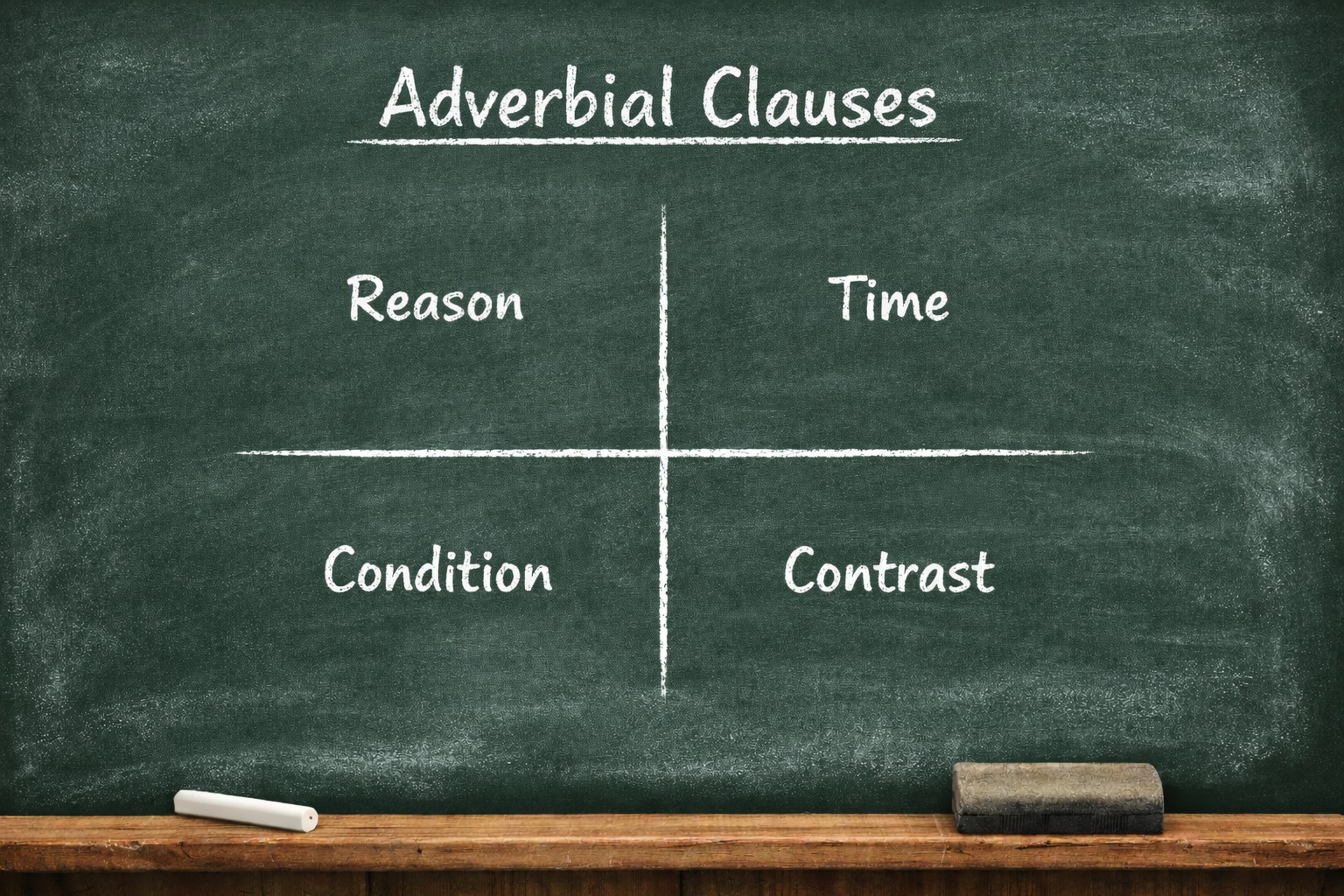
    Adverbial clauses in English function as an adverb to modify verbs, adjectives, or other adverbs. They answer how? when? where? why? or under what conditions?

    Related Guide:

    Adverbial clauses and phrases function like adverbs. For a complete guide to how adverbs work in English, visit Adverbs in English: Practical Rules, Examples, and Practice .

    An adverbial clause is a dependent clause that begins with a subordinating conjunction. Clauses have both a subject and a verb.

    An adverbial phrase is a group of words that functions as an adverb but does not have a subject and a verb.

    Quick Review:

    Before you study adverbial clauses, make sure you understand the difference between independent and dependent clauses. Read this guide: Independent and Dependent Clauses in English .

     1. Reason and Purpose Clauses and Phrases

    We use these to explain reasons and purposes.

    Reason Clauses and Phrases

    The reason for an action is expressed in an adverbial clause (dependent clause) or an adverbial phrase. The main clause (independent clause) expresses the result.

    1. Many people move to Mexico because they want a lower cost of living.
    2. Since punk music challenged authority, it became popular among young people.
    3. Jaguars are endangered because of habitat loss in the Amazon.

    Quick Review

    1. Which two sentences use an adverbial clause?
    2. Which one uses an adverbial phrase?
    3. What is the reason in each sentence?
    4. What is the result?

    Answers

    1. Sentences 1 and 2
    2. Sentence 3
    3. because they want a lower cost of living / Since punk music challenged authority / because of habitat loss in the Amazon
    4. Many people move to Mexico / it became popular among young people / Jaguars are endangered

    Structure

    because + clause

    since + clause

    because of + noun phrase

    Purpose Clauses and Phrases

    The purpose of an action is expressed in an adverbial clause (dependent clause) or an adverbial phrase. The main clause (independent clause) expresses the action.

    1. The band signed to an independent label in order to keep creative control of their music.
    2. He moved to Buenos Aires so that he could become fluent in Spanish.
    3. She adopted a dog for companionship.

    Quick Review

    1. Which two sentences use an adverbial clause?
    2. Which one uses an adverbial phrase?
    3. What is the purpose in each sentence?
    4. What is the action?

    Answers

    1. Sentences 1 and 2
    2. Sentence 3
    3. in order to keep creative control of their music / so that she could become fluent in Spanish / for companionship
    4. The band signed to an independent label / He moved to Buenos Aires / She adopted adopted a dog

    Structure

    in order to + clause

    so that + clause

    for + noun phrase

    In order to‘ can be shortened to just ‘to

    • The band signed to an independent label to keep creative control if their music.

    so that’ can be shortened to ‘so’

    • He moved to Buenos Aires so he could become fluent in Spanish.

    💡 Spanish Speaker Tip: Don’t Use “For + Verb”

    In Spanish, it’s common to use “para + infinitivo”:

    • Estudio inglés para mejorar mi carrera.

    👉 In English, we do NOT use “for + verb” to express purpose.

    ❌ Incorrect:

    • I study English for improve my career.

    ✔️ Correct:

    • I study English to improve my career.
    • I study English for better job opportunities.

    🧠 Quick Rule:
    to + verb → purpose
    for + noun → purpose

    Quick Challenge

    Complete each sentence using for, because of, since, or in order to

    1. The students fell asleep in class ____ the boring lecture.
    2. Many people move to Mexico ____ the cost of living is lower.
    3. Many Venezuelans have left their country ____ escape the Chavistas.
    4. He wears a water proof jacket ____ protection from the rain.
    5. Alejandra goes to the gym ____ get in shape.

    ✔️ Answer Key + Explanations

    1. The students fell asleep in class because of the boring lecture.
      → “the boring lecture” is a noun phrase, so we use because of.
    2. Many people move to Mexico since the cost of living is lower.
      → “the cost of living is lower” is a clause, so we use since.
    3. Many Venezuelans have left their country in order to escape the Chavistas.
      → “in order to + verb” expresses purpose.
    4. He wears a waterproof jacket for protection from the rain.
      → “protection” is a noun, so we use for + noun.
    5. Alejandra goes to the gym in order to get in shape.
      → “in order to + verb” expresses purpose.

    🧠 Quick Summary:
    since + clause (reason)
    because of + noun phrase
    in order to + verb (purpose)
    for + noun (purpose/benefit)

    2. Time Clauses and Phrases

    These show when something happens or how two actions are related in time. They can describe:

    • actions happening at the same time
    • actions happening every time
    • actions up to a specific point in time
    • actions from the past until now
    • continuous actions with another action
    • actions over a duration (how long)
    • actions within a specific time period
    1. When I lived in Mexico, I could speak Spanish fluently.
    2. Whenever lightning strikes outside, my dog hides under the bed.
    3. I worked in Querétaro until my work visa expired.
    4. I have been a fan of Black Flag since I was a teenager.
    5. While I was living in Mexico, the U.S. dollar was strong.
    6. I lived in Oaxaca for 3 months.
    7. During the summer in San Antonio, I try to stay inside as much as possible.

    Quick Challenge

    Match each of the previous sentences to the correct use below:

    a. amount of time

    b. a continuous action

    c. a time period

    d. same time

    e. a time in the past to the present

    f. every time

    g. up to that time

    ✔️ Answer Key + Explanations

    1. When I lived in Mexico, I could speak Spanish fluently. → d (same time)
      → Both actions happen at the same time.
    2. Whenever lightning strikes outside, my dog hides under the bed. → f (every time)
      → “whenever” shows a repeated action.
    3. I worked in Querétaro until my work visa expired. → g (up to a specific point in time)
      → “until” shows an action continuing up to a specific moment.
    4. I have been a fan of Black Flag since I was a teenager. → e (a time in the past to the present)
      → “since” connects the past to the present.
    5. While I was living in Mexico, the U.S. dollar was strong. → b (a continuous action)
      → “while” shows a longer action happening at the same time as another.
    6. I lived in Oaxaca for 3 months. → a (amount of time)
      → “for” shows duration (how long).
    7. During the summer in San Antonio, I try to stay inside as much as possible. → c (a time period)
      → “during” refers to a specific time period.

    🧠 Quick Summary:
    when → same time
    whenever → every time
    until → up to a point in time
    since → past → present
    while → continuous action
    for → duration (how long)
    during → time period

    💡 Comma Tip: Adverbial Clauses and Phrases

    Use a comma when the adverbial clause or phrase comes first. Do not use a comma when it comes after the main clause.

    Quick Rule:
    • Adverbial clause or phrase first → use a comma
    • Adverbial clause or phrase second → no comma

    3. Using -ING After Time Words

    When the subject is the same, we can shorten the clause:

    Examples:

    • After leaving the concert, we went to get something to eat.
    • While walking through the jungle, they saw a jaguar in a tree.

    If the subjects are different, we cannot shorten the clause.

    Examples:

    • After we left the concert, my friends went to get something to eat.
    • While the tourists walked through the jungle, a jaguar ran across the path.

    Related Topic:

    Some time clauses describe actions that happen regularly or over time. To learn more about expressions like always, usually, often, and other time expressions, visit Adverbs of Frequency and Time Expressions .

    4. Contrast Clauses

    These show unexpected results or opposing ideas.

    1. Even though Bad Bunny is very popular, his critics don’t think he is very talented.
    2. In spite of the fact that the tickets cost $1,000 each, the concert sold out.
    3. In spite of the difficult material, the students passed the final exam!
    4. Although Fiesta is very crowded and expensive, people still attend the festivities.

    Structure

    even though + clause

    in spite of the fact that + clause

    in spite of + noun phrase

    although / even though + clause → use for contrast The main clause can include ‘still’ for emphasis.

    Quick Challenge

    Complete each sentence using even though, in spite of, or still.

    1. ____ the fact that the restaurant was crowded, we decided to wait for a table.
    2. ____ the tickets were expensive, I paid for a direct flight to Buenos Aires.
    3. Although Spanish is very difficult to learn, I ____ attend classes.
    4. ____ the fact that I hate exercising, I continue to go to the gym.
    5. Even though pizza is unhealthy, I ____ eat it every Friday.

    ✔️ Answer Key + Explanations

    1. In spite of the fact that the restaurant was crowded, we decided to wait for a table.
      → “the fact that + clause” allows in spite of to introduce a clause.
    2. Even though the tickets were expensive, I paid for a direct flight to Buenos Aires.
      → followed by a clause (subject + verb).
    3. Although Spanish is very difficult to learn, I still attend classes.
      still emphasizes the surprising result.
    4. In spite of the fact that I hate exercising, I continue to go to the gym.
      → “the fact that + clause” allows in spite of to connect to a clause.
    5. Even though pizza is unhealthy, I still eat it every Friday.
      still shows contrast with the first clause.

    🧠 Quick Summary:
    even though → + clause
    in spite of → + noun OR “the fact that + clause”
    still → emphasizes contrast in the main clause

    5. Condition Clauses

    They show a condition → result relationship.

    • The condition is expressed in the adverbial clause
    • The result is expressed in the main clause

    Condition clauses show how a condition affects (or does not affect) the result.

    Structure

    if + clause (the condition affects the result)

    even if + clause (the result is the same regardless of the condition)

    unless + clause (if not)

    1. If you practice English every day, you will become fluent.
    2. Even if I’m tired, I will go to the gym.
    3. Your dog won’t behave unless you train him.

    Quick Challenge

    Match the sentence halves that go together.

    1. If I meet my soulmate, . . .
    2. Unless you practice English outside of class, . . .
    3. If inflation continues to rise, . . .
    4. Even if the tickets are expensive, . . .
    5. If students write a positive evaluation, . . .

    a. . . . you won’t become fluent.

    b. . . . more people will struggle financially.

    c. . . . I will still buy them.

    d. . . . the teacher will give them a good grade. 😉

    e. . . . I will get married.

    Which sentence shows a result that does NOT change?

    ✔️ Answer Key + Explanations

    1. If I meet my soulmate, e. I will get married.
      → The result happens if the condition becomes true.
    2. Unless you practice English outside of class, a. you won’t become fluent.
      unless means if not.
    3. If inflation continues to rise, b. more people will struggle financially.
      → The condition leads to a likely result.
    4. Even if the tickets are expensive, c. I will buy them.
      even if = the result does not change.
    5. If students write a positive evaluation, d. the teacher will give them a good grade.
      → 😄 Just a chiste!!

    🧠 Reflection:
    Which sentence shows a result that does NOT change?

    → Sentence 4 (even if)

    🧠 Quick Summary:
    if → result depends on the condition
    unless → = if not
    even if → result does not change

    💡 Tip: Using unless

    Unless means ‘if not’ or ‘except if’. When you rewrite an ‘if’ sentence with ‘unless’, you may need to change the other clause to keep the same meaning.

    Quick Rule:
    Rewrite the sentence so the meaning stays the same.
    ‘Unless’ often changes a positive idea into a negative one.

    ⚠️ Important:
    Do not just replace ‘if’ with ‘unless’. Check whether you also need to change the main clause.

    Quick Challenge

    Rewrite each sentence. Use an ‘unless’ clause instead of the ‘if’ clause.

    1. If I meet my soulmate, I will get married.
    2. If you practice English outside of class, you will become fluent.
    3. If inflation continues to rise, people will struggle financially.
    4. If the tickets are expensive, I won’t buy them.
    5. If students write a positive evaluation, they will get a good grade.

    ✔️ Answer Key + Explanations

    1. Unless I meet my soulmate, I won’t get married.
      → The condition is reversed, and the result becomes negative.
    2. Unless you practice English outside of class, you won’t become fluent.
      unless = if not, so the result changes to negative.
    3. Unless inflation stops rising, people won’t struggle financially.
      → The condition is changed to the opposite idea to keep the same meaning.
    4. Unless the tickets are cheap, I will buy them.
      → “expensive” is changed to the opposite idea, and the result is reversed.
    5. Unless students write a positive evaluation, they won’t get a good grade.
      → The result becomes negative to match the meaning of unless.

    🧠 Quick Summary:
    unless = if not / except if
    • You often need to change the result (positive → negative)
    • Sometimes you must change the condition to the opposite idea


    Conclusion

    Adverbial clauses and phrases are essential for expressing relationships between ideas clearly and naturally. They allow you to explain reasons, purposes, time relationships, contrasts, and conditions—all of which are key to more advanced and fluent communication.

    As you continue practicing, focus on both form and meaning:

    • Identify whether you need a clause or a phrase
    • Choose the correct structure (because, in order to, while, even though, if, etc.)
    • Pay attention to how ideas are connected (cause → result, condition → result, contrast, time)

    The more you notice these patterns and use them in real contexts, the more natural your English will become.

    Remember! Learning a language is not about perfection—it’s about progress. Keep practicing, stay curious, and trust the process. You are moving beyond English to more opportunities, connections, and self-expression!

    💡Need personalized help using these grammar structures? Explore my ESL lessons and services for individual and group support.
  • Mastering Gerunds in English: Practical Examples and Common Mistakes

    Mastering Gerunds in English: Practical Examples and Common Mistakes

    Gerunds in English are one of the most useful—and most confusing—parts of English grammar. They look like verbs, but they function as nouns. That means they can be the subject of a sentence, the object of a verb, or the object of a preposition.

    In this guide, you will learn what gerunds are, how to use them correctly, when they appear after prepositions and certain verbs, and how they compare to infinitives. You will also see common mistakes that many English learners make, especially Spanish speakers.

    Quick Answer: What Is a Gerund?

    A gerund is the -ing form of a verb used as a noun.

    What Is a Gerund?

    A gerund is formed by adding -ing to a verb, but it is not acting like a normal verb. Instead, it functions as a noun.

    Examples:

    • Running is good for your health.
    • I enjoy reading.
    • She is interested in learning English.

    In these examples, running, reading, and learning are all gerunds.

    Key Idea

    A gerund can be the subject of a sentence, the object of a verb, or the object of a preposition.

    Gerunds as Subjects

    A gerund can be the subject of a sentence when you are talking about an activity in a general way.

    Examples:

    • Volunteering is enjoyable.
    • Helping others makes people feel good.
    • Studying every day improves your English.

    Remember that a gerund subject usually takes a singular verb.

    Correct: Helping others is important.
    Incorrect: Helping others are important.

    Common Mistake

    Do not use a plural verb with a gerund subject. A gerund phrase usually acts like a singular noun.

    Gerunds After Prepositions

    One of the most important grammar rules in English is this: after a preposition, use a gerund—not an infinitive.

    Examples:

    • She talked about starting a business.
    • He is interested in learning Spanish.
    • They succeeded in finding a solution.

    Incorrect: She talked about to start a business.
    Correct: She talked about starting a business.

    Gerunds After Verbs, Nouns, and Adjectives with Prepositions

    Many English expressions follow this pattern:

    • verb + preposition + gerund
    • adjective + preposition + gerund
    • noun + preposition + gerund

    Verb + Preposition + Gerund

    • think about moving
    • insist on paying
    • believe in working hard
    • succeed in learning

    Adjective + Preposition + Gerund

    • afraid of failing
    • interested in studying abroad
    • excited about traveling
    • good at solving problems

    Noun + Preposition + Gerund

    • reason for leaving
    • advantage of studying online
    • interest in learning English

    Student Tip

    When you see a preposition like in, on, about, for, or of, check the next verb. It usually needs to be in the -ing form.

    Verbs Followed by Gerunds

    Some verbs are commonly followed by a gerund. After these verbs, do not use the infinitive.

    Common verbs followed by gerunds:

    • enjoy
    • avoid
    • consider
    • finish
    • suggest
    • keep
    • admit
    • mind
    • practice
    • quit

    Examples:

    • I enjoy teaching.
    • She avoided answering the question.
    • They suggested changing the plan.
    • He kept talking.

    Go + Gerund Expressions

    English often uses go + gerund for sports and recreational activities.

    Examples:

    • go swimming
    • go hiking
    • go shopping
    • go jogging
    • go skating

    Example sentence: We went hiking last weekend.

    Related Grammar Post

    Want to understand how gerunds compare to infinitives?

    👉 Read: Mastering Infinitives in English

    Verbs Followed by a Gerund or an Infinitive

    Some verbs can be followed by either a gerund or an infinitive, often with no major change in meaning.

    Common verbs in this group:

    • begin
    • start
    • continue
    • like
    • love
    • hate
    • prefer
    • can’t stand

    Examples:

    • I like reading.
    • I like to read.
    • She started working.
    • She started to work.

    In many cases, both forms are acceptable. However, gerunds are often more common in natural conversation.

    Gerund or Infinitive as Subject

    Both a gerund phrase and an infinitive phrase can be the subject of a sentence.

    Examples:

    • Helping others is important.
    • To help others is important.

    Both are grammatically correct, but the gerund version usually sounds more natural. The infinitive version often sounds more formal.

    The “It” Structure

    In everyday English, speakers often prefer this pattern:

    • It is important to help others.
    • It takes time to learn a language.
    • It is difficult to find a good job.

    This structure is especially common with adjectives like important, hard, easy, difficult, and necessary.

    Need More Grammar Help?

    At Beyond English, I create grammar lessons that are clear, practical, and designed for real English use.

    👉 Explore English Lessons

    Used To, Be Used To, and Get Used To

    These structures often confuse English learners because they look similar, but they have different meanings.

    Used to + Base Verb

    Use ‘used to + base verb‘ for a past habit or past state that is no longer true.

    • I used to live in Mexico.
    • She used to drink coffee every day.

    Be Used To + Gerund or Noun

    Use ‘be used to + gerund/noun‘ to mean “be accustomed to.”

    • I am used to waking up early.
    • They are used to the heat.

    Get Used To + Gerund or Noun

    Use ‘get used to + gerund/noun‘ to mean “become accustomed to.”

    • He is getting used to working from home.
    • We finally got used to driving in the city.

    Watch Out

    Be used to and get used to are followed by a gerund or noun, not a base verb.

    Sense-Perception Verbs

    After verbs like see, hear, watch, and notice, English can use either the base form or the -ing form.

    Base Form

    Use the base form to show the action as a complete event.

    • I saw him leave the building.
    • We heard her sing.

    -ing Form

    Use the gerund-like -ing form to show the action in progress.

    • I saw him leaving the building.
    • We heard her singing in the kitchen.

    This is an important meaning difference. The first form focuses on the complete action. The second focuses on the action while it was happening.

    Common Mistakes with Gerunds

    Common Gerund Mistakes

    She is interested to learn English.
    She is interested in learning English.

    I enjoy to travel.
    I enjoy traveling.

    Swimming are fun.
    Swimming is fun.

    I am used to wake up early.
    I am used to waking up early.

    Spanish Speaker Issues

    Spanish speakers often have specific difficulties with gerunds because English and Spanish do not use these forms in exactly the same way.

    1. Overusing the Infinitive

    Spanish often uses the infinitive where English may prefer a gerund.

    Example:
    Spanish: Me gusta leer.
    English: I like reading / I like to read

    2. Forgetting the Gerund After Prepositions

    Students may remember the preposition but still use the wrong verb form.

    Incorrect: She is interested in to learn English.
    Correct: She is interested in learning English.

    3. Confusing “Used To” Structures

    Many learners mix up:

    • used to + base verb
    • be used to + gerund
    • get used to + gerund

    This is very common and needs repeated practice.

    Let’s Practice Gerunds in English!!

    Exercise A

    Complete each sentence with one of the following prepositions:

    from, in, to, on, about, for

    1. I believe ____ preparing for the zombie apocalypse.
    2. My students insist ____ using their phones during class.
    3. Diego always forgets ____ setting his alarm clock.
    4. Some of my students thank me ____ helping them learn English.
    5. I can’t stop my dog ____ chasing ardillas when we go to the park.

    Exercise B

    Complete each sentence with either the gerund or infinitive for of the verb in parentheses.

    1. Always remember ____ (study) for the exams.
    2. I remember ____ (attend) Tec de Monterrey in 2013.
    3. Please stop ____ (scroll) TikTok videos during class. It will rot your brain!
    4. We stopped ____ (buy) some souvenirs before boarding the airplane.
    5. I tried ____ (eat) tripa, but I didn’t like it.
    6. Don’t forget ____ (lock) the door before you leave.
    7. I’ll never forget ____ (meet) my best friend for the first time.
    8. She stopped ____ (talk) when the teacher entered the room.
    9. He stopped ____ (check) his phone for directions to the store.
    10. I tried ____ (fix) my computer, but it still doesn’t work.

    Exercise C

    Complete each sentence with ‘used to’, ‘was used to’, or ‘get used to’ (Be careful of the verb tense).

    1. I ______ work as an investment banker, but I had to stop because of the stress.
    2. Americans can’t ______ driving in Mexico City. The traffic is horrible!!
    3. Her dog ______ sleeping inside. He is spoiled.
    4. Alejandra ______ be afraid to speak English with strangers. Now she has a lot of confidence!
    5. After a lot of practice, she ______ speaking to strangers.

    Scoring and Feedback

    🔵 17 – 20 Correct

    Excellent work! 🎉 You really understand how to use gerunds and infinitives. Keep using them in your everyday conversations and writing.

    🟢 14 – 16 Correct

    Great job! ✅ You have a good understanding of gerunds and infinitives. Review the ones you missed.

    🟡 12 – 13 Correct

    Good effort! 💪You’re learning, and that’s what matters. Take a moment to review the examples and do the quiz again.

    🔴 0 – 11 Correct

    No worries! 🌱 Gerunds and infinitives can be tricky at first. Go back and review the examples in the lesson.

    Practice Idea

    A good way to master gerunds is to notice them in real sentences. Pay special attention to verbs followed by gerunds and to expressions with prepositions.

    Conclusion

    Gerunds are a core part of English grammar because they let you talk naturally about actions, habits, experiences, and general activities. Once you understand that a gerund is an -ing form used as a noun, many grammar patterns become much easier to understand.

    Focus especially on these three areas:

    • gerunds as subjects
    • gerunds after prepositions
    • verbs that are followed by gerunds

    Then compare them carefully with infinitives. That is where many learners begin to sound more natural and more advanced in English.

    Keep Learning with Beyond English

    Want more clear, practical grammar explanations?

    Visit Beyond English for more grammar guides

    Remember! Learning a language is not about perfection—it’s about progress. Keep practicing, stay curious, and trust the process. You are moving beyond English to more opportunities, connections, and self-expression!

    Leave a comment below!

    And remember . . . Practice, Practice, Practice

Verified by MonsterInsights