
White text-logo on blue background.

Category: English Grammar

  • Subject Pronouns in English: Simple Rules and Examples

    Subject Pronouns in English: Simple Rules and Examples

    Today, we are going to learn about subject pronouns in English. These are small words, but they are very important. We use them every day when we speak or write. Let’s learn how to use them!

    💡 Want to learn more?
    If you want to learn about other types of pronouns, check out our complete guide to English pronouns for clear explanations and practice.

    What is a Subject Pronoun?

    A subject pronoun is a word we use instead of a noun (a person, place, or thing). The subject is the person or thing that does the action in a sentence.

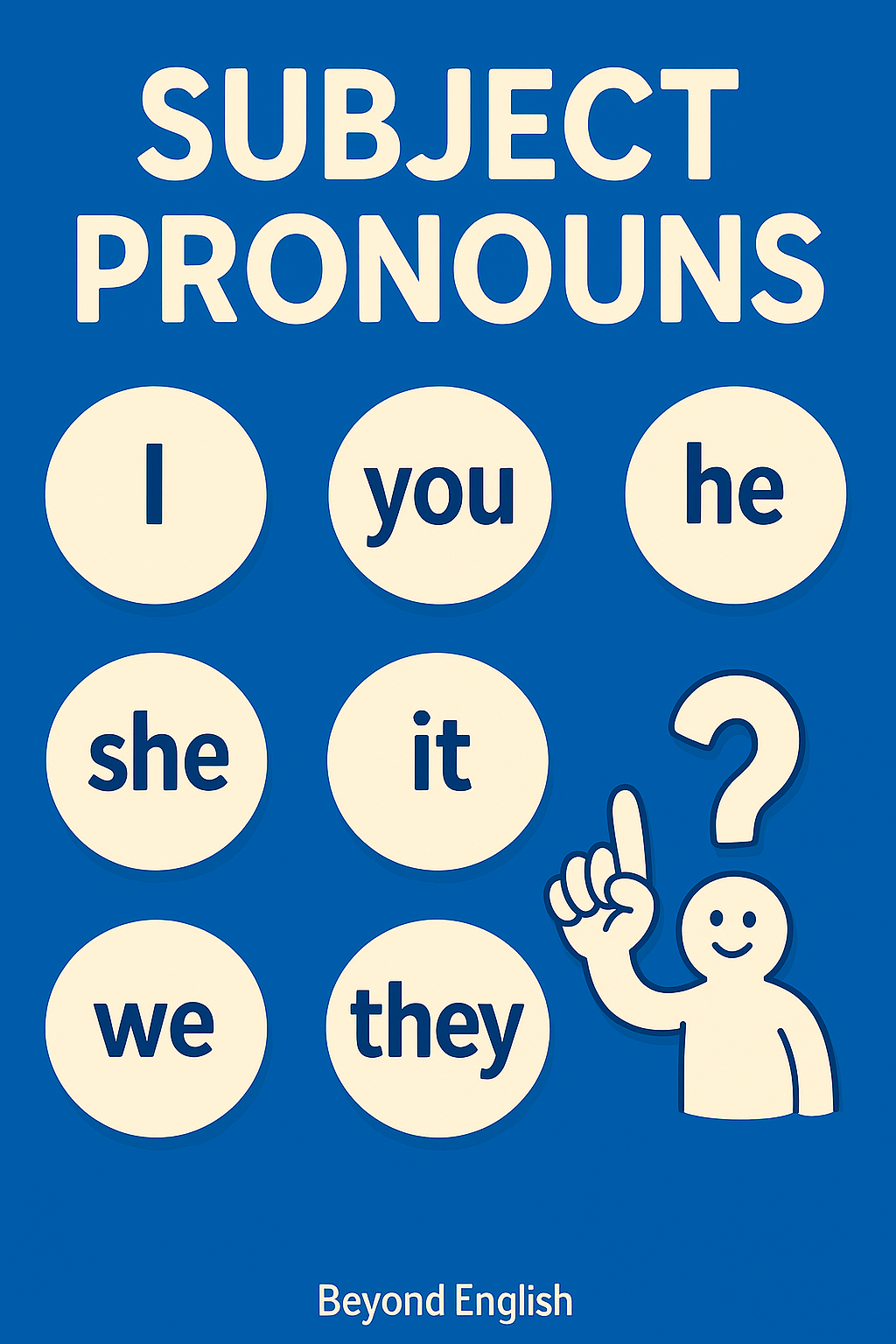
    There are 7 subject pronouns in English

    1. I
      • We use I when we talk about ourselves.
        • I am a student.
        • I like pizza.
        • I live in San Antonio.
    2. You
      • We use you when we talk to someone.
        • You are my friend.
        • You have a nice smile.
        • You are in the classroom.
      • Tip: “You” can be one person as in the previous examples or “You” can be more than one person.
        • You are students.
        • You are at the concert.
        • You are my friends.
    3. He
      • We use he when we talk about one man or boy.
        • He is my brother.
        • He plays soccer.
        • He is a teacher.
    4. She
      • We use she when we talk about one woman or girl.
        • She is my sister.
        • She is pretty.
        • She is very intelligent.
    5. It
      • We use it when we talk about one thing, the weather, or the time.
        • It is a book.
        • It is cold today.
        • It is 9:00 in the morning.
      • Tip: Do not use “It” for people.
    6. We
      • We use we when we talk about ourselves and other people.
        • We are students.
        • We like tacos.
        • We study at the library.
    7. They
      • We use they when we talk about two or more people or things.
        • They are my parents.
        • They like coffee.
        • They live in Austin.

    Why use subject pronouns?

    Subject pronouns help us speak clearly and avoid repeating names. Look at this example.

    Maria is nice. Maria is a student. Maria lives in Austin.

    Maria is nice. She is a student. She lives in Austin.

    Using ‘she’ makes the sentence easier to read and understand.

    🚫 Common Mistakes to Avoid with Subject Pronouns

    Using an Object Pronoun as the Subject

    Him is my teacher.
    He is my teacher.

    Me and my friend are in class.
    My friend and I are in class.

    Confusing “He” and “She”

    My mother is a doctor. He works at a hospital.
    My mother is a doctor. She works at a hospital.

    My brother is 12. She is in middle school.
    My brother is 12. He is in middle school.

    Using “It” for People

    Maria is nice. It is my friend.
    Maria is nice. She is my friend.

    The new students are here. It is from Brazil.
    The new students are here. They are from Brazil.

    Forgetting the Subject Pronoun (Leaving It Out)

    Is from Mexico.
    He is from Mexico. / She is from Mexico. / They are from Mexico.

    Speak English at work.
    I speak English at work. / We speak English at work.

    Repeating the Noun and the Pronoun Together

    My sister she is 20 years old.
    My sister is 20 years old.

    The students they are tired.
    The students are tired. (or They are tired.)

    Mixing Singular and Plural Pronouns

    My friends is funny. He tells jokes.
    My friends are funny. They tell jokes.

    The team are ready. They is excited.
    The team is ready. They are excited.

    💡If you need a refresher on other grammar topics, check out our Blog for more lessons.

    Here’s a great animation on subject pronouns – after you watch the video, try the quiz below!

    Let’s Practice

    A. Choose the correct subject pronoun for each sentence

    a. I  b. You  c. He  d. She  e. It  f. We  g. They

    1. My name is Alejandra. ____ am from Colombia.
    2. Carlos is my brother. ____ is a doctor.
    3. Ana and I are friends. ____ like to study together.
    4. I am talking to you. ____ are my classmate.
    5. My cat is very funny. ____ likes to jump.
    6. Diego and Elena are at school. ____ are learning English.
    7. There is snow on the ground outside. ____ is very cold.
    8. Maria is an accountant. ____ likes to work with numbers.
    9. I wake up at 6:00 every morning. ____ is very early.

    B. Fill in the blank with the correct subject pronoun

    1. Maria is my friend. ____ is very smart.
    2. John and I are at the store. ____ are buying groceries.
    3. My dog is cute. ____ is a Labrador Retriever.
    4. Tom and Jerry are funny. ____ make people laugh.
    5. I am talking to one student. ____ are my student.
    6. You and I are at the library. ____ are studying for an exam.
    7. The weather is nice. ____ is sunny and warm.
    8. Do you have the time? ____ is 10:30.
    9. Joe plays soccer every Saturday. ____ is very athletic.
    10. The book is on the table. ____ is very interesting.
    11. I am talking to five students. ____ are my students.

    Scoring and Feedback

    🔵 17 – 20 correct:
    Excellent work! 🎉 You really understand subject pronouns. Keep using them in your everyday conversations and writing.

    🟢 12 – 16 correct:
    Great job! ✅ You know most of the subject pronouns, but review the ones you missed.

    🟡 7 – 11 correct:
    Good effort! 💪 You’re learning, and that’s what matters. Take a moment to review the examples and do the quiz again.

    🔴 0–6 correct:
    No worries! 🌱 Subject pronouns can be tricky at first. Go back and review the examples in the lesson.

    📚 Want more reading, writing, listening, and speaking practice? Check out the Essential English series on Amazon!

    Practice Tips

    Learning English is easier when you practice a little every day. Here are some fun and easy ways to practice subject pronouns by yourself!

    🗣️ 1. Say It Out Loud

    Practice saying sentences with each subject pronoun. Do this in front of a mirror. This helps with speaking and confidence!

    ✍️ 2. Write 7 Simple Sentences

    Write one sentence for each subject pronoun. You can write about your life, family, or school.

    Try this every week with new ideas!

    📸 3. Use Photos or Drawings

    Look at pictures in a book or online. Say or write a sentence using a subject pronoun.

    Example:
    You see a picture of a boy:
    🗣️ “He is playing.”

    You see a picture of two people:
    ✍️ “They are dancing.”

    🎲 4. Make Flashcards

    Make flashcards with subject pronouns on one side and an example sentence or picture on the other.

    Card 1:

    • Front: She
    • Back: A drawing of a girl + “She is eating.”

    Mix them up and practice every day!

    🎵 5. Listen and Repeat

    Listen to English songs, videos, or short conversations. Try to hear the subject pronouns.

    Then pause and repeat the sentence.

    Example:
    You hear: “She is happy today.”
    🗣️ Say: “She is happy today.”

    Tip: Start with slow English songs or beginner-level listening videos on YouTube.

    📅 6. Do a Daily Pronoun Challenge

    Each day, focus on one subject pronoun.

    • Monday = I
    • Tuesday = You
    • Wednesday = He
    • Thursday = She
    • Friday = It
    • Saturday = We
    • Sunday = They

    Try to write or say 3–5 sentences using that pronoun. It’s a fun way to build a habit!

    🧠 7. Talk to Yourself!

    Yes, it sounds silly — but it helps! Describe what you or other people are doing around you.

    Examples:

    • “I am washing the dishes.”
    • “He is walking the dog.”
    • “They are watching TV.”

    This helps you think in English!

    Keep It Simple and Have Fun!

    You don’t need to be perfect. The most important thing is to practice a little every day. Subject pronouns are the building blocks of English. When you use them correctly, your sentences sound better and clearer!

    You can do it! 💪

    Conclusion

    Subject pronouns are small words, but they are very useful. By using them every day you will become more confident. Feel free to share your thoughts or ask any questions in the comments below.

    And remember . . . Practice, Practice, Practice!!!

    💡Need personalized help using these grammar structures? Explore my ESL lessons and services for individual and group support.

  • 5 Essential Prepositions of Place: Simple Grammar Rules with Examples

    5 Essential Prepositions of Place: Simple Grammar Rules with Examples

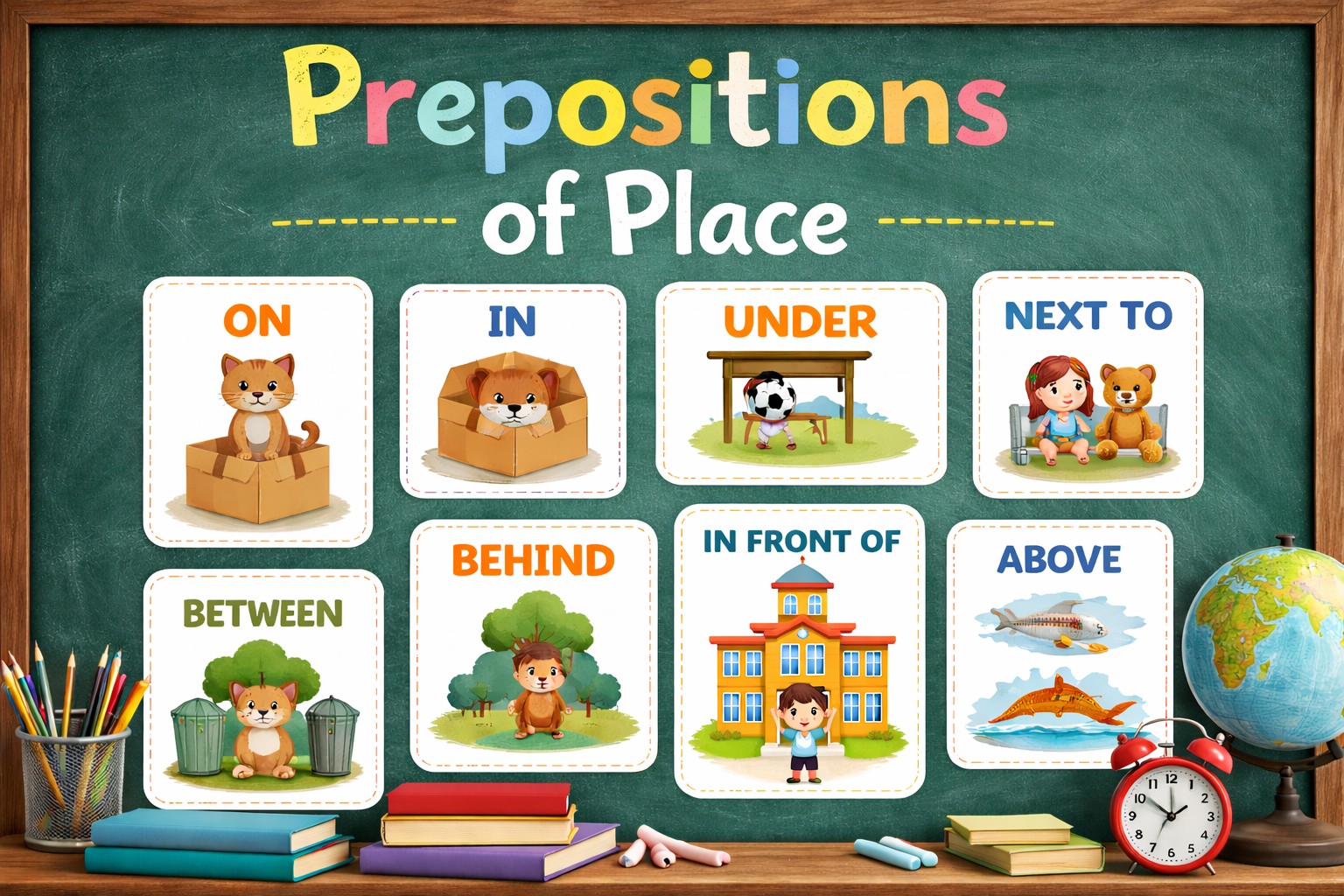
    On At In Under Above

    What Are Prepositions of Place?

    Prepositions of place are small words that help us talk about where things are. They are very important for telling others exactly where something is. They answer the question “Where?” In this guide, we’ll learn about some common prepositions of place, with examples and tips to help you use them.

    Common Prepositions of Place

    1. In

    • Used to show that something or someone is enclosed or surrounded by something else; located inside a space or area.

                            The cat is in the box.

                            The apple is in the bag.

                            The students are in the grammar class.

    2. On

    • Used to show that something is touching and supported by the surface of something else.

                            The cat is on the couch.         

                            The cup is on the desk.

                            She is on the second floor.

    3. At

    • Used to show a specific point or exact location At a specific place.

                            He is at the door.

                            We are at the park.

                            The students are at school.

    4. Under

    • Used to show that something is directly below or beneath something else.

                            The dog is under the table.

                            The shoes are under the bed.

                            The car is under the bridge.

    5. Above

    • Used to show that something is higher than something else, without touching it.

                           The painting is above the fireplace.  

                            The clock is above the door.

                            The airplane is above the clouds.

    🚫 Common Mistakes to Avoid with Prepositions of Place

    Using the Wrong Preposition

    ❌ The cat is in the table.
    ✅ The cat is on the table.

    Tip: Use ‘in’ for enclosed spaces and ‘on’ for surfaces.

    Forgetting the Preposition

    ❌ The keys are the bag.
    ✅ The keys are in the bag.

    Tip: A place word usually needs a preposition.

    Confusing “in front of” and “behind”

    ❌ The car is behind the house. (when it is visible)
    ✅ The car is in front of the house.

    Tip: ‘In front of’ means you can see it. ‘Behind’ means you cannot.

    Differences Between English and Spanish

    Spanish often uses “en” to express location in many situations. English is more specific.

    1️⃣ In vs On

    Spanish:

    • El libro está en la mesa.
    • El libro está en la caja.

    English:

    • The book is on the table. (surface)
    • The book is in the box. (inside)

    📌 English distinguishes between:

    • in → inside a space
    • on → touching a surface

    Spanish often uses ‘en‘ for both.

    2️⃣ At

    Spanish:

    • Estoy en la escuela.
    • Nos vemos en el parque.

    English:

    • I am at school.
    • We will meet at the park.

    📌 At is used for a specific point or location.
    Spanish still uses ‘en.’

    3️⃣ Under vs Above

    Spanish:

    • El gato está debajo de la mesa.
    • El avión está sobre la ciudad.

    English:

    • The cat is under the table.
    • The plane is above the city.

    📌 English separates:

    • under → lower and covered/close
    • above → higher but not touching

    Spanish uses different words, but learners sometimes confuse ‘on‘ and ‘above‘ in English.

    Key Difference

    Spanish often relies on en for many location situations.
    English requires choosing the correct preposition based on:

    • Inside → in
    • Surface → on
    • Specific point → at
    • Lower position → under
    • Higher position → above

    Choosing the correct preposition makes your English more accurate and natural.

    💡If you need a refresher on other grammar topics, check out our Blog for more lessons.

    What Do I Know About Prepositions of Place?

    A. Match the image to the correct preposition of place.

    a. under           b. above          c. on                d. in                 e. at

    B. Use the images to complete each sentence with the correct preposition of place.

    1. Where is the dog? The dog is _______ the table.

                a. on                b. at                 c. in                 d. under

    2. Where are the books? The books  ________ the table.

    a. in                 b. on                c. above           d. at    

    3. Where are Alejandra and Diego? They are _______ the bus stop.

                a. at                 b. on                c. in                 d. above

    4. Where is your computer? My computer is ______ the my backpack.

                a. at                 b. in                 c. on                d. under

    5. Where is the clock? It is _______ the door.

                a. on                b. at                 c. above           d. under

    C. Choose the correct preposition of place for each sentence.

    1. Where is the table? The table is _______ the dining room.

                a. above           b. at                 c. in                 d. under

    2. Where is the projector? The projector is ________ the teacher.

          a. above           b. under           c. on                d. in

    3. Where are the cats? The cats are _________ the bed.

           a. above           b. under           c. at                 d. in

    4. Where is my phone? Your phone is _______ the table.

          a. above           b. under           c. on                d. in

    5. Where is the teacher? She is ______ the whiteboard.

                a. at                 b. on                c. in                 d. above

    Scoring & Feedback

    🔵 13–15 correct:
    Excellent work! 🎉 You really understand prepositions of place. Keep using them in your everyday conversations and writing. Try explaining where things are to a friend or family member!

    🟢 10–12 correct:
    Great job! ✅ You know most of the prepositions, but review the ones you missed. Look around your house or classroom and describe what you see using in, on, at, above, and under.

    🟡 7–9 correct:
    Good effort! 💪 You’re learning, and that’s what matters. Take a moment to review the examples and do the quiz again. Try drawing a simple room and labeling objects using prepositions.

    🔴 0–6 correct:
    No worries! 🌱 Prepositions can be tricky at first. Go back and review the examples in the lesson.

    📚 Want more reading, writing, listening, and speaking practice? Check out the Essential English series on Amazon!

    Grammar Practice Tips

    1. Look Around You

    Use the objects around you to practice. Say where they are.

    2. Practice with Friends

    Ask your friends where things are and use prepositions in your answers.

    3. Use Pictures

    Look at pictures and describe where things are using prepositions.

    Fun Activities to Learn Prepositions

    1. Treasure Hunt

    Hide something and give clues using prepositions of place.

    2. Matching Game

    Match pictures with the correct prepositions.

    3. Describe a Picture

    Look at a picture and say where things are using prepositions.

    Conclusion

    Prepositions of place are important words that help us talk about where things are. By using them every day, you will get better at describing locations. Feel free to share your thoughts or ask any questions in the comments below.

    💡Need personalized help using these grammar structures? Explore my ESL lessons and services for individuals and small groups.

    Leave a comment below! 

    And remember . . . Practice, Practice, Practice!!!!!