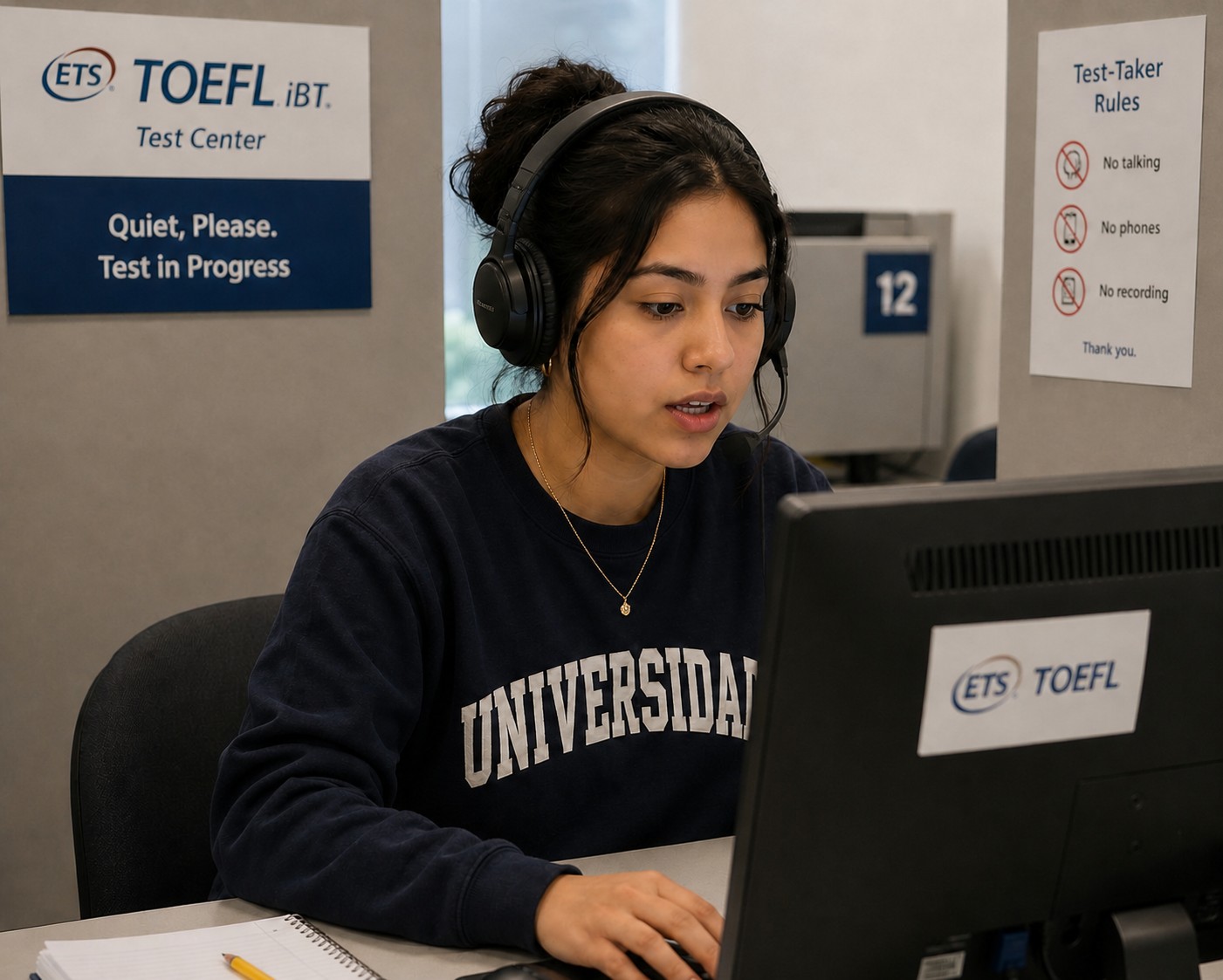
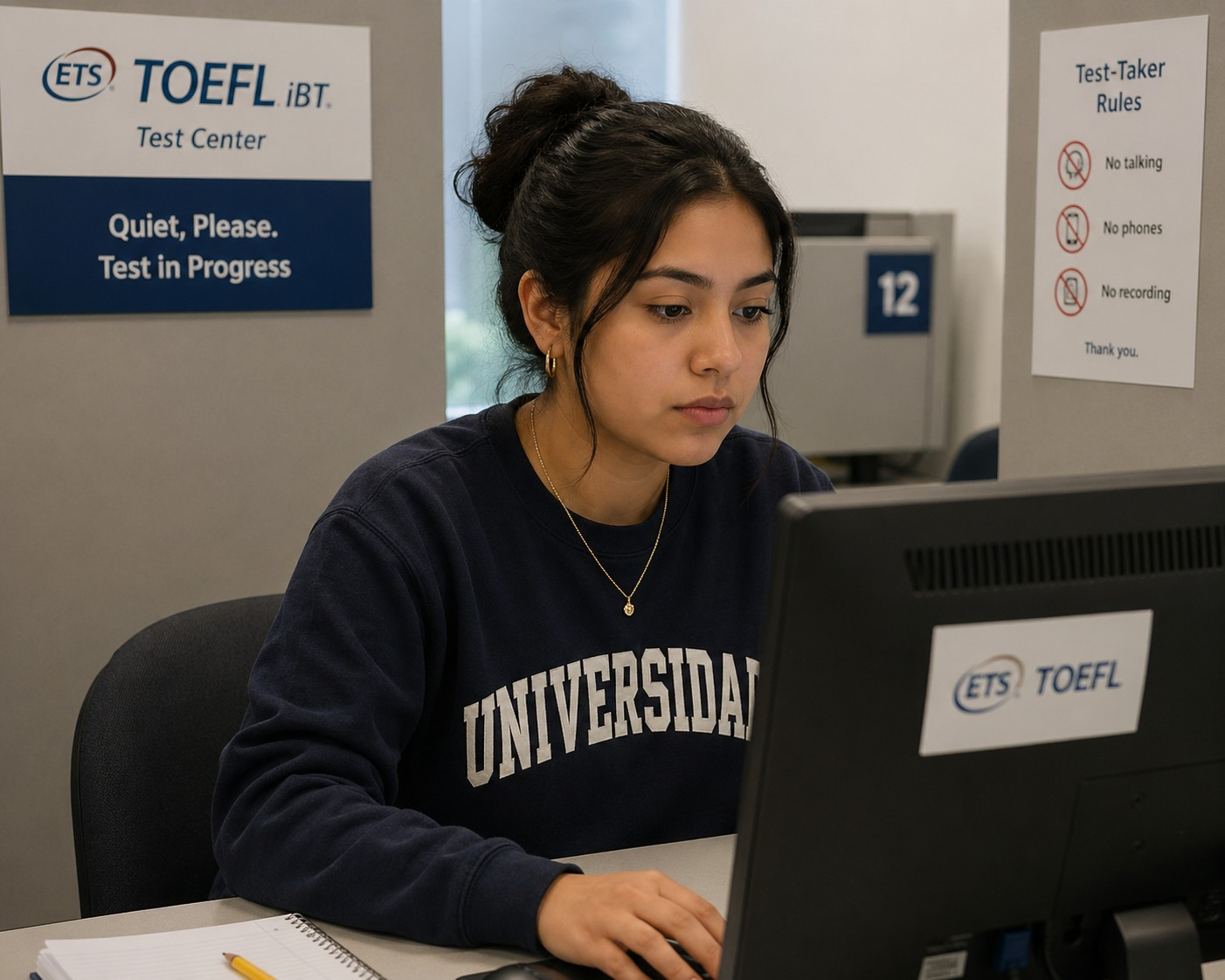
The 2026 TOEFL “Listen and Repeat” task might look like a simple memory test, but it’s actually a sophisticated gauge of your natural fluency. Rather than rewarding rote memorization, this task evaluates pronunciation, intonation and rhythm, accuracy, short-term memory. Essentially, it’s designed to answer one vital question: can you authentically reproduce English as it’s spoken in the real world?
What Changed from the Old TOEFL Speaking Section
In the previous TOEFL format, speaking tasks focused on:
There was no direct test of pronunciation in isolation.
Old TOEFL Speaking
Focus: ideas and organization
More time to think
Longer responses (45–60 seconds)
TOEFL 2026 Speaking
Focus: accuracy + clarity in real time
Immediate response required
No preparation time
👉 This is a major shift:
From: What you say To: How clearly and accurately you say it
How the TOEFL “Listen and Repeat” Task Works
The format is straightforward:
You hear a sentence (usually 6–12 words)
You have a short pause
You repeat the sentence exactly
That’s it.
Example
Audio
The professor emphasized the importance of consistent practice.
Your response
The professor emphasized the importance of consistent practice.
What Makes This Difficult?
Even though the sentences are short, the challenge comes from:
Speed of delivery
Unfamiliar vocabulary
Natural pronunciation features (linking, reductions)
Memory pressure
👉 You are processing and speaking simultaneously
What the TOEFL “Listen and Repeat” Task Is Actually Testing
The Listen and Speak section targets four high-level linguistic skills:
Pronunciation Precision: Can you articulate individual sounds clearly enough for a native speaker (or an AI rater) to recognize them instantly?
Natural Prosody: This measures your rhythm and intonation. Are you hitting the right “peaks and valleys” of English, or do you sound like a robot?
Auditory Accuracy: This tests your “ear.” It ensures you aren’t just getting the gist, but catching every small detail, like “a” vs. “the” or plural endings.
Cognitive Retention: It tests your short-term memory — the ability to hold a complete sentence in your mind and reproduce it without losing the structure.
⚠️ Common Mistakes
Even with strong English skills, small habits can lower your score. Avoid these common traps:
1. Focusing only on individual words
→ This destroys rhythm and natural flow
2. Speaking too slowly
→ Sounds unnatural and breaks intonation patterns
3. The “Robot” Voice (Monotone)
→ Speaking with no variation in pitch reduces your score, even if the words are correct
4. The “Staccato” Trap
→ Saying each word separately (I—want—to—go) breaks natural linking and fluency
→ Learn how sentences connect here:
Independent & Dependent Clauses
5. Trying to translate mentally
→ You will fall behind instantly and lose accuracy
6. Correcting yourself mid-sentence
→ Stopping to fix mistakes disrupts flow and counts as additional errors
7. Panicking if you miss one word
→ This often leads to multiple mistakes instead of one small error
Strategies to Succeed on the TOEFL “Listen and Repeat” Task
1. Think in Chunks (Not Words)
Native English speakers don’t process individual words; they speak in “meaning groups.” To succeed, you should listen for these natural pauses rather than trying to memorize every single letter.
Hear this:The professor emphasized / the importance / of consistent practice.
Pro Tip: By focusing on the “music” of the sentence (the chunks), your brain processes the information faster, making it much easier to repeat accurately.
2. Master the “Shadowing” Technique
Shadowing is the most effective way to train for this task. Instead of waiting for a sentence to end, you repeat it almost at the same time as the speaker.
How to Practice:
Listen & Mimic: Play a short audio clip and repeat the words 1–2 seconds after the speaker.
Match the “Music”: Don’t just focus on the words; copy the speaker’s volume, speed, and pauses.
Why it Works: This builds muscle memory for English. It forces your brain to process pronunciation and rhythm automatically, so you don’t have to “think” about your accent during the actual test.
3. Focus on Stress and Intonation
English is a “stress-timed” language, meaning the rhythm of the sentence is created by emphasizing certain syllables while rushing over others.
How it works: Listen for the “peaks” in each sentence. Notice which words are louder and longer:
Example: “The proFESSor EMpha-sized the im-POR-tance of con-SIS-tent PRAC-tice.”
Why it matters: You don’t actually need a “perfect” accent to score high. As long as you hit the correct stress patterns, the AI grader will recognize your speech as clear and natural.
4. Prioritize Clarity Over Perfection
Don’t panic if you miss a small word or trip over a syllable. The AI isn’t looking for a 100% identical recording; it’s looking for intelligibility.
Your goals are:
Clear Pronunciation: Making sure the core words are easy to understand.
Natural Rhythm: Keeping the “beat” of the sentence consistent.
Minimal Hesitation: Maintaining a smooth flow without long pauses.
The Bottom Line: If you miss a word, just keep moving. A confident, clear delivery with one small mistake will score much higher than a “perfect” sentence that is full of stammers and pauses.
5. Boost Your Listening Speed
Your speaking is only as good as your hearing. If you can’t catch the words in real-time, you won’t be able to repeat them accurately under pressure.
How to Train:
Vary Your Sources: Practice with academic podcasts, university lectures, and official TOEFL listening tracks.
Increase the Pace: Once you’re comfortable, try listening at 1.2x speed. This makes the actual test feel slower and easier to manage.
The Golden Rule: You cannot reproduce what you didn’t fully process. Training your ears to handle fast-paced English ensures your mouth isn’t left guessing.
🔗 External TOEFL Resource
Want more examples and practice for the TOEFL speaking section?
Explore detailed explanations and strategies here:
Consistency is key. Follow this simple loop for 10–15 minutes every day to build the necessary muscle memory:
Listen: Play a short sentence.
Pause & Mimic: Stop the audio and repeat the sentence immediately.
Compare: Record yourself and listen back. Does your version match the “music” of the original?
Refine: Repeat the sentence one more time, fixing any awkward pauses.
👉 Your Focus Hierarchy:
Top Priority: Rhythm, Stress, and Flow.
Bottom Priority: Perfection.
The Goal: Make natural English sounds feel like a reflex rather than a memory exercise.
Final Thoughts on the TOEFL “Listen and Repeat” Task
The Listen and Repeat task marks a major evolution in the TOEFL Speaking section. It moves away from rehearsed templates and long, structured answers to focus on what really matters: real-time communication.
Success on this task isn’t about how much you can memorize—it’s about how well you:
Hear clearly
Process quickly
Speak naturally
Master these three habits, and you’ll have no trouble handling the new format with confidence.
🚀 Want to Improve Your TOEFL Speaking?
I offer personalized TOEFL speaking practice with real feedback on:
✔ Pronunciation
✔ Fluency
✔ Test strategies
The 2026 TOEFL iBT exam is changing significantly — and these updates are not minor adjustments. The Educational Testing Service (ETS) has redesigned the test to be:
Shorter: Reduced to a streamlined 90-minute experience, respecting the test-taker’s time and focus.
Adaptive: Using smart technology to adjust section difficulty in real-time based on your performance.
Aligned with Global Proficiency Standards: Shifting to a familiar 1–6 band scale to match the CEFR framework used worldwide.
For students preparing for university admission or professional opportunities, understanding these changes is essential. This isn’t just about a shorter timer; it’s about a fundamental shift in how your English skills are measured. Gone are the days of the three-hour marathon. In its place is a more focused, intuitive assessment that moves away from rigid academic templates and toward the way we actually communicate in the modern world. Whether you are unscrambling sentences in the “Build a Sentence” task or responding to a fast-paced “Academic Discussion,” the 2026 TOEFL iBT is designed to prove you can thrive—not just survive—in an English-speaking environment.
In this guide, you’ll learn:
What changed in the TOEFL format
How the new scoring system works
What adaptive testing means for your strategy
How to prepare effectively
1. Key Changes to the 2026 TOEFL iBT
Shorter Test (≈ 90 Minutes)
The total test time has been slashed from roughly two hours to a streamlined 90 minutes. While this is a relief for those who dreaded the old three-hour “marathon,” the shift effectively turns the TOEFL into a sprint. Reducing fatigue is a major benefit, but the trade-off is a much higher psychological intensity.
Less time to think: With the clock ticking faster, you lose the luxury of over-analyzing. You must rely on instinct and quick pattern recognition.
High-stakes questions: With fewer total questions, the “weight” of each individual answer increases. A single mistake has a larger mathematical impact on your final score than it did in the longer version.
Precision focus: There is no room for a “slow start.” You need to be at 100% mental capacity from the moment the first screen loads.
Adaptive Reading and Listening
In a major technological leap, the TOEFL now utilizes a multi-stage adaptive format. The test essentially “gets to know you” as you take it.
The Structure: Everyone starts with Module 1, which features questions of medium difficulty. Your accuracy here acts as a filter.
The Pivot: If you ace Module 1, Module 2 will be significantly more challenging, unlocking the path to the highest possible scores. If you struggle, Module 2 will be easier, but your scoring potential will be “capped.”
The Strategy: Treat Module 1 as the most important part of your exam. It isn’t a warm-up; it is the trajectory setter that determines whether you are playing for a top-tier score or a mid-range one.
New 1.0–6.0 Scoring Scale
To make results more intuitive for international universities, TOEFL has retired the 120-point scale in favor of a 1.0–6.0 band scale, moving in 0.5 increments. This shift creates a “universal language” for proficiency, directly mirroring the CEFR levels used by recruiters and admissions officers worldwide.
3.0 (B1): Intermediate—functional for everyday tasks.
4.0 (B2): Upper Intermediate—the standard for many undergraduate programs.
5.0 (C1): Advanced—demonstrating the “Professional English” needed for grad school.
6.0 (High C1/C2): Mastery—indicating near-native fluency and academic precision
Transition Period (2026–2028)
We are currently in a “bridge” era. Because thousands of universities have spent decades setting their requirements based on the old 0–120 scale, ETS is providing Dual-Score Reporting until 2028.
What you see: Your official report will list both your 1–6 band and its 0–120 equivalent.
The Benefit: This prevents any confusion during your application process. If a university still lists a “90” as their requirement, your report will clearly show how your new band score maps to that old standard, ensuring your hard work is accurately recognized
2. Why These Changes Matter (The Strategic Shift)
This is not just a format update—it’s a fundamental change in how you must approach test day. In the past, the TOEFL was a test of stamina; today, it is a test of precision.
The Old TOEFL iBT: A Marathon of Endurance
Endurance mattered: Success was often about who could stay focused for three hours without burning out.
Recovery was possible: With a high volume of questions, you could “warm up” during the first few passages and still recover a high score even after a shaky start.
Static difficulty: Every student saw roughly the same level of difficulty, regardless of their actual ability.
The 2026 TOEFL iBT: A High-Stakes Sprint
Early accuracy is everything: Because the test is adaptive, your performance in the first 15 minutes dictates the difficulty—and the maximum possible score—of the rest of the exam.
Difficulty is a moving target: The test “levels up” with you. If the questions are getting harder, it’s actually a good sign—it means you’ve unlocked the higher scoring bracket.
The “Ceiling” Effect: If you make careless mistakes in Module 1, the algorithm may categorize you as a “lower-level” speaker. Even if you get every question right in Module 2, you may be stuck under a lower score ceiling.
The Bottom Line: The 2026 TOEFL measures true proficiency faster, but it is much less forgiving. You don’t have time to “settle in.” You must be sharp, accurate, and strategically aware from the very first click.
3. How Adaptive Testing Changes Your Strategy
The introduction of multi-stage adaptive testing means your old study habits might actually hurt your score. In a fixed-form test, every question is worth the same. In the 2026 adaptive TOEFL iBT, the questions in the first module act as “gatekeepers” to your target score.
The Strategy Pivot
Old Strategy (Outdated)
New Strategy (Required)
“Warm up slowly” Many students used the first few questions to get into the “zone.”
“Sprint from the start” There is no warm-up period. You must be at peak mental performance the moment Module 1 begins.
“Make up points later” If you missed a passage, you could hope for a perfect run later to save your score.
“The first module is final” If you underperform in Module 1, you may be locked out of the “Advanced” (Band 5–6) questions entirely.
“Focus on completion” Just getting to the end was half the battle.
“Prioritize early accuracy” Accuracy in the first half of the section is more valuable than speed in the second half.
Your New Action Plan
Front-Load Your Focus: Dedicate your highest level of concentration to the first module of the Reading and Listening sections. Think of it as a qualifying round; if you don’t “qualify” for the hard module, you can’t win the top prize.
Eliminate Careless Errors: In the 2026 format, a “silly mistake” on a medium-difficulty question in Module 1 is penalized more heavily by the algorithm because it signals to the test that you haven’t mastered the basics.
Manage the “Difficulty Spike”: If Module 2 feels significantly harder, don’t panic—celebrate. It means the algorithm has recognized your high proficiency and is testing your limits to see if you deserve a Band 5.5 or 6.0.
👉 The “Golden Rule” for 2026:
Success is no longer about how many questions you answer; it’s about which questions you earn the right to answer.
A Practical Example: The Two Paths
To understand how this works in real-time, let’s look at two students, A and B, taking the same Reading section. Both are capable of scoring well, but their strategy in the first 15 minutes changes everything.
Student A (The “Slow Starter”):
Module 1: They are a bit distracted and miss four medium-difficulty questions due to careless errors.
The Pivot: The algorithm identifies these misses as a lack of proficiency.
Module 2: They are served an easier set of questions. Student A finds them simple and gets them all right.
The Result: Because they were “locked” into the easier track, their final score is capped at a 3.5 (B1/B2 level), regardless of their perfect performance in the second half.
Student B (The “Precision Sprinter”):
Module 1: They stay intensely focused and answer every question correctly.
The Pivot: The algorithm recognizes high-level mastery.
Module 2: They are served a significantly harder set of academic passages with complex vocabulary. Student B struggles more and misses a few.
The Result: Because they proved themselves in Module 1, they are scored on the “Advanced” track. Even with a few misses in the harder module, they land a 5.5 (C1 level).
👉 The Takeaway:
Student B had a “harder” test experience but ended up with a much higher score. In 2026, struggling with difficult questions is actually a good sign—it means you’ve earned your way into the high-scoring bracket. Your score path is largely decided in those opening minutes.
4. How to Prepare for 2026 TOEFL iBT
Preparing for the 2026 format requires a shift from “general studying” to targeted precision. Because the test is shorter and smarter, your training must be more disciplined.
Train for Accuracy First (The “No-Mistake” Zone)
In the 2026 adaptive environment, a string of early errors can permanently derail your score. You must prioritize getting it right over getting it done.
Accuracy Over Guessing Speed: Your primary goal in practice should be a 100% success rate on “Medium” difficulty questions. If you can’t nail the basics with total certainty, you won’t unlock the high-scoring modules.
Early Mistakes are Costly: Treat the first module of any section as the “High-Stakes” zone. A “silly mistake” here is penalized more heavily because it signals to the algorithm that you haven’t mastered foundational English.
👉 Practice Tip: Use timed, high-precision exercises. Instead of doing a full 90-minute mock test every day, do 15-minute “sprints” where the goal is zero errors. Analyze every wrong answer—was it a lack of knowledge, or a lack of attention?
Improve Reading Speed (Without Losing Meaning)
With the total time reduced to roughly 90 minutes, the Reading section moves fast. You no longer have the luxury of reading every word of a passage twice.
Identify Main Ideas Instantly: Practice “skimming for structure.” You should be able to look at a paragraph and identify the “Topic Sentence” and the author’s primary goal within seconds.
Recognize Structure and Tone: The 2026 test focuses heavily on why an author wrote something. Look for transition words to map out the logic of the passage without getting bogged down in technical vocabulary.
Strengthen Listening Under Pressure
Listening is no longer just about catching facts; it’s about understanding nuance in a fast-paced, adaptive environment.
Capture Key Details: You need to distinguish between the “main point” and the “supporting examples” on the first listen. There is rarely time to second-guess your notes.
Decode Speaker Attitude: Pay attention to intonation and “filler words.” Is the professor certain, skeptical, or surprised? In the 2026 format, understanding the vibe of the conversation is as important as the data.
Organization of Ideas: Practice predicting where a lecture is going. If a speaker says “On the other hand,” your brain should immediately prepare for a contrasting point.
Improve Your TOEFL Speaking Skills
One of the best ways to improve your TOEFL speaking performance is through Listen and Repeat practice. This technique helps develop pronunciation, fluency, listening comprehension, and speaking confidence while preparing for academic English tasks.
While the TOEFL doesn’t have a “Grammar Section,” your command of sentence structure is the “invisible engine” behind your entire score.
Speaking Clarity: Proper grammar allows you to speak fluidly without awkward pauses to self-correct—critical for the “Take an Interview” task.
Writing Accuracy: In the new “Build a Sentence” and “Write an Email” tasks, your ability to handle clauses and tenses determines whether you hit the 5.0–6.0 band.
Reading Comprehension: If you understand how a sentence is built, you can’t be “tricked” by complex distractors in the reading passages.
📘 2026 TOEFL iBT Grammar Toolbox
To reach the highest scoring bands, you must move beyond simple sentences.
Use these targeted resources to master the grammar behind the new 2026 tasks.
🔹 Build a Sentence Task
This task is a puzzle of word order.
If you understand how clauses connect, you can “see” the correct sentence before moving any words.
🔹 Narrative Clarity (Reading & Speaking)
You need to clearly describe background actions and ongoing processes.
This is essential for academic explanations and listening tasks.
⚠️ Critical Mistakes to Avoid in the 2026 TOEFL iBT
The redesign has changed the “rules of the game.” Avoid these four common pitfalls to ensure your preparation actually leads to a high band score:
Treating Module 1 as a “Warm-Up” In the old format, you could start slow and recover. In 2026, Module 1 is the gatekeeper. If you underperform in the first 15 minutes, the adaptive algorithm will “lock” you into a lower-difficulty track. This lowers your score ceiling immediately, making it mathematically impossible to hit a Band 5.5 or 6.0, no matter how well you do in the second half.
Sacrificing Accuracy for Speed While the 90-minute timer is intimidating, rushing leads to “silly” mistakes that the new scoring system penalizes heavily. In adaptive testing, precision is more valuable than speed. It is better to answer 80% of the questions with 100% accuracy than to rush through the entire test and make careless errors on foundational questions.
Ignoring the CEFR Band Scale Many students still think in terms of the old 0–120 scale and don’t realize that universities now look for specific CEFR levels (B2, C1, C2). If you don’t understand that a 5.0 represents C1 proficiency, you may not realize the level of linguistic complexity—such as advanced clauses and hedging—required to meet your target.
Using Outdated “Template-Heavy” Strategies The 2026 TOEFL has been updated to detect and penalize rigid, memorized templates. Many older prep books focus on “tricking” the test. The new format—especially the Academic Discussion and Virtual Interview tasks—prioritizes natural, flexible communication. If you rely on 2024 strategies for a 2026 exam, your score will likely suffer.
🔗 Official TOEFL Resource
This is the most accurate place to find TOEFL materials—created by the test makers themselves.
The 2026 update is more than just a shorter timer—it represents a fundamental evolution in how global English proficiency is measured. By moving to an adaptive, 90-minute format, the Educational Testing Service (ETS) has built a test that is:
Faster: Eliminating the “test-taking fatigue” of the old three-hour marathon.
Smarter: Using sophisticated algorithms to pinpoint your exact skill level in half the time.
More Aligned with Reality: Moving away from rigid academic templates and focusing on how you actually communicate in modern university and professional settings.
For students, the message is clear: The era of “gaming the test” with old templates is over. Success in the 2026 landscape depends on three pillars:
Strong Foundational English: You need an intuitive grasp of grammar and structure to handle the fast-paced “Build a Sentence” and “Reading” tasks.
Rapid Comprehension: You must be able to identify main ideas and speaker attitudes on the first pass.
Consistent Accuracy: In an adaptive world, every click counts. You must be sharp from the very first question to unlock your highest scoring potential.
The 2026 TOEFL iBT is a sprint, not a marathon. Prepare with precision, focus on your foundations, and you’ll be ready to claim your spot at your dream university.
Cookie Consent
We use cookies to improve your experience on our site. By using our site, you consent to cookies.