
White text-logo on blue background.

Category: Uncategorized

  • The Present Continuous: A Complete Guide for ESL Students

    The Present Continuous: A Complete Guide for ESL Students

    What is the present continuous?

    The present continuous tense – sometimes called the present progressive –  is one of the first tenses English learners practice after the simple present. In this blog, we will discuss using the present continuous in affirmative statement, negative statements, Yes/No questions, and Wh- questions. We will also discuss the spelling rules for the present continuous. As always, you will have the opportunity to practice everything discussed in this blog.

    Affirmative Statements in the Present Continuous

    When we want to describe something that is happening right now, we use affirmative statements in the present continuous. These sentences show actions in progress, like “I am reading” or “They are playing.” The pattern is simple once you learn it.

    How to Form the Present Continuous (Affirmative Statements)

    The structure of affirmative statements in the present continuous is simple:

    Subject + Be verb (am / is / are) + Verb + -ing

    1. I am drinking coffee.
    2. You are listening to music.
    3. He is watching television.
    4. She is cooking dinner.
    5. It is raining.
    6. Alejandra is playing tennis.
    7. We are studying grammar.
    8. Alejandra and I are swimming in the pool.
    9. They are driving to class.
    10. Alejandra and Diego are doing homework.

    Be Verbs in the Present Continuous

    • I –> am
    • He / She / It / Singular Nouns –> is
    • You / We / They / Plural Nouns –> are
    💡 Tip: If you need a refresher on subjects, check out our complete guide on subject pronouns.

    When Do We Use the Present Continuous?

    1. Actions happening in the present moment – right now.

    • She is eating pizza.
    • They are watching a movie.

    2. Actions happening over a longer period of time.

    • They are studying English at UNAM.
    • Karina is traveling in Mexico this summer.
    🚫 Common Mistakes to Avoid

    ❌ She cooking dinner.
    ✅ She is cooking dinner.

    ❌ They is playing soccer.
    ✅ They are playing soccer.

    ❌ He am running.
    ✅ He is running.

    The present continuous is a very useful tense for describing what’s happening right now. Remember the pattern: subject + am/is/are + verb-ing. With practice, it will become natural to use.

    Negative Statements in the Present Continuous

    Sometimes we need to say what is not happening. That’s where negative statements come in.

    How to Form the Present Continuous (Negative Statements)

    The structure of negative statements in the present continuous is simple:

    Subject + Be verb (am / is / are) + not + Verb + -ing

    1. I am not drinking coffee.
    2. You are not listening to music.
    3. He is not watching television.
    4. She is not cooking dinner.
    5. It is not raining.
    6. Alejandra is not playing tennis.
    7. We are not studying grammar.
    8. Alejandra and I are not swimming in the pool.
    9. They are not driving to class.
    10. Alejandra and Diego are not doing homework.
    📘 Remember: Contractions

    1. Subject Pronoun + Be Verb
    I am → I’m
    You are → You’re
    He is → He’s
    She is → She’s
    It is → It’s
    We are → We’re
    They are → They’re

    2. Be Verb + Not
    is not → isn’t
    are not → aren’t
    am not → (❌ no contraction; just say I’m not)

    3. Singular Nouns + Is
    Maria is → Maria’s
    The teacher is → The teacher’s
    My dog is → My dog’s

    👉 Be careful! Maria’s can also mean Maria’s book (possessive). Context will tell you the meaning.

    When Do We Use the Present Continuous (Negative Statements)?

    1. Actions not happening in the present moment – not right now.

    • She is not eating pizza.
    • They are not watching a movie.

    2. Actions that are not happening over a longer period of time.

    • They are not studying English at UNAM.
    • Karina is not traveling in Mexico this summer.
    🚫 Common Mistakes to Avoid

    ❌ She not cooking dinner.
    ✅ She is not cooking dinner.

    ❌ They not playing soccer.
    ✅ They are not playing soccer.

    ❌ I amn’t running.
    ✅ I am not running.

    Negative statements in the present continuous are easy once you remember the formula: subject + am/is/are + not + verb-ing. Practice using both full forms (is not / are not) and contractions (isn’t / aren’t) to sound more natural in everyday English.

    Questions in the Present Continuous

    You already know how to make affirmative and negative statements in the present continuous. Now let’s practice asking questions. We use questions in this tense to ask about actions happening right now or over a longer period of time.  

    Yes/No Questions in the Present Continuous

    The structure of Yes/No questions in the present continuous is simple:

    Be verb (am / is / are) + Subject + Verb + -ing

    1. Am I drinking coffee?
    2. Are you listening to music?
    3. Is he watching television?
    4. Is she cooking dinner?
    5. Is it raining?
    6. Is Alejandra playing tennis?
    7. Are we studying grammar?
    8. Are Alejandra and I swimming in the pool?
    9. Are they driving to class?
    10. Are Alejandra and Diego doing homework?
    📘 Remember: Short Answers in the Present Continuous

    When answering Yes/No questions, we use a short answer with the subject + be verb.
    Do not repeat the whole sentence.

    Examples:
    Q: Are you studying English?
    ✅ Yes, I am. / ❌ Yes, I am studying English.

    Q: Is she cooking dinner?
    ✅ No, she isn’t. / ❌ No, she isn’t cooking dinner.

    Q: Are they playing soccer?
    ✅ Yes, they are. / ❌ Yes, they are playing soccer.

    👉 Keep it simple: Subject + Be verb.

    Wh-Questions in the Present Continuous

    When we want more information, we use question words (Who, What, Where, When, Why, How)

    The structure of Wh- questions in the present continuous is simple:

    Wh-word + Be verb (am / is / are) + Subject + Verb + -ing

    1. What are you reading?
    2. Where is he going?
    3. Who is she talking to?
    4. Why are they laughing?
    5. How am I doing?

    Example Conversation

    A: What are you doing?
    B: I’m studying English.
    A: Are you studying at the library?
    B: No, I’m not. I’m studying at home.

    🚫 Common Mistakes to Avoid

    ❌ You are studying? (word order is wrong)
    ✅ Are you studying?

    ❌ Where you are going?
    ✅ Where are you going?

    ❌ She is talking who?
    ✅ Who is she talking to?

    Spelling Rules for the -ing Form

    1. Most Verbs (add -ing)

    1. work –> working
    2. eat –> eating
    3. sleep –> sleeping

    2. Verbs ending in -e (drop the -e. Add -ing)

    1. make –> making
    2. bake –> baking
    3. write –> writing

    3. One-syllable verbs with vowel + consonant

    → double the consonant + -ing

    1. run –> running
    2. sit –> sitting
    3. stop –> stopping
    ⚠️ Do not double w, x, y
    1. snow –> snowing
    2. fix –> fixing
    3. play –> playing

    4. Verbs ending in -ie → change -ie to -y + -ing

    1. die → dying
    2. lie → lying
    3. try –> trying
    🚫 Common Mistakes in Spelling the -ing Form

    ❌ makeing
    ✅ making

    ❌ runing
    ✅ running

    ❌ stoping
    ✅ stopping

    ❌ lieing
    ✅ lying

    Simple Present vs. Present Continuous

    English learners often confuse the simple present and the present continuous, but they are used in different situations.

    The Simple Present

    We use the simple present for:

    • Habits and routines → I wake up at 7:00 every day.
    • General facts and truths → Water boils at 100°C.
    • Schedules or timetables → The bus leaves at 8:00 a.m.

    Formula: Subject + Base Verb (add -s for he/she/it / singular nouns)

    • We go to class during the week.
    • She works in an office.
    • They play soccer on Sundays.
    • Regina eats breakfast at 7:00 in the morning.

    The Present Continuous

    1. Actions happening in the present moment – right now.

    • She is sleeping.
    • They are watching YouTube.

    2. Actions happening over a longer period of time.

    • They are studying English at UNAM.
    • Karina is losing weight.

    ✅ Key Differences

    • Use the simple present for things that are always true or a regular action.
    • Use the present continuous for things that are happening right now or are happening over a longer period of time.

    👉 Examples:

    Simple Present:

    1. I live in Mexico. (a fact)
    2. I eat pizza on Friday nights. (regular action/habit/routine)

    Present Continuous:

    1. I am studying for an exam. (happening right now)
    2. I’m living in Mexico this year. (over a longer period of time)
    🚫 Common Mistakes to Avoid

    ❌ She is cooking dinner every Friday night.
    ✅ She cooks dinner every Friday night.

    ❌ They play soccer right now.
    ✅ They are playing soccer right now.

    ❌ He studies English right now.
    ✅ He is studying English right now.

    Let’s Practice!

    Exercise A

    Use the cues to write affirmative or negative statements in the present continuous. Use contractions.

    1. They / play soccer.
    2. Ana / not live in Spain.
    3. You / sit at the bus stop.
    4. She / write an email to a friend.
    5. I / fix my bike.

    Exercise B

    Unscramble the words to form questions.

    1. is / she / at UNAM / English / studying / ?
    2. of music / what kind / he / is / listening to / ?
    3. visiting / when / you / are / Mexico / ?
    4. are / they / where / traveling / summer / this / ?
    5. Frida / is / a portrait / painting / ?

    Exercise C

    Complete each sentence with the correct simple present or present continuous form of the verb in parentheses. Do not use contractions.

    1. She _____ (practice) English when she isn’t in class.
    2. That’s my dog by the tree. It _____ (bark) at a squirrel.are takin
    3. Maria’s parents _____ (live) in Argentina.
    4. Diego _____ (wear) a hat. It is sunny outside.
    5. He _____ (listen to) the Joe Rogan podcast every day.
    6. My girlfriend _____ (look) for her purse. She is buying me lunch today.
    7. I _____ (need) to buy a new car. Taking the bus is horrible.
    8. I _____ (hear) loud music next door. My neighbors are annoying!!!
    9. The teacher _____ (grade) exams right now.
    10. They _____ (take) a test this morning.

    Scoring & Feedback

    🔵 17 – 20 correct

    Excellent work! 🎉You really understand the present continuous. Keep using it in your everyday conversations and writing.

    🟢 14 – 16 correct
    Great job! ✅ You have a good understanding of the present continuous. Review the ones you missed.

    🟡 7 – 13 correct
    Good effort! 💪You’re learning, and that’s what matters. Take a moment to review the examples and do the quiz again.

    🔴 0–6 correct
    No worries! 🌱 The present continuous can be tricky at first. Go back and review the examples in the lesson.

    📚 Want more reading, writing, listening, and speaking practice? Check out the Essential English series on Amazon!

    Conclusion

    The present continuous tense gives your English life, energy, and movement. It’s the tense of right now—the tense that helps you describe what’s happening around you now and over longer periods of time. By mastering affirmatives, negatives, questions, contractions, spelling rules, and knowing when to use it (and when not to!), you’ve built a strong foundation for clear and confident communication.

    Remember: learning a language is not about perfection—it’s about progress. Every time you say “I’m learning English” you are using the present continuous to tell the truth about your journey. Keep practicing, stay curious, and trust the process. Your English is not standing still—it’s moving forward, step by step.
    Leave a comment below!

    And remember . . . Practice, Practice, Practice!!!!!

  • Subjects and Objects in English Grammar: Easy Guide for ESL Students

    Subjects and Objects in English Grammar: Easy Guide for ESL Students

    Subjects and Objects in English Sentences

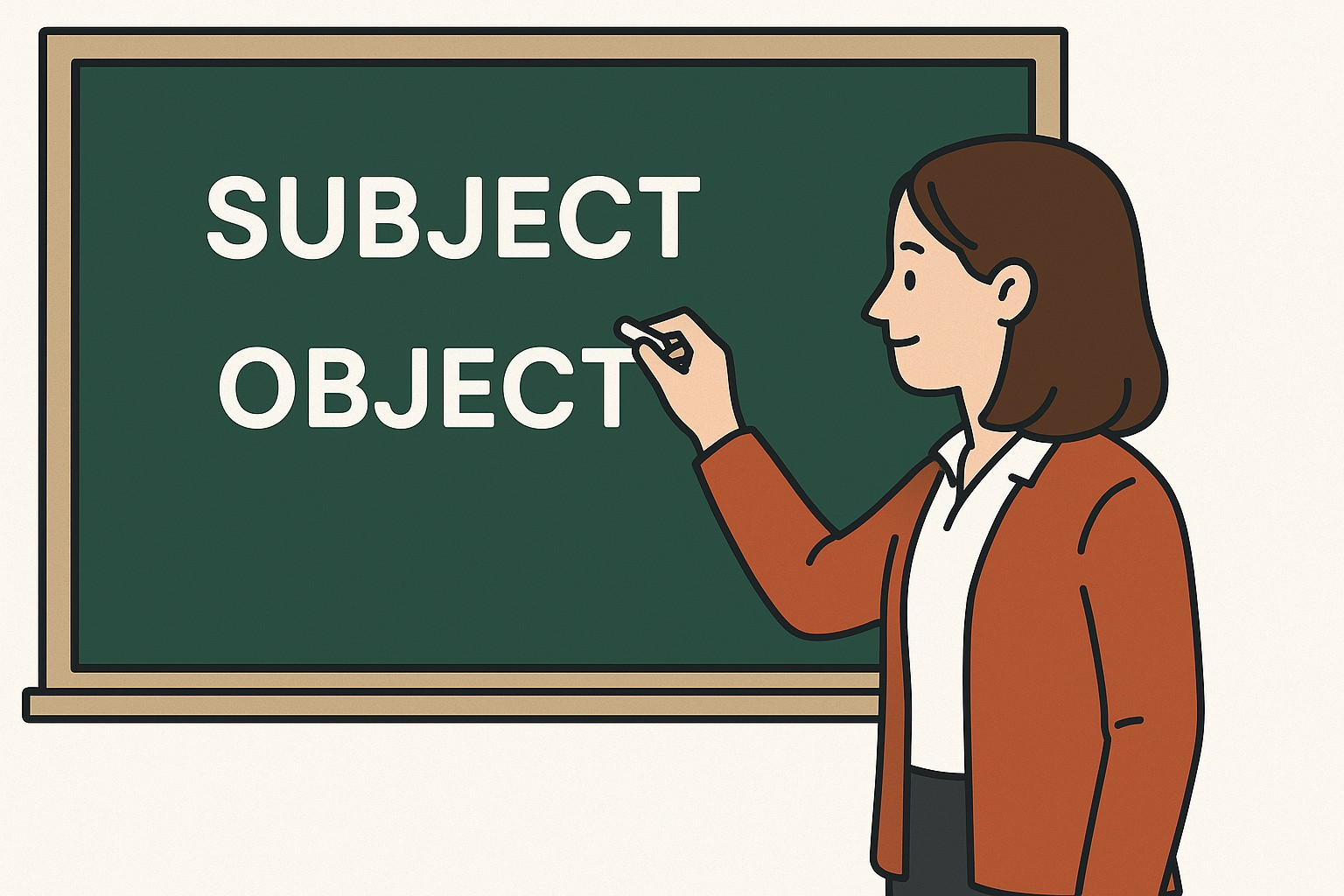
    Understanding the difference between a subject and an object is one of the foundations of English grammar. Without this knowledge, it can be difficult to write clearly and understand how sentences work. In this post, we’ll break it down with simple explanations, examples, and practice.

    What is the Subject?

    The subject is the person, place, thing, or idea that does the action in a sentence. Think of the subject as the “who” or “what” the sentence is about.

    The subject goes before the verb.

    1. John plays soccer every Saturday.
    2. She practices tennis in the evening.
    3. Dogs bark at strangers.
    4. My friends and I watch movies on Friday night.
    5. They do their homework on time.

    In each sentence, the subject is the one doing the action (plays, practices, bark, speak, do).

    What is the Object?

    The object is the person, place, thing, or idea that receives the action of the verb. Objects often answer the questions “who?” or “what?”

    Objects usually come after the verb.

    1. John plays soccer every Saturday (John play what? soccer).
    2. She practices tennis in the evening (She practices what? tennis).
    3. Dogs bark at strangers. (Dogs bark at who? à strangers)
    4. My friends and I watch movies on Friday night (My friends and I watch what? movies)
    5. They do their homework on time. (They do what? homework).

    Subjects vs. Objects: A Side-by-Side Look

    SentenceSubjectVerbObject
    Mary reads a book.Maryreadsa book
    The teacher helps the student.The teacherhelpsthe student
    They built a house.Theybuilta house
    We study grammar.Westudygrammar

    Notice that the subject comes before the verb, and the object usually comes after the verb.

    Object Pronouns

    In English, we often replace the object with an object pronoun so we don’t repeat words too much.

    Subject PronounsObject Pronouns
    Ime
    youyou
    hehim
    sheher
    itit
    weus
    theythem
    1. I am a teacher. Students call me Alan.
    2. You are my friend. I will help you.
    3. He plays soccer. Everyone likes him.
    4. She is my girlfriend. I love her.
    5. It rains a lot in April.  I love it.  
    6. We watched a scary movie. It scared us.
    7. They drive to school. I ride with them.

    🔗 Read Our Guide on Subject Pronouns

    Objects After Prepositions

    In English, prepositions (words like to, for, with, at, in, on, about, from) are always followed by an object. This object can be a noun, a noun phrase, or an object pronoun.

    Examples with nouns and noun phrases

    1. She is talking to the teacher.
    2. We study with classmates.
    3. The book is on the table.
    4. I study at night.
    5. They complain about the homework.
    6. My computer is in my backpack.
    7. I buy flowers for my girlfriend.

    Examples with pronouns

    When a pronoun follows a preposition, we always use the object pronoun, not the subject pronoun.

    ❌ She is talking to he.

    ✅ She is talking to him.

    ❌ The gift is for I.

    ✅The gift is for me.

    ❌ We went with they.

    ✅ We went with them.

    ❌ The message is from we.

    ✅ This message is from us.  

    👉 Grammar Tip!

    Preposition + Object (noun or object pronoun)

    Common Mistakes ESL Students Make

    1. Mixing up pronouns

    ❌ Me like pizza.

    ✅ I like pizza. (Subject = I)

    ❌ He gave she a gift.

    ✅ He gave her a gift. (Object = her)

    2. Forgetting the object when the verb needs one

    ❌ She put on.

    ✅ She put on her jacket. (Object = her jacket)

    ❌ The teacher talks to.

    ✅ The teacher talks to the students.

    👉 Grammar Tip!

    When the subject is another person or people and yourself, you put yourself last.

    Karina and I are students.

    When the object is another person or people and yourself, you also put yourself last.

    Our teacher gave Gabriel and me extra homework!

    🔗 Read Our Complete Guide on Pronouns

    Let’s Practice!

    Exercise A

    Identify the subject and object in each sentence.

    1. The children are students.   
    2. My mother makes dinner every night.
    3. We listen to music at the gym.    
    4. The students look at TikTok during class.  
    5. Tom helps his father cut the grass.     

    Exercise B

    Fill in the blank with the correct word.

    1. ______ went to the park yesterday. (I / Me)
    2. She helped ______ with my homework. (I / Me)
    3. ______ are my best friends. (They / Them)
    4. The teacher spoke to ______ after class. (they / them)
    5. He is taller than ______. (I / me)
    6. ______ really likes soccer. (He / Him)
    7. Can you come with ______ to the store? (we / us)
    8. This gift is for ______. (she / her)
    9. ______ am very tired today. (I / Me)
    10. I called ______ last night. (he / him)
    11. My parents invited ______ to dinner. (we / us)
    12. The dog is playing with ______. (it / it)
    13. ______ are very smart students. (You / Your / Yours)
    14. She lives next to ______. (they / them)
    15. The teacher explained the lesson to ______. (we / us)

    Scoring & Feedback

    🔵 17 – 20 correct

    Excellent work! 🎉You really understand the subject and the object. Keep using them in your everyday conversations and writing.

    🟢 14 – 16 correct
    Great job! ✅ You have a good understanding of the subject and the object. Review the ones you missed.

    🟡 7 – 13 correct
    Good effort! 💪You’re learning, and that’s what matters. Take a moment to review the examples and do the quiz again.

    🔴 0–6 correct
    No worries! 🌱 Subjects and Objects can be tricky at first. Go back and review the examples in the lesson.

    Want more reading, writing, listening, and speaking practice? Check out the Essential English series on Amazon!

    Conclusion

    The subject and object are like two sides of a conversation: one does the action, and the other receives it. Once you can tell them apart, your grammar and sentence-building skills will improve quickly. Keep practicing, and soon you’ll be able to spot the subject and object in any sentence! Subscribe for updated content from Beyond English!

    Leave a comment below!

    And remember . . . Practice, Practice, Practice!!!!!

  • Possessives: A Complete Guide for ESL Students

    Possessives: A Complete Guide for ESL Students

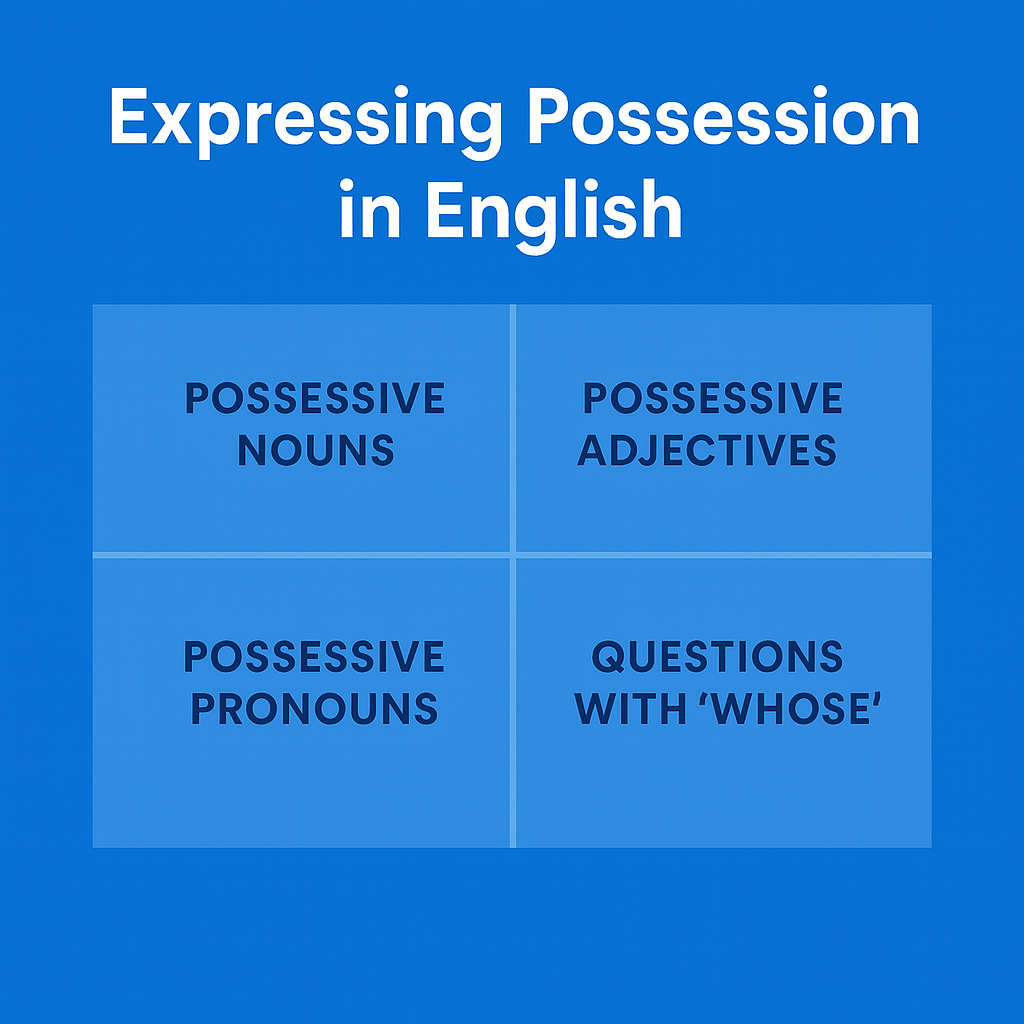
    In English, we often need to make statements or ask questions about possession – ownership. Possessives help us do this in different ways: with possessive nouns, possessive adjectives, possessive pronouns, and with the question word ‘whose‘.

    This lesson will help you understand how to use each form with simple rules, clear examples, and common mistakes to avoid. You will also be able to test your knowledge of the material. By the end, you’ll be more confident using different types of possessives.

    What Are Possessive Nouns in English?

    When we want to show that something belongs to someone or something, we use possessive nouns.

    How to Make a Possessive Noun

    For most singular nouns, add ’s (apostrophe + s).

    1. That is Maria’s book.
    2. The dog’s toy is under the couch.
    3. Those are the student’s books.
    4. The teacher’s computer is on the desk.

    For plural nouns that already end in s, just add an apostrophe (’).

    1. The teachers’ room is next to the library.
    2. The students’ teacher is in front of the class.
    3. The dogs’ food is in the bowl.  
    4. My parents’ car is red. 

    For irregular plural nouns (that don’t end in s), add ’s.

    1. The children’s shoes are in the bedroom.
    2. The men’s jackets are grey. 
    3. The women’s department is on the third floor. 
    4. The sheep’s wool is soft.

    Common Mistakes with Possessive Nouns

    Don’t forget the apostrophe (’).

    Marias book

    Maria’s book

    Be careful with plural nouns.

    The students teacher

    The students’ teacher

    Don’t use “of” and ’s together.

    The book of Maria’s

    Maria’s book / The book of Maria

    👉 Grammar Tip!

    Don’t confuse the ‘s with a possessive noun with the contraction of a noun and the Be verb ‘is.’  A noun comes after the possessive noun.

    • The cat’s toy is under the couch (Possessive)
    • The cat’s under the couch (Contraction of the noun ‘cat’ and the Be verb ‘is’).

    Possessive Adjectives Explained (my, your, his, her, its, our, their)

    We use possessive adjectives to show that something belongs to someone. Possessive adjectives come before a noun.

    Subject PronounsPossessive AdjectivesExamples
    IMyThis is my book.
    YouYourThat is your pen.
    HeHisThis is his bag.
    SheHerThat is her phone.
    ItItsThe dog eats its food.
    WeOurThis is our classroom.
    TheyTheirThose are her shoes.

    🔗 Read Our Guide on Subject Pronouns

    👉 Grammar Tip!

    Possessive adjectives are not plural. They always stay the same.

    ✅ This is my book. / These are my books.

    Be careful with its (no apostrophe).

    Its = possession → The cat licked its paw.

    It’s = the contraction of ‘it is’It’s a sunny day.

    Sentences Using Possessive Adjectives

    1. I visit my family on Saturdays.
    2. You have your homework.
    3. He likes his guitar.
    4. She is talking to her teacher.
    5. The bird is in its cage.
    6. We are eating our lunch.
    7. They are watching their favorite movie.

    Common Mistakes with Possessive Adjectives

    This is me book.
    This is my book.
    👉 Remember: use my, not me.

    She is playing with her’s doll.
    She is playing with her doll.
    👉 Don’t add ’s to possessive adjectives.

    That is your’s pen.
    That is your pen.
    👉 Again: no apostrophe in possessive adjectives.

    This is mine pencil.
    This is my pencil.
    👉 Mine is a possessive pronoun. Use my before nouns.

    He is doing he homework.
    He is doing his homework.
    👉 Each subject has its own special form.

    👉 Grammar Tip!

    Possessive adjectives always go before a noun:

    • my book
    • your phone
    • our teacher

    Possessive Pronouns in English (mine, yours, his, hers, ours, theirs)

    We use possessive pronouns to show that something belongs to someone. Unlike possessive adjectives, possessive pronouns stand alone. They do not come before a noun.

    Subject PronounsPossessive AdjectivesPossessive PronounsExamples
    IMyMineThis book is mine.
    YouYourYoursThat pen is yours.
    HeHisHisThe bag is his.
    SheHerHersThe phone is hers.
    ItIts**
    WeOurOursThe classroom is ours.
    TheyTheirTheirsThe shoes are theirs.

    👉 Grammar Tip!

    Possessive pronouns replace the noun.

    This is my book. (possessive adjective + noun)

    ✅ This is mine. (possessive pronoun)

    Do not use both at the same time.

    This is my book mine.

    This is my book. / This is mine.

    Examples of Possessive Pronouns in Sentences

    1. That is your pencil. This pencil is mine. (mine = my pencil)
    2. That is her car. The blue car is yours. (yours = your car)
    3. Those are his books. These are his. (his = his books)
    4. Her jacket is black. Hers is blue. (Hers = her jacket)    
    5. Our house is big. Ours is small. (Ours = our house)     
    6. Their toys are in the bedroom. Theirs are in the closet. (Theirs = their toys)

    Common Mistakes with Possessive Pronouns

    This is my book mine.
    ✅ This is my book. / This is mine.

    👉 Don’t use a possessive adjective (my) and a possessive pronoun (mine) together.

    That is your’s.
    That is yours.
    👉 Never add an apostrophe to possessive pronouns.

    These are our’s bags.
    These are ours.
    👉 Possessive pronouns stand alone, without nouns after them.

    This is her. (when you mean possession)
    This is hers.
    👉 Her is an adjective, hers is the pronoun.

    The house is their.
    The house is theirs.
    👉 Always use the full possessive pronoun.

    👉 Grammar Tip!

    Use possessive adjectives (my, your, his) before nouns, but use possessive pronouns (mine, yours, his) without nouns.

    🔗 Read Our Complete Guide on Pronouns

    How to Ask Questions with Whose

    We use whose to ask about ownership or possession. It means Who does this belong to?

    Whose + Noun + Is This/Are These?

    1. Whose pen is this? → It’s my pen.
    2. Whose shoes are these? → They are her shoes.

    You can also ask without the noun:

    1. Whose is this?
    2. Whose are these?

    Answering Whose Questions (Adjectives and Pronouns)

    With a possessive adjective:

    1. Whose book is this? → It’s my book.
    2. Whose car is that? → It’s our car.

    With a possessive pronoun:

    1. Whose book is this? → It’s mine.
    2. Whose shoes are these? → They’re hers.

    Examples of Possessive Pronouns in Sentences

    1. Whose backpack is this? → It’s his.
    2. Whose phone is on the table? → It’s mine.
    3. Whose tickets are these? → They’re theirs.
    4. Whose dog is in the yard? → It’s our dog.

    Common Mistakes with Whose vs. Who’s

    Who’s book is this?

    Whose book is this?

    👉 Grammar Tip!

    Use whose to ask who owns something. Be careful not to confuse it with who’s (who is).

    1. Whose = possession (Whose pen?)
    2. Who’s = who is (Who’s at the door?)

    FAQ: Possessive Nouns, Adjectives, Pronouns, and Whose

    1. What is the difference between a possessive adjective and a possessive pronoun?
    A possessive adjective comes before a noun (my book, their house). A possessive pronoun replaces the noun (mine, theirs).

    2. Can we use ‘its’ with an apostrophe at the end?
    No. The correct form is ‘its’ (no apostrophe). It’s means it is.

    3. How do I know if I should use ’s or s’ in possessive nouns?

    • Add ’s for singular nouns (the dog’s toy).
    • Add only an ’ for plural nouns that end in s (the students’ teacher).

    4. Do we use “whose” for things or only for people?
    You can use whose for both people and things.

    • Whose pen is this? (thing)
    • Whose brother is he? (person)

    5.  What are the most common mistakes with possessives?

    • Adding an apostrophe to possessive adjectives (❌ your’s).
    • Using both forms together (❌ This is my book mine).
    • Confusing whose (possession) and who’s (who is).

    Let’s Practice!

    Exercise A

    Fill in the blank with the correct possessive noun.

    1. This is ______ (Charles) book.
    2. The _____ (boys) coach is tough.
    3. The _____ (children) teacher gives too much homework!
    4. We visited my ______ (friend) apartment.
    5. The _____ (woman) purse cost $5,000.

    Exercise B

    Complete each sentence with a possessive adjective.

    1. The students have class at 9:00am. _____ class is on the first floor.
    2. Diego and I are in the same class. _____ class starts at 9:00am.
    3. The woman is from Mexico City. _____ name is Frida.
    4. I have a dog. _____ hair is short.
    5. You are late to class. Where is _____ homework?

    Exercise C

    Complete each sentence with a possessive pronoun.

    1. I have my favorite teacher and my classmates have ______.
    2. My car is fast. Is _____ fast, too?
    3. Can I borrow your calculator? I left _____ at home.
    4. Their teacher doesn’t give a lot of homework. ______ gives homework everyday!
    5. Diego has his friends and his sister has ______ .
    6. I lost my wallet. John didn’t lose _____.

    Exercise D

    Match the beginning of the sentence with the correct ending.

    a. Who

    b. Whom

    c. Whose

    d. Who’s

    1. _____ is from Latin America?

    2. _____ in the library now?

    3. _____ backpack is under the desk?

    4. _____ does she want to date?

    Scoring & Feedback

    🔵 17 – 20 correct

    Excellent work! 🎉You really understand possessives. Keep using them in your everyday conversations and writing.

    🟢 14 – 16 correct
    Great job! ✅ You know most of the possessives. Review the ones you missed.

    🟡 7 – 13 correct
    Good effort! 💪You’re learning, and that’s what matters. Take a moment to review the examples and do the quiz again.

    🔴 0–6 correct
    No worries! 🌱 Possessives can be tricky at first. Go back and review the examples in the lesson.

    Want more reading, writing, listening, and speaking practice? Check out the Essential English series on Amazon!

    Conclusion

    Possessive Nouns, Possessive Adjectives, Possessive Pronouns, and questions with ‘Whose’ are important words in English. Use them every day and you will become more confident. Feel free to share your thought or ask any question in the comments below.

    And remember . . . Practice, Practice, Practice!!!