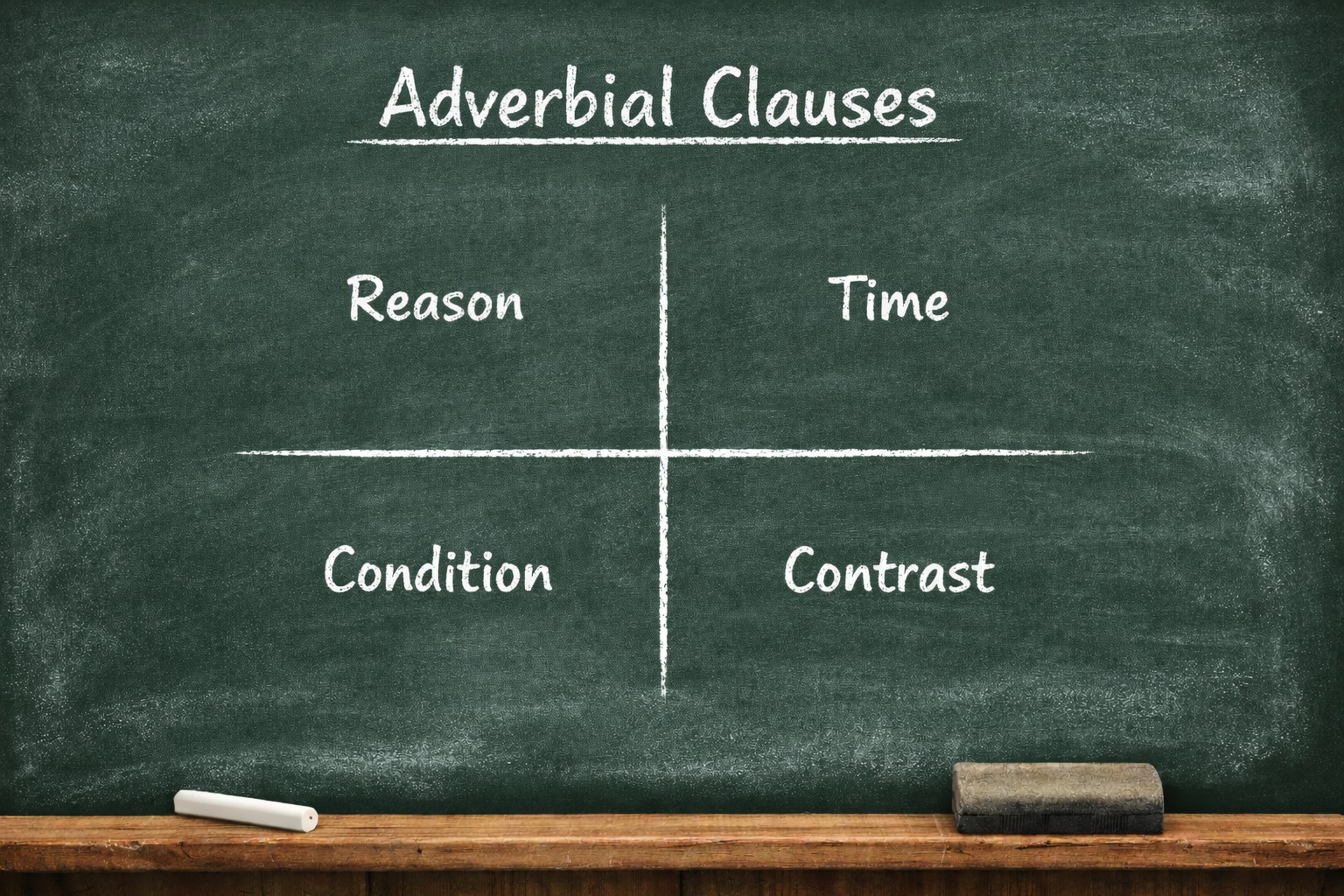
Adverbial clauses in English function as an adverb to modify verbs, adjectives, or other adverbs. They answer how? when? where? why? or under what conditions?
Related Guide:
Adverbial clauses and phrases function like adverbs. For a complete guide to how adverbs work in English, visit Adverbs in English: Practical Rules, Examples, and Practice .
An adverbial clause is a dependent clause that begins with a subordinating conjunction. Clauses have both a subject and a verb.
An adverbial phrase is a group of words that functions as an adverb but does not have a subject and a verb.
Quick Review:
Before you study adverbial clauses, make sure you understand the difference between independent and dependent clauses. Read this guide: Independent and Dependent Clauses in English .
1. Reason and Purpose Clauses and Phrases
We use these to explain reasons and purposes.
Reason Clauses and Phrases
The reason for an action is expressed in an adverbial clause (dependent clause) or an adverbial phrase. The main clause (independent clause) expresses the result.
- Many people move to Mexico because they want a lower cost of living.
- Since punk music challenged authority, it became popular among young people.
- Jaguars are endangered because of habitat loss in the Amazon.
Quick Review
- Which two sentences use an adverbial clause?
- Which one uses an adverbial phrase?
- What is the reason in each sentence?
- What is the result?
Answers
- Sentences 1 and 2
- Sentence 3
- because they want a lower cost of living / Since punk music challenged authority / because of habitat loss in the Amazon
- Many people move to Mexico / it became popular among young people / Jaguars are endangered
Structure
because + clause
since + clause
because of + noun phrase
Purpose Clauses and Phrases
The purpose of an action is expressed in an adverbial clause (dependent clause) or an adverbial phrase. The main clause (independent clause) expresses the action.
- The band signed to an independent label in order to keep creative control of their music.
- He moved to Buenos Aires so that he could become fluent in Spanish.
- She adopted a dog for companionship.
Quick Review
- Which two sentences use an adverbial clause?
- Which one uses an adverbial phrase?
- What is the purpose in each sentence?
- What is the action?
Answers
- Sentences 1 and 2
- Sentence 3
- in order to keep creative control of their music / so that she could become fluent in Spanish / for companionship
- The band signed to an independent label / He moved to Buenos Aires / She adopted adopted a dog
Structure
in order to + clause
so that + clause
for + noun phrase
‘In order to‘ can be shortened to just ‘to‘
- The band signed to an independent label to keep creative control if their music.
‘so that’ can be shortened to ‘so’
- He moved to Buenos Aires so he could become fluent in Spanish.
💡 Spanish Speaker Tip: Don’t Use “For + Verb”
In Spanish, it’s common to use “para + infinitivo”:
- Estudio inglés para mejorar mi carrera.
👉 In English, we do NOT use “for + verb” to express purpose.
❌ Incorrect:
- I study English for improve my career.
✔️ Correct:
- I study English to improve my career.
- I study English for better job opportunities.
🧠 Quick Rule:
• to + verb → purpose
• for + noun → purpose
Quick Challenge
Complete each sentence using for, because of, since, or in order to
- The students fell asleep in class ____ the boring lecture.
- Many people move to Mexico ____ the cost of living is lower.
- Many Venezuelans have left their country ____ escape the Chavistas.
- He wears a water proof jacket ____ protection from the rain.
- Alejandra goes to the gym ____ get in shape.
✔️ Answer Key + Explanations
-
The students fell asleep in class because of the boring lecture.
→ “the boring lecture” is a noun phrase, so we use because of. -
Many people move to Mexico since the cost of living is lower.
→ “the cost of living is lower” is a clause, so we use since. -
Many Venezuelans have left their country in order to escape the Chavistas.
→ “in order to + verb” expresses purpose. -
He wears a waterproof jacket for protection from the rain.
→ “protection” is a noun, so we use for + noun. -
Alejandra goes to the gym in order to get in shape.
→ “in order to + verb” expresses purpose.
🧠 Quick Summary:
• since + clause (reason)
• because of + noun phrase
• in order to + verb (purpose)
• for + noun (purpose/benefit)
2. Time Clauses and Phrases
These show when something happens or how two actions are related in time. They can describe:
- actions happening at the same time
- actions happening every time
- actions up to a specific point in time
- actions from the past until now
- continuous actions with another action
- actions over a duration (how long)
- actions within a specific time period
- When I lived in Mexico, I could speak Spanish fluently.
- Whenever lightning strikes outside, my dog hides under the bed.
- I worked in Querétaro until my work visa expired.
- I have been a fan of Black Flag since I was a teenager.
- While I was living in Mexico, the U.S. dollar was strong.
- I lived in Oaxaca for 3 months.
- During the summer in San Antonio, I try to stay inside as much as possible.
Quick Challenge
Match each of the previous sentences to the correct use below:
a. amount of time
b. a continuous action
c. a time period
d. same time
e. a time in the past to the present
f. every time
g. up to that time
✔️ Answer Key + Explanations
-
When I lived in Mexico, I could speak Spanish fluently. → d (same time)
→ Both actions happen at the same time. -
Whenever lightning strikes outside, my dog hides under the bed. → f (every time)
→ “whenever” shows a repeated action. -
I worked in Querétaro until my work visa expired. → g (up to a specific point in time)
→ “until” shows an action continuing up to a specific moment. -
I have been a fan of Black Flag since I was a teenager. → e (a time in the past to the present)
→ “since” connects the past to the present. -
While I was living in Mexico, the U.S. dollar was strong. → b (a continuous action)
→ “while” shows a longer action happening at the same time as another. -
I lived in Oaxaca for 3 months. → a (amount of time)
→ “for” shows duration (how long). -
During the summer in San Antonio, I try to stay inside as much as possible. → c (a time period)
→ “during” refers to a specific time period.
🧠 Quick Summary:
• when → same time
• whenever → every time
• until → up to a point in time
• since → past → present
• while → continuous action
• for → duration (how long)
• during → time period
💡 Comma Tip: Adverbial Clauses and Phrases
Use a comma when the adverbial clause or phrase comes first. Do not use a comma when it comes after the main clause.
Quick Rule:
• Adverbial clause or phrase first → use a comma
• Adverbial clause or phrase second → no comma
3. Using -ING After Time Words
When the subject is the same, we can shorten the clause:
Examples:
- After leaving the concert, we went to get something to eat.
- While walking through the jungle, they saw a jaguar in a tree.
If the subjects are different, we cannot shorten the clause.
Examples:
- After we left the concert, my friends went to get something to eat.
- While the tourists walked through the jungle, a jaguar ran across the path.
Related Topic:
Some time clauses describe actions that happen regularly or over time. To learn more about expressions like always, usually, often, and other time expressions, visit Adverbs of Frequency and Time Expressions .
4. Contrast Clauses
These show unexpected results or opposing ideas.
- Even though Bad Bunny is very popular, his critics don’t think he is very talented.
- In spite of the fact that the tickets cost $1,000 each, the concert sold out.
- In spite of the difficult material, the students passed the final exam!
- Although Fiesta is very crowded and expensive, people still attend the festivities.
Structure
even though + clause
in spite of the fact that + clause
in spite of + noun phrase
although / even though + clause → use for contrast The main clause can include ‘still’ for emphasis.
Quick Challenge
Complete each sentence using even though, in spite of, or still.
- ____ the fact that the restaurant was crowded, we decided to wait for a table.
- ____ the tickets were expensive, I paid for a direct flight to Buenos Aires.
- Although Spanish is very difficult to learn, I ____ attend classes.
- ____ the fact that I hate exercising, I continue to go to the gym.
- Even though pizza is unhealthy, I ____ eat it every Friday.
✔️ Answer Key + Explanations
-
In spite of the fact that the restaurant was crowded, we decided to wait for a table.
→ “the fact that + clause” allows in spite of to introduce a clause. -
Even though the tickets were expensive, I paid for a direct flight to Buenos Aires.
→ followed by a clause (subject + verb). -
Although Spanish is very difficult to learn, I still attend classes.
→ still emphasizes the surprising result. -
In spite of the fact that I hate exercising, I continue to go to the gym.
→ “the fact that + clause” allows in spite of to connect to a clause. -
Even though pizza is unhealthy, I still eat it every Friday.
→ still shows contrast with the first clause.
🧠 Quick Summary:
• even though → + clause
• in spite of → + noun OR “the fact that + clause”
• still → emphasizes contrast in the main clause
5. Condition Clauses
They show a condition → result relationship.
- The condition is expressed in the adverbial clause
- The result is expressed in the main clause
Condition clauses show how a condition affects (or does not affect) the result.
Structure
if + clause (the condition affects the result)
even if + clause (the result is the same regardless of the condition)
unless + clause (if not)
- If you practice English every day, you will become fluent.
- Even if I’m tired, I will go to the gym.
- Your dog won’t behave unless you train him.
Quick Challenge
Match the sentence halves that go together.
- If I meet my soulmate, . . .
- Unless you practice English outside of class, . . .
- If inflation continues to rise, . . .
- Even if the tickets are expensive, . . .
- If students write a positive evaluation, . . .
a. . . . you won’t become fluent.
b. . . . more people will struggle financially.
c. . . . I will still buy them.
d. . . . the teacher will give them a good grade. 😉
e. . . . I will get married.
Which sentence shows a result that does NOT change?
✔️ Answer Key + Explanations
-
If I meet my soulmate, e. I will get married.
→ The result happens if the condition becomes true. -
Unless you practice English outside of class, a. you won’t become fluent.
→ unless means if not. -
If inflation continues to rise, b. more people will struggle financially.
→ The condition leads to a likely result. -
Even if the tickets are expensive, c. I will buy them.
→ even if = the result does not change. -
If students write a positive evaluation, d. the teacher will give them a good grade.
→ 😄 Just a chiste!!
🧠 Reflection:
Which sentence shows a result that does NOT change?
→ Sentence 4 (even if)
🧠 Quick Summary:
• if → result depends on the condition
• unless → = if not
• even if → result does not change
💡 Tip: Using unless
Unless means ‘if not’ or ‘except if’. When you rewrite an ‘if’ sentence with ‘unless’, you may need to change the other clause to keep the same meaning.
Quick Rule:
Rewrite the sentence so the meaning stays the same.
‘Unless’ often changes a positive idea into a negative one.
⚠️ Important:
Do not just replace ‘if’ with ‘unless’. Check whether you also need to change the main clause.
Quick Challenge
Rewrite each sentence. Use an ‘unless’ clause instead of the ‘if’ clause.
- If I meet my soulmate, I will get married.
- If you practice English outside of class, you will become fluent.
- If inflation continues to rise, people will struggle financially.
- If the tickets are expensive, I won’t buy them.
- If students write a positive evaluation, they will get a good grade.
✔️ Answer Key + Explanations
-
Unless I meet my soulmate, I won’t get married.
→ The condition is reversed, and the result becomes negative. -
Unless you practice English outside of class, you won’t become fluent.
→ unless = if not, so the result changes to negative. -
Unless inflation stops rising, people won’t struggle financially.
→ The condition is changed to the opposite idea to keep the same meaning. -
Unless the tickets are cheap, I will buy them.
→ “expensive” is changed to the opposite idea, and the result is reversed. -
Unless students write a positive evaluation, they won’t get a good grade.
→ The result becomes negative to match the meaning of unless.
🧠 Quick Summary:
• unless = if not / except if
• You often need to change the result (positive → negative)
• Sometimes you must change the condition to the opposite idea
Conclusion
Adverbial clauses and phrases are essential for expressing relationships between ideas clearly and naturally. They allow you to explain reasons, purposes, time relationships, contrasts, and conditions—all of which are key to more advanced and fluent communication.
As you continue practicing, focus on both form and meaning:
- Identify whether you need a clause or a phrase
- Choose the correct structure (because, in order to, while, even though, if, etc.)
- Pay attention to how ideas are connected (cause → result, condition → result, contrast, time)
The more you notice these patterns and use them in real contexts, the more natural your English will become.
Remember! Learning a language is not about perfection—it’s about progress. Keep practicing, stay curious, and trust the process. You are moving beyond English to more opportunities, connections, and self-expression!