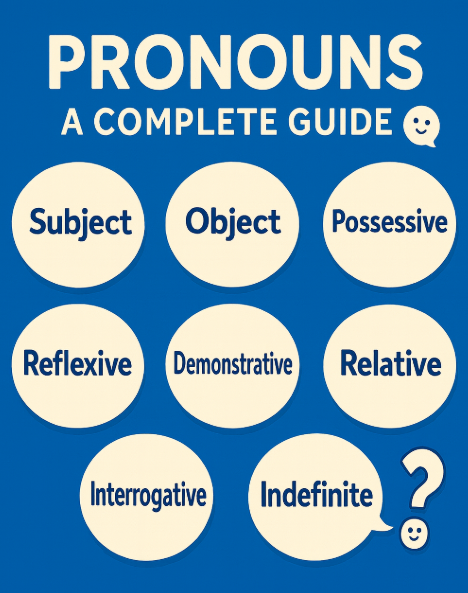
Learning English pronouns can feel confusing at first, but they are one of the most important parts of grammar. Pronouns are words that replace nouns. Instead of saying Maria is Karina’s friend, we can say She is her friend. This makes sentences easier to read and say. Today, we will review 8 different types of pronouns, so you can use them correctly and confidently in writing and speaking.
In this guide, we will look at all the main types of pronouns in English, with simple examples for ESL learners.
1. Subject Pronouns
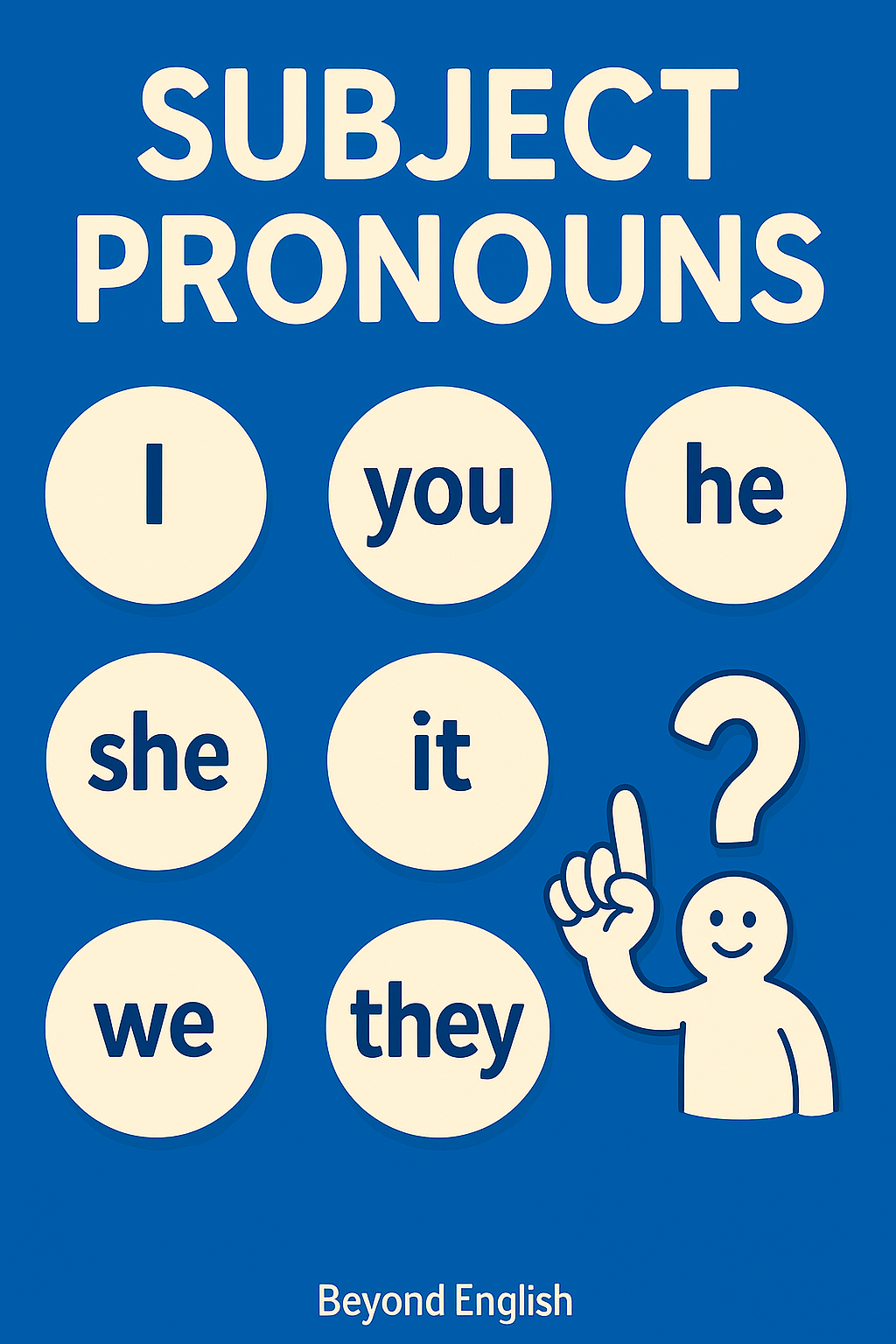
Subject pronouns replace the person or thing doing the action.
- I
- You (singular – for one person or plural for more than one person)
- He
- She
- It
- We (used when you are talking about another person and yourself)
- They
Examples
- I like pizza.
- You are my friend. (singular) You are my friends. (plural)
- John is in my grammar class. He is very smart.
- Regina is at the library. She is studying for an exam.
- My dog is a puppy. It is very playful.
- Alejandra and I are at the mall. We are shopping for clothes.
- John and Maria live in Guanajuato. They are professors at the university.
In Spanish, you can often drop the subject:
Hablo inglés.
In English, you must always include it:
I speak English.
View our complete guide on Subject Pronouns
2. Object Pronouns
Object pronouns replace the person or thing that receives the action. They answer the question “who?” or “what?” after the verb or a preposition.
Each Subject Pronoun has a matching Object Pronoun
I
you
he
she
it
we
they
me
you
him
her
it
us
them
How they work together
1. When the pronoun is doing the action, use a subject pronoun.
I eat chocolate.
She is studying English.
We are driving to Austin to watch the game.
2. When the pronoun is receiving the action, use the object pronoun.
The teacher likes me. (Likes who? Like me)
Everyone is helping her. (Helping who? Helping her)
My dogs love it. (Love what? Love it)
⚖️ Common Mistakes ESL Students Make
❌ Us are going to the store.
✅ We are going to the store. (subject pronoun, not object, is needed here)
❌ Me am a student.
✅ I am a student. (subject pronoun, not object, is needed here)
❌ She loves I.
✅ She loves me. (object pronoun needed after the verb)
👉 Quick Tip
If the pronoun is at the beginning of the sentence, it’s usually a subject pronoun.
If the pronoun comes after a verb or preposition, it’s usually an object pronoun.
Spanish often uses object pronouns differently, especially with word order:
Me dio el libro.
In English, the object usually comes after the verb:
He gave me the book.
⚠️ Avoid direct translation:
❌ Gave me the book.
❌ He gave the book me.
✅ He gave me the book.
Let’s Practice!
Fill in the blanks with the correct Subject or Object Pronoun
- This is my friend Carlos. ___ is from Mexico.
- Where is Maria? I want to talk to ___ .
- My brother and I are hungry. Please give ___ some food.
- ___ am very tired today.
- David is funny. I like ___ a lot.
- Mr. Smith is our teacher. ___ teaches English.
- The student is Anna. Do you know ___ ?
- Peter and I are good students. ___ study every day.
- Excuse me, can you help ___ ? (speaker asking for help)
- My parents are kind. Everyone likes ___ .
- This is my dog. ___ is very cute.
- I don’t understand this problem. Can you explain it to ___ ?
3. Possessive Pronouns
Possessive pronouns show ownership and replace a noun.
They can be the subject or the object.
Subject Pronouns
I
you
he
she
it
we
they
Object Pronouns
me
you
him
her
it
us
them
Possessive Pronouns
mine
yours
his
hers
its
ours
theirs
Examples
- I have a book. It is mine. (‘mine’ replaces the noun ‘book’ – the object)
- This is my pen. Is this yours? (‘yours’ replaces the noun ‘pen’)
- Maria’s phone is on the desk. Where is hers? (‘hers’ replaces the noun ‘phone’ – the subject)
- ‘Its’ as a possessive pronoun is rarely used, so we won’t discuss it here.
- Karina and Diego’s car is fast. Ours is slow. (‘ours’ replaces the noun ‘car’ – the subject)
- We have a small home. Theirs is big. (‘their’ replaces the noun ‘home’ – the object)
Possessive pronouns never come before a noun.
❌ Mine book
✅ This book is mine.
Spanish uses su for many meanings:
su libro = his / her / their book
English is more specific:
- his = for a man
- her = for a woman
- their = for plural or unknown gender
4. Reflexive Pronouns
Reflexive pronouns refer back to the subject.
Subject Pronouns
I
you
he
she
it
we
they
Object Pronouns
me
you
him
her
it
us
them
Possessive Pronouns
mine
yours
his
hers
its
ours
theirs
Reflexive Pronouns
myself
yourself
himself
herself
itself
ourselves
themselves
Examples
- I made the cake myself.
- Can you drive yourself to class?
- He started the business himself.
- Regina wrote the essay herself. She didn’t use ChatGPT.
- My cat cleans itself.
- Diego and I created the ad campaign ourselves.
- They painted the house themselves.
⚖️ Common Reflexive Pronoun Errors
Using a reflexive pronoun instead of a subject pronoun
❌ Myself went to the store.
✅ I went to the store.
Using a reflexive pronoun instead of an object pronoun
❌ She told myself the answer.
✅ She told me the answer.
Forgetting to use a reflexive pronoun when the subject and object are the same
❌ He looked at him in the mirror.
✅ He looked at himself in the mirror.
Overusing reflexive pronouns for emphasis
❌ Myself will finish the project.
✅ I will finish the project myself. (Reflexive pronouns can be used for emphasis, but they don’t replace the subject.)
Confusing singular and plural forms
❌ We did it by myself.
✅ We did it by ourselves.
❌ They introduced hisself.
✅ They introduced themselves.
Using reflexive pronouns where no object is needed
❌ She sat herself on the chair.
✅ She sat on the chair.
Using the wrong reflexive form
❌ He hurt hisself while playing.
✅ He hurt himself while playing.
❌ You should be proud of meself.
✅ You should be proud of yourself.
Forgetting that itself can’t describe people
❌ The baby can feed itself. (⚠️ This is okay only if we don’t want to specify gender, but usually…)
✅ The baby can feed himself / herself.
👉 Quick Tip
Use a reflexive pronoun only when the subject and the object are the same (I taught myself Spanish). Otherwise, use a subject or object pronoun.
Spanish uses reflexive verbs very frequently:
me levanto, se bañó, nos vemos
In English, reflexive pronouns are used much less often.
⚠️ Do NOT translate directly:
❌ I wake up myself.
✅ I wake up.
Use reflexive pronouns only when the action clearly returns to the subject:
I hurt myself.
Let’s Practice!
Fill in the blanks with the correct possessive or reflexive pronoun
- This book belongs to me. It is ___ .
- She fixed the computer by ___ .
- These bags belong to Carlos and Maria. They are ___ .
- Don’t worry, I can do it by ___ .
- That phone isn’t mine. Is it ___ ?
- We built this house all by ___ .
- He looked at ___ in the mirror before the interview.
- The cat cleaned ___ with its tongue.
- This pen is hers, not ___ .
- Did you two enjoy ___ at the party?
- The children hurt ___ while playing outside.
- That’s my seat. It’s not ___ .
5. Demonstrative Pronouns – This, That, These, and Those
This, that, these, and those are used to describe the existence of something or someone, often with a location.
Affirmative Statements with This or That
Remember!! Singular = 1
This/That + the Be verb is (or a singular noun) + other information
Use this to talk about something or someone that is next to or near you.
Examples
This is my yoga mat.
This is her newspaper.
This song is my favorite.
Use that to talk about something or someone that is not next to you.
Examples
That is an umbrella.
That is an airport.
That tent is Reginas.
Affirmative Statements with These or Those
Remember!! Plural = 2 or more
These/Those + the Be verb are (or a plural noun) + other information.
Use these to talk about more than one thing or person that is next to or near you.
Examples
These are my clothes.
These are her headphones.
These recipes are from my grandmother.
Use those to talk about more than one thing or person that is not next to you.
Examples
Those are clean clothes.
Those trails are difficult.
Those spoons are dirty.
Negative Statements with demonstrative pronouns
The negative (not) goes after the Be verb.
Examples
This is not my passport.
That is not her newspaper.
These are not his paintings.
Those magazines are not theirs.
Yes/No Questions and Short Answers with demonstrative pronouns
A Be verb + (a demonstrative pronoun) + a noun + other information.
Examples
Is this yoga mat expensive? Yes, it is. / No, its’ not. / No, it isn’t.
Is that song your favorite? Yes, it is. / No, it’s not. / No, it isn’t.
Are these books hers? Yes, they are. / No, they’re not. / No, they aren’t.
Are those songs on Spotify? Yes, they are. / No, they’re not. / No, they aren’t.
Remember!!
Affirmative answers are not contracted
❌ Yes, she’s.
✅ Yes, she is.
Spanish has three levels of distance:
este (near), ese (medium), aquel (far)
English only has two:
this / these (near)
that / those (far)
👉 There is no direct equivalent for aquel in English, so both ese and aquel often translate as that or those.
Let’s Practice!
Fill in the blanks with the correct demonstrative pronoun
- ___ is my favorite movie. (pointing to a DVD in your hand)
- ___ are my best friends. (showing a photo of friends)
- ___ is a beautiful day! (talking about today’s weather)
- ___ tastes delicious. (eating a piece of cake)
- ___ is my brother over there. (pointing across the street)
- ___ is very expensive. (looking at a car nearby)
- ___ are my shoes by the door.
- Who is ___ standing next to Maria? (pointing to one person)
- ___ is my teacher’s desk. (close to you)
- ___ were the best days of my life. (talking about years ago)
- ___ is my favorite pen. (holding one pen in your hand)
- ___ are the mountains we visited last summer. (showing photos)
6. Relative Pronouns
Relative pronouns connect a main clause with a relative clause (a dependent clause that describes a noun). They act as the subject or object inside the relative clause.
a. Who
- Refers to people (as the subject of the relative clause).
- Example: The teacher who helped me is very kind.
→ “who helped me” describes the teacher.
b. Whom
- Refers to people (as the object of the relative clause).
- Example: The student whom I tutored passed the test.
→ “whom I tutored” describes the student.
(In modern English, people often use “who” instead of “whom.”)
c. Whose
- Shows possession (for people, animals, or things).
- Example: I know a girl whose brother is famous.
→ “whose brother is famous” describes a girl.
d. Which
- Refers to things or animals.
- Example: The book which is on the table is mine.
→ “which is on the table” describes the book.
e. That
- Refers to people, animals, or things.
- Example: This is the car that I bought.
→ “that I bought” describes the car.
(“That” is often used in defining clauses instead of who/which.)
Spanish often uses que for people, things, and ideas:
La persona que trabaja aquí…
In English, you must choose the correct relative pronoun:
- who → for people
- which → for things
- that → for people or things (less formal)
❌ The person which works here is friendly.
✅ The person who works here is friendly.
Types of Relative Clauses
Relative pronouns introduce two main kinds of clauses:
1. Defining (restrictive) relative clauses
- Essential information. No commas.
- The man who lives next door is a doctor.
(We need this information to know which man.)
2. Non-defining (non-restrictive) relative clauses
- Extra information. Use commas.
- My uncle, who lives in Canada, is visiting us.
(The relative clause just adds extra detail.)
👉 Quick Tip
- Use who for people (subject).
- Use whom for people (object – but less common in everyday speech).
- Use whose for possession.
- Use which for things/animals.
- Use that for essential information (people, things, or animals).
7. Interrogative Pronouns
Interrogative pronouns are used to ask questions. They stand in place of the noun you’re asking about.
The Main Interrogative Pronouns
a. Who
- Refers to a person (subject of the question).
- Example: Who is calling? (= Which person is calling?)
b. Whom
- Refers to a person (object of the question).
- Example: Whom did you meet at the party?
- Note: In modern English, most people just say “Who did you meet?”
c. Whose
- Asks about possession (person/thing).
- Example: Whose book is this?
d. Which
- Asks about a specific choice from a limited set.
- Example: Which shirt do you like better—blue or red?
e. What
- Asks about things or information (not limited choice).
- Example: What is your favorite food?
Spanish questions do not use an auxiliary verb like do/does/did:
¿Qué quieres?
In English, you must add an auxiliary verb and change the order:
❌ What you want?
✅ What do you want?
👉 English structure:
Question word + auxiliary + subject + verb
(What + do + you + want)
⚖️ Key Notes for Learners
Who vs. Whom
→ Who = subject (Who called you?)
→ Whom = object (Whom did you call?)
(In daily speech, “whom” is rare.)
Which vs. What
→ Which = limited options (Which bus goes downtown—7 or 9?)
→ What = open possibilities (What bus should I take?)
Whose
→ Shows possession (Whose phone is ringing?)