
White text-logo on blue background.

Category: English Grammar

  • Master Relative Clauses in English: Practical Rules, Examples, and Practice

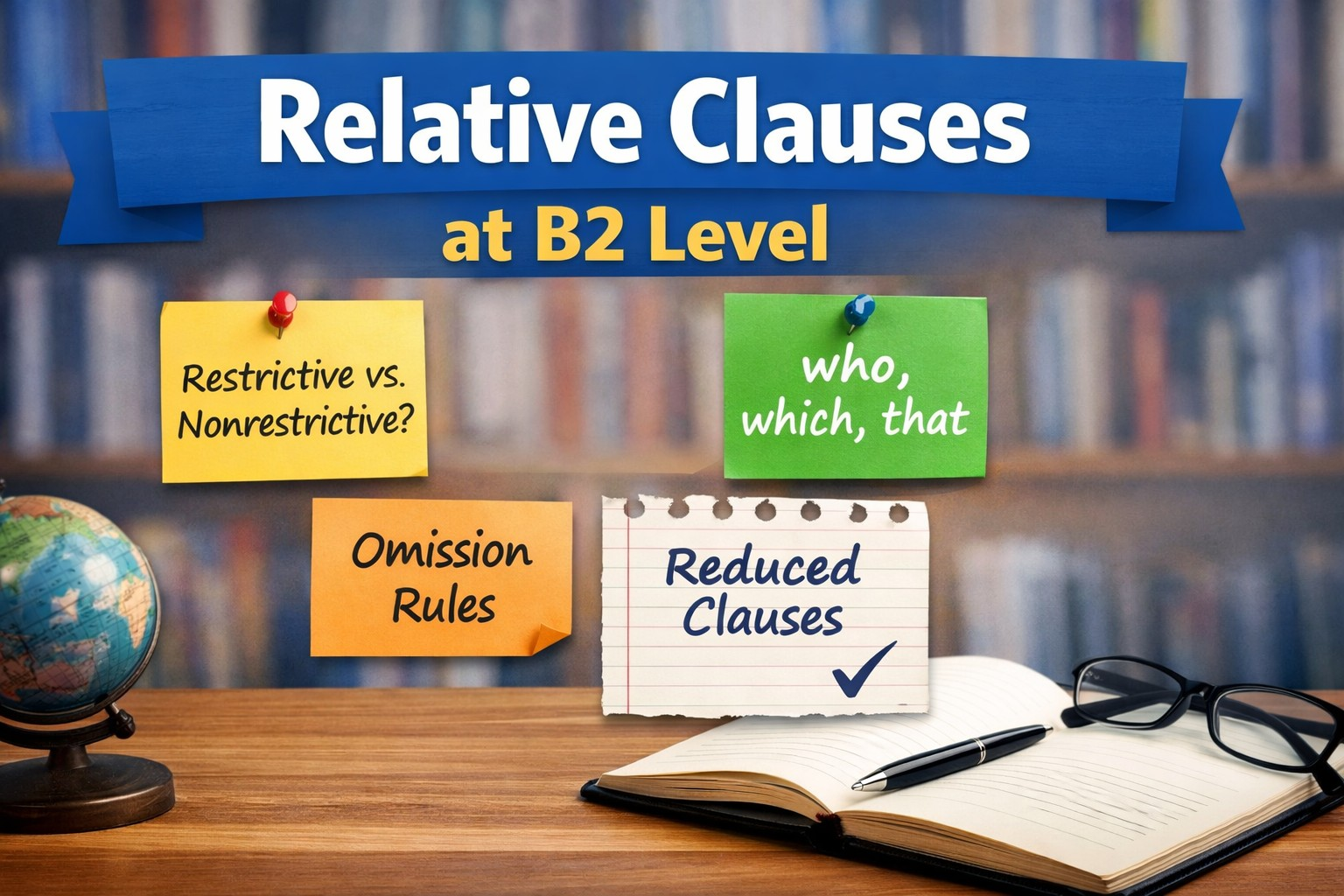
    Master Relative Clauses in English: Practical Rules, Examples, and Practice

    1️⃣ What Is a Relative Clause?

    Mastering relative clauses in English is an important skill. A relative clause (also called an adjective clause) is a dependent clause that describes or gives more information about a noun.

    It usually begins with a relative pronoun such as:

    • who
    • which
    • that
    • whose
    • where

    A relative clause answers the question:

    Which one? What kind? Whose?

    Example:

    The student who won the scholarship studied every day.

    • Main noun: student
    • Relative clause: who won the scholarship
    • Function: identifies which student

    The clause cannot stand alone. It depends on the noun it modifies.

    🔁 Need a Review?

    Relative clauses are a type of dependent clause. If you want to strengthen your understanding of how clauses work in English, review this guide first:

    Independent and Dependent Clauses in English: How to Write Clear Sentences

    2️⃣ Restrictive vs. Nonrestrictive Clauses

    FeatureRestrictive ClauseNonrestrictive Clause
    PurposeIdentifies which nounAdds extra information
    MeaningEssentialAdditional
    CommasNo commasCommas required
    Information HierarchyHigh importanceSecondary importance
    Pronoun Usethat / who / whichwho / which (not that)

    🔹 Restrictive = Necessary Information

    Without the clause, the meaning changes or becomes unclear.

    Example:

    The employees who work remotely need secure access.

    • Main noun: employees
    • Relative clause: who work remotely
    • Function: identifies which employees – only remote employees

    🔹 Nonrestrictive = Extra Information

    The noun is already clear. The clause just adds detail.

    Example:

    The employees, who work remotely, need secure access.

    • Main noun: employees
    • Relative clause: who work remotely
    • Function: identifies which employees – all employees

    Information Hierarchy

    Think of it as:

    Restrictive → limits or defines the noun
    Nonrestrictive → adds optional, non-essential (extra) information

    How Meaning Changes

    Pair 1: People

    A. The teachers who arrived late apologized.
    → Only the late teachers apologized.

    B. The teachers, who arrived late, apologized.
    → All the teachers arrived late.

    Pair 2: Objects

    A. The books that are on the table are mine.
    → Only the books on the table.

    B. The books, which are on the table, are mine.
    → All the books are on the table.

    3️⃣ Relative Pronouns (who, which, that, whose, where)

    Relative pronouns introduce a relative clause and connect it to the noun it describes.

    They do two jobs:

    1. They refer back to the noun (the antecedent).
    2. They act as part of the clause (subject, object, or possessive).
    PronounRefers toSubject exampleObject exampleNotes
    whoPeopleThe manager who leads the team is experienced.The candidate (who) we interviewed was confident.Object who is often omitted in speech. Whom is formal.
    whichThingsThe report which explains the results is attached.The report (which) I reviewed was detailed.After commas, use which (not that).
    thatPeople / ThingsThe student that won the prize is here.The book (that) I bought is excellent.Restrictive only. Never after a comma.
    whosePeople / ThingsThe women whose husbands are wealthy went on a shopping spree.Shows possession/relationship. Can refer to things in formal English.
    wherePlacesThe restaurant where we met has closed.More formal: in which we met.

    Quick Selection Rule

    • Personwho
    • Thingwhich
    • Restrictive (informal)that
    • Possessionwhose
    • Placewhere
    🔎 Grammar Support:

    Understanding subject and object roles is essential for using relative clauses correctly — especially when deciding if you can omit the relative pronoun.

    Review here:
    Mastering Direct and Indirect Objects in English

    4️⃣ Omitting the Relative Pronoun

    You can omit the relative pronoun only when it functions as the object of the relative clause. If the pronoun is the subject of the clause, you cannot omit it.

    When You CAN Omit It (Object)

    Full: The book that I bought is excellent.

    Omitted: The book I bought is excellent.

    In the clause (that) I bought, the subject is I. The relative pronoun is the object of bought, so it can be removed.

    Full: The person who we met was helpful.

    Omitted: The person we met was helpful.

    When You CANNOT Omit It (Subject)

    Full: The student who won the prize is here.

    Incorrect: ❌ The student won the prize is here.

    In who won the prize, who is the subject of won. If you remove it, the clause has no subject.

    Quick Test

    • If the clause already has a subject (e.g., I / we / they), you can often omit the pronoun: the book (that) I bought.
    • If the relative pronoun is followed directly by a verb, do not omit it: the student who won.

    5️⃣ Advanced Forms: Reduced Relative Clauses

    A reduced relative clause is a shortened form of a relative clause.

    We can reduce a relative clause when:

    • The relative pronoun is the subject of the clause.
    • The verb allows structural simplification.
    • The meaning remains clear after reduction.

    Reduced clauses are common in formal, academic, and professional writing because they make sentences more concise.

    ✅ When Reduction Is Possible

    There are two advanced forms:

    1️⃣ Passive Form → Past Participle

    If the relative clause contains be + past participle, remove:

    • the relative pronoun
    • the form of be

    Structure:

    Full:

    Noun + that/which + be + past participle

    Reduced:

    Noun + past participle


    Full:
    The documents that were submitted yesterday are missing.

    Reduced:
    The documents submitted yesterday are missing.


    Full:
    The products which are manufactured in Germany are expensive.

    Reduced:
    The products manufactured in Germany are expensive.


    Full:
    The proposal that was approved by the board will be implemented.

    Reduced:
    The proposal approved by the board will be implemented.


    2️⃣ Active Form with -ing (Present Participle)

    If the relative clause contains who/that + be + verb-ing, remove the relative pronoun and be.

    Structure:

    Full:

    Noun + who/that + be + verb-ing

    Reduced:

    Noun + verb-ing


    Full:
    The students who are preparing for the exam look stressed.

    Reduced:
    The students preparing for the exam look stressed.


    Full:
    The company that is expanding rapidly needs more staff.

    Reduced:
    The company expanding rapidly needs more staff.


    Full:
    The man who was standing near the door left early.

    Reduced:
    The man standing near the door left early.

    ❌ When Reduction Is NOT Possible

    There are two advanced cases where reduction is not possible:

    1️⃣ Active Finite Clause Without “Be”

    If the clause contains a normal active verb (no form of be), do not reduce it.

    Full:
    The employee who works in accounting received a promotion.

    Incorrect:
    ❌ The employee works in accounting received a promotion.

    The verb works is a finite verb, and who is the subject. Removing it creates a grammatical error.

    2️⃣ When Meaning Becomes Ambiguous

    Some reductions are grammatically possible but may change emphasis or clarity.

    Full:
    The professor who lives next door is retiring.

    Reduced:
    The professor living next door is retiring.

    This is grammatically correct, but depending on context, it may suggest temporary description rather than clear identification.

    ⚠️ Common Mistakes with Relative Clauses

    1️⃣ Missing commas in nonrestrictive clauses

    ❌ My brother who lives in Dallas is visiting.

    ✅ My brother, who lives in Dallas, is visiting.

    (Use commas when the information is extra, not essential.)

    2️⃣ Using “that” after a comma

    ❌ The report, that explains the results, is attached.

    ✅ The report, which explains the results, is attached.

    (“That” is only used in restrictive clauses.)

    3️⃣ Omitting the relative pronoun incorrectly

    ❌ The student won the prize is here.

    ✅ The student who won the prize is here.

    (Do not omit the pronoun when it is the subject of the clause.)

    4️⃣ Confusing “who’s” and “whose”

    ❌ The company who’s products are popular is expanding.

    ✅ The company whose products are popular is expanding.

    (Who’s = who is. Whose = possession.)

    5️⃣ Reducing clauses incorrectly

    ❌ The employee works in marketing received a bonus.

    ✅ The employee who works in marketing received a bonus.

    (Only reduce when the structure allows it.)

    🌎 Spanish Speaker Notes

    If Spanish is your first language, pay attention to these differences:

    1️⃣ “Que” vs. “Who”
    Spanish uses que for people and things.
    In English, use who for people.

    ❌ The student that won the prize…
    ✅ The student who won the prize…

    2️⃣ Commas Change Meaning
    English is strict about restrictive vs. nonrestrictive clauses.
    Commas are not optional — they change the meaning of the sentence.

    3️⃣ Don’t Avoid “Whose”
    Spanish often uses que + su instead of cuyo.
    In English, whose is natural — even for things.
    ✅ The company whose products are popular…

    4️⃣ Omission Works Differently
    In English, you can sometimes omit the relative pronoun:
    ✅ The book (that) I bought
    This does not work the same way in Spanish.

    Let’s Practice Relative Clauses

    Exercise A

    Complete the paragraph using a relative pronoun from the word bank.

    You may use some pronouns more than once.

    Word Bank

    who which that whose where

    Paragraph

    Last year, I joined a company (1) ______ develops renewable energy solutions. The CEO, (2) ______ founded the organization in 2008, believes strongly in innovation. The company works with engineers (3) ______ specialize in sustainable design and researchers (4) ______ ideas are changing the industry.

    We recently completed a project (5) ______ was funded by a European agency. The building (6) ______ we constructed uses solar panels and recycled materials. The architect (7) ______ we hired had previously designed offices (8) ______ focus on energy efficiency.

    One of the challenges (9) ______ we faced involved reducing costs without lowering quality. The strategy (10) ______ we implemented proved successful.

    Exercise B

    Part 1 – Omit the Relative Pronoun (If Possible)

    1. The movie that we watched was fascinating.
    2. The woman who called earlier left a message.
    3. The article that I read was controversial.
    4. The student who won the prize is here.
    5. The candidate who we interviewed was confident.

    Part 2 – Reduce the Relative Clause (If Possible)

    1. The documents that were signed yesterday are missing.
    2. The students who are studying abroad often face challenges.
    3. The employee who works in marketing received a bonus.
    4. The products which are produced locally are cheaper.
    5. The man who was sitting near the window left early.

    Scoring & Feedback

    🔵 17 – 20 Correct

    Excellent work! 🎉 You really understand how to use adjective clauses. Keep using it in your everyday conversations and writing.

    🟢14 – 16 Correct

    Great job! ✅ You have a good understanding of adjective clauses. Review the ones you missed.

    🟡12 – 13 Correct

    Good effort! 💪You’re learning, and that’s what matters. Take a moment to review the examples and do the quiz again.

    🔴 0 – 11 Correct

    No worries! 🌱 Adjective clauses can be tricky at first. Go back and review the examples in the lesson.

    Relative clauses are a powerful tool for writing clearer, more sophisticated sentences. By understanding how restrictive and nonrestrictive clauses work, when pronouns can be omitted, and how advanced reductions function, you move from intermediate grammar to confident B2-level communication. If you’d like guided practice using these structures in real conversation and writing tasks, explore our English lessons for personalized support.

    💡Need personalized help using these grammar structures? Explore my ESL lessons and services for individual and group support.

    Remember! Learning a language is not about perfection—it’s about progress. Keep practicing, stay curious, and trust the process. You are moving beyond English to more opportunities, connections, and self-expression!
  • Master the Past Continuous Tense: Practical Rules, Examples, and Practice

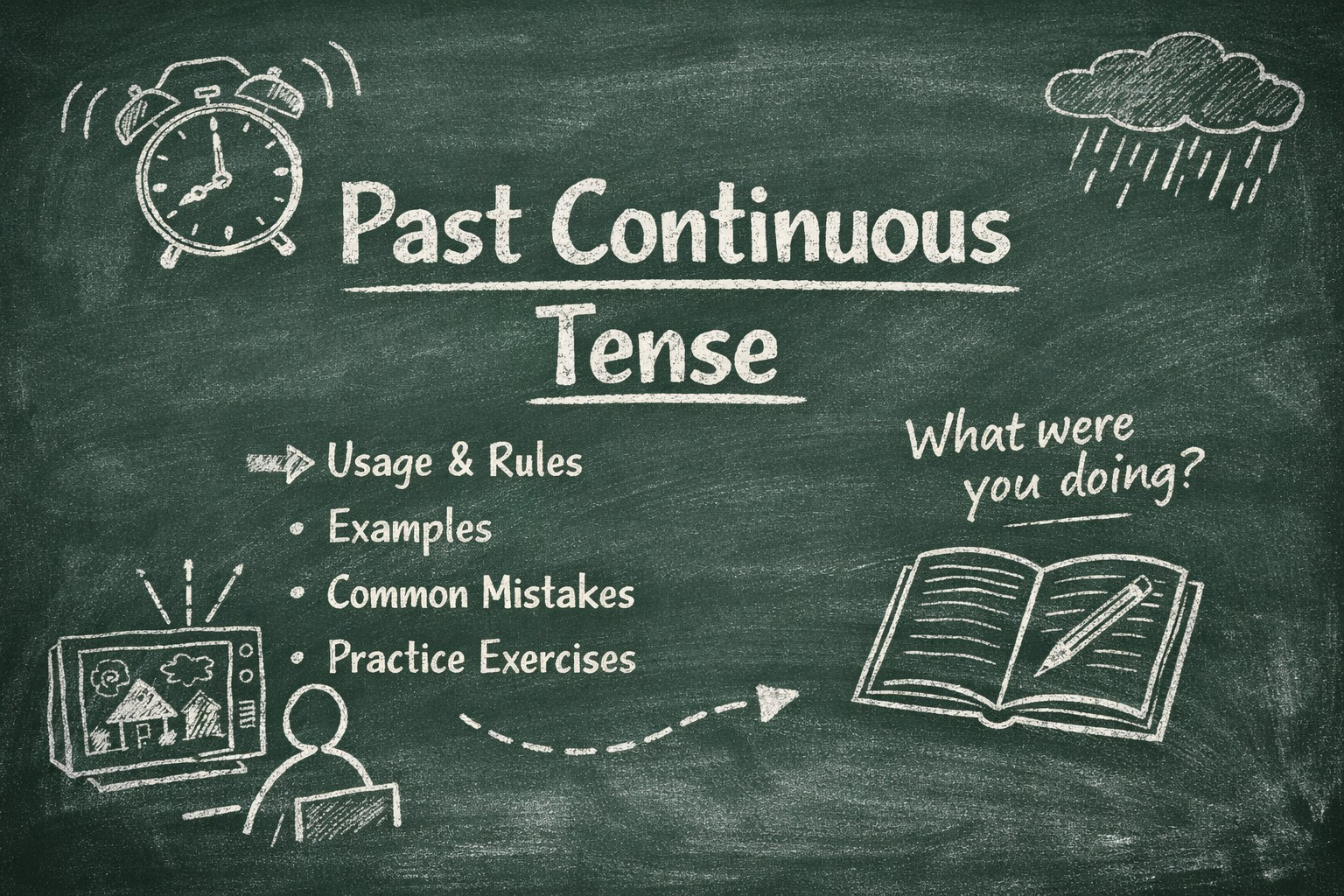
    Master the Past Continuous Tense: Practical Rules, Examples, and Practice

    The past continuous tense (also called the past progressive) describes actions that were in progress at a specific time in the past.

    It is commonly used to:

    • Describe background actions in stories
    • Show an action interrupted by another action
    • Emphasize duration in the past
    • Describe two simultaneous actions

    This guide explains the form, uses, examples, signal words, and common mistakes.

    🔁 Quick Review: If you need to review how Be verbs work in the present tense, start here before continuing: How to Use Be Verbs in the Present Tense

    1️⃣ Structure of the Past Continuous

    Affirmative Statements in the Past Continuous

    Structure:

    Subject + was/were + verb (-ing)

    Subject Be Verb Main Verb (-ing)
    I was working
    You were studying
    He / She / It was sleeping
    Singular Subjects (e.g., the teacher, my friend) was working / studying / sleeping
    We were talking
    They were playing
    Plural Subjects (e.g., the students, my parents) were talking / playing / working

    Negative Statements in the Past Continuous

    Structure:

    Subject + was/were + not + verb (-ing)

    Examples:

    • I was not (wasn’t) sleeping.
    • They were not (weren’t) listening.
    • He wasn’t working yesterday afternoon.

    Questions in the Past Continuous

    To form questions in the past continuous, we change the position of the verb was/were and the subject.

    Yes / No Questions in the Past Continuous

    Structure:

    Was / Were + subject + verb (-ing)?

    Examples:

    • Was she studying at the library last night?
    • Were they working last weekend?
    • Was it raining yesterday?
    • Were you listening to music during class?

    Short Answers:

    • Yes, she was.
    • No, they weren’t.
    • Yes, it was.
    • No, I wasn’t.

    Wh- Questions in the Past Continuous

    When we need more information, we add a Wh- word before was/were.

    Structure:

    Wh-word + was / were + subject + verb (-ing)?

    Examples:

    • What were you doing at 8 PM?
    • Where was she going after class?
    • Why were they laughing?
    • Who was talking during the exam?
    🔎 Important Grammar Notes

    If the question word is the subject, we do NOT change the order:

    Why were they laughing? (Normal change)

    Subject question (no change needed):
    Who was calling? She was calling. (The subject in the answer is the ‘who?’)
    Who was driving? Diego was driving. (The subject in the answer is the ‘who?’)
    What was making that noise? The cat was making that noise. (The subject in the answer is the ‘what?’)

    There is no extra subject after the question word.

    Incorrect:
    ❌ Who was he calling? (This changes the meaning — now “he” is the subject.)

    Correct subject question:
    ✅ Who was calling?

    2️⃣ When Do We Use the Past Continuous?

    We can use the past continuous in the following situations:

    A. Action in Progress at a Specific Time

    We use the past continuous to show an action happening at a particular moment in the past.

    Examples:

    • At 9 PM, I was studying.
    • This time last year, we were living in Mexico.
    • Yesterday at 5 o’clock, she was driving home.

    👉 The action was not finished at that moment.

    🔁 Quick Review: The past continuous is often used together with the simple past tense, especially for interrupted actions.

    I was studying when he called.

    ✅ Review the full guide here:
    The Simple Past Tense in English: Rules, Examples & Practice

    B. Interrupted Action (Past Continuous + Simple Past)

    We use:

    • Past continuous for the longer background action
    • Simple past for the shorter interrupting action

    Structure:

    While + past continuous, simple past

    Past continuous + when + simple past

    Examples:

    • While I was traveling in Colombia, my sister graduated high school.
    • While she was studying, her friend called.
    • I was cooking when the phone rang.
    • They were walking when it started to rain.

    C. Two Actions Happening at the Same Time

    We use the past continuous to describe simultaneous actions.

    Examples:

    • I was watching TV while my brother was playing video games.
    • She was listening to music while she was cleaning.

    D. Background Description in Stories

    The past continuous sets the scene in storytelling.

    Example:

    • It was raining, the wind was blowing, and people were running inside.

    Then we often switch to simple past for the main action:

    • Suddenly, a tree fell.

    E. Temporary Situations in the Past

    A temporary situation in the past describes a condition or activity that was true for a limited period of time and was not permanent.

    Examples:

    • I was living with my parents at that time.
    • She was working at a café during college.
    • I was studying at the Tec in Querétaro.
    💡If you need a refresher on other grammar topics, check out our Blog for more lessons.

    3️⃣ Stative Verbs and the Past Continuous

    Not all verbs can be used in the continuous form.

    Some verbs describe states, not actions. These are called stative verbs (or non-action verbs).

    Stative verbs describe:

    • Thoughts
    • Feelings
    • Possession
    • Senses
    • Opinions

    Because they describe a condition — not an activity in progress — they usually do NOT use -ing forms, even in the past.

    Category Common Stative Verbs
    Mental States know, believe, understand, remember, forget
    Emotions like, love, hate, want, prefer
    Possession have (possession), own, belong
    Senses / Perception see, hear, smell, taste

    4️⃣ Important Exceptions: Some Verbs Change Meaning

    Some verbs can be stative OR dynamic depending on meaning.

    A. Have

    Possession (stative)

    ✅ I had a car. ❌ NOT “I was having a car.”

    Activity (dynamic)

    ✅ I was having dinner.

    B. Think

    Opinion (stative)

    • I thought it was good.

    Mental activity (dynamic)

    • I was thinking about you.

    C. See

    Perception (stative)

    • I saw him yesterday.

    Meeting (dynamic)

    • I was seeing a doctor at that time.

    Quick Rule for Students

    Ask:

    Is this an action I can physically see happening?

    If yes → Past continuous may be correct.
    If no (it’s a state, feeling, belief, or possession) → Use simple past.

    Past Continuous Error Hub
    Common mistakes students make with structure and usage

    1️⃣ Structure Errors

    ❌ She studying when I arrived.
    ✅ She was studying when I arrived.
    (Don’t forget was/were.)

    ❌ They was working.
    ✅ They were working.
    (Use were with you/we/they.)

    ❌ I was study last night.
    ✅ I was studying last night.
    (The main verb must be in the -ing form.)

    2️⃣ Action in Progress at a Specific Time

    ❌ At 8 PM, I watched TV.
    ✅ At 8 PM, I was watching TV.
    (Use past continuous for actions in progress at a specific moment.)

    ❌ This time yesterday, she worked.
    ✅ This time yesterday, she was working.

    3️⃣ Interrupted Actions

    ❌ I was cooking when the phone was ringing.
    ✅ I was cooking when the phone rang.
    (The shorter interrupting action uses simple past.)

    ❌ While I studied, he called.
    ✅ While I was studying, he called.
    (The longer background action uses past continuous.)

    4️⃣ Two Actions at the Same Time

    ❌ I was watching TV while my brother played video games.
    ✅ I was watching TV while my brother was playing video games.
    (Use past continuous for both simultaneous actions.)

    5️⃣ Background in Stories

    ❌ It rained and people ran inside.
    ✅ It was raining, and people were running inside.
    (Use past continuous to describe the scene.)

    ❌ Suddenly, a tree was falling.
    ✅ Suddenly, a tree fell.
    (Main events usually use simple past.)

    6️⃣ Temporary Situations

    ❌ In 2020, I lived in Texas (temporary situation).
    ✅ In 2020, I was living in Texas.
    (Use past continuous to emphasize temporary background situations.)

    ❌ I was living there for five years (completed period).
    ✅ I lived there for five years.
    (Use simple past for finished time periods.)

    7️⃣ Stative Verbs (Do NOT Use -ing)

    ❌ I was knowing the answer.
    ✅ I knew the answer.

    ❌ She was wanting coffee.
    ✅ She wanted coffee.

    ❌ They were having a new car.
    ✅ They had a new car.
    (Stative verbs like know, want, and have for possession do not use the continuous form.)

    5️⃣ Common Mistakes for Spanish Speakers

    Transfer errors from Spanish to English

    ❌ When I arrived, she cooked.
    ✅ When I arrived, she was cooking.
    (Spanish imperfect = English past continuous for background actions.)

    ❌ At that moment, I studied.
    ✅ At that moment, I was studying.
    (“En ese momento” usually requires past continuous in English.)

    ❌ I was knowing the answer.
    ✅ I knew the answer.
    (Spanish imperfect allows sabía, but English does not use -ing with stative verbs.)

    ❌ I studied during three hours.
    ✅ I studied for three hours.
    (“Durante” ≠ “during” + time period. Use for + duration.)

    ❌ I was living in Texas for five years (completed period).
    ✅ I lived in Guadalajara for five years.
    (Use simple past for finished time periods.)

    Let’s Practice the Past Continuous

    Exercise A

    Choose the correct answer.

    1. At 8 PM last night, I ______ dinner.
      1. ate
      2. am eating
      3. have eaten
      4. was eating
    2. She ______ when the phone rang.
      1. slept
      2. is sleeping
      3. was sleeping
      4. sleeps
    3. While they ______ TV, it started to rain.
      1. watched
      2. watch
      3. are watching
      4. were watching
    4. I ______ in Mexico at that time.
      1. was living
      2. am living
      3. lived
      4. have lived
    5. What ______ you ______ at 6 PM yesterday?
      1. did / do
      2. was / doing
      3. are / doing
      4. were / doing
    6. They ______ when the teacher walked into the room.
      1. have talked
      2. talked
      3. were talking
      4. are talking
    7. I was cooking while my brother ______ the table.
      1. sets
      2. was setting
      3. set
      4. is setting
    8. She ______ the answer.
      1. was knowing
      2. knows
      3. knew
      4. was know
    9. Suddenly, the lights ______ off.
      1. went
      2. were going
      3. go
      4. are going
    10. This time last year, we ______ in Texas.
      1. lived
      2. live
      3. have lived
      4. were living
    11. Exercise B

      Each sentence has one mistake. Rewrite the sentence correctly.

      1. At 9 PM last night, I watched TV when you called.
      2. She were studying when the lights went out.
      3. While they played soccer, it was starting to rain.
      4. I was knowing the answer during the test.
      5. This time last year, we lived in Spain.
      6. What was you doing at 6 PM yesterday?
      7. The students was talking while the teacher was explaining the lesson.
      8. Suddenly, the car was crashing into the wall.
      9. I was living in Mexico for five years before I moved to Texas.
      10. While I was cooking dinner, the phone was ringing.

      Scoring & Feedback

      🔵 17 – 20 Correct

      Excellent work! 🎉 You really understand how to use the past continuous. Keep using it in your everyday conversations and writing.

      🟢 14 – 16 Correct

      Great job! ✅ You have a good understanding of the past continuous. Review the ones you missed.

      🟡 12 – 13 Correct

      Good effort! 💪You’re learning, and that’s what matters. Take a moment to review the examples and do the quiz again.

      🔴 0 – 11 Correct

      No worries! 🌱 The past continuous can be tricky at first. Go back and review the examples in the lesson.

      📚 Want more reading, writing, listening, and speaking practice? Check out the Essential English series on Amazon!

      Conclusion

      The past continuous is an essential tense for describing actions that were in progress at a specific moment in the past. It allows you to explain what was happening, set the background in a story, describe temporary situations, and show how one action interrupted another. By using was/were + verb (-ing), you make it clear that the action was ongoing — not completed — at that time.

      Understanding how the past continuous works together with the simple past is especially important. The past continuous usually describes the longer or background action, while the simple past introduces the shorter, completed event. Mastering this contrast will help you tell clearer stories, write more naturally, and communicate events in the correct sequence.

      Remember! Learning a language is not about perfection—it’s about progress. Keep practicing, stay curious, and trust the process. You are moving beyond English to more opportunities, connections, and self-expression!


      💡Need personalized help using these grammar structures? Explore my ESL lessons and services for individual and group support.

  • Adverbs in English: Practical Rules, Examples, and Practice

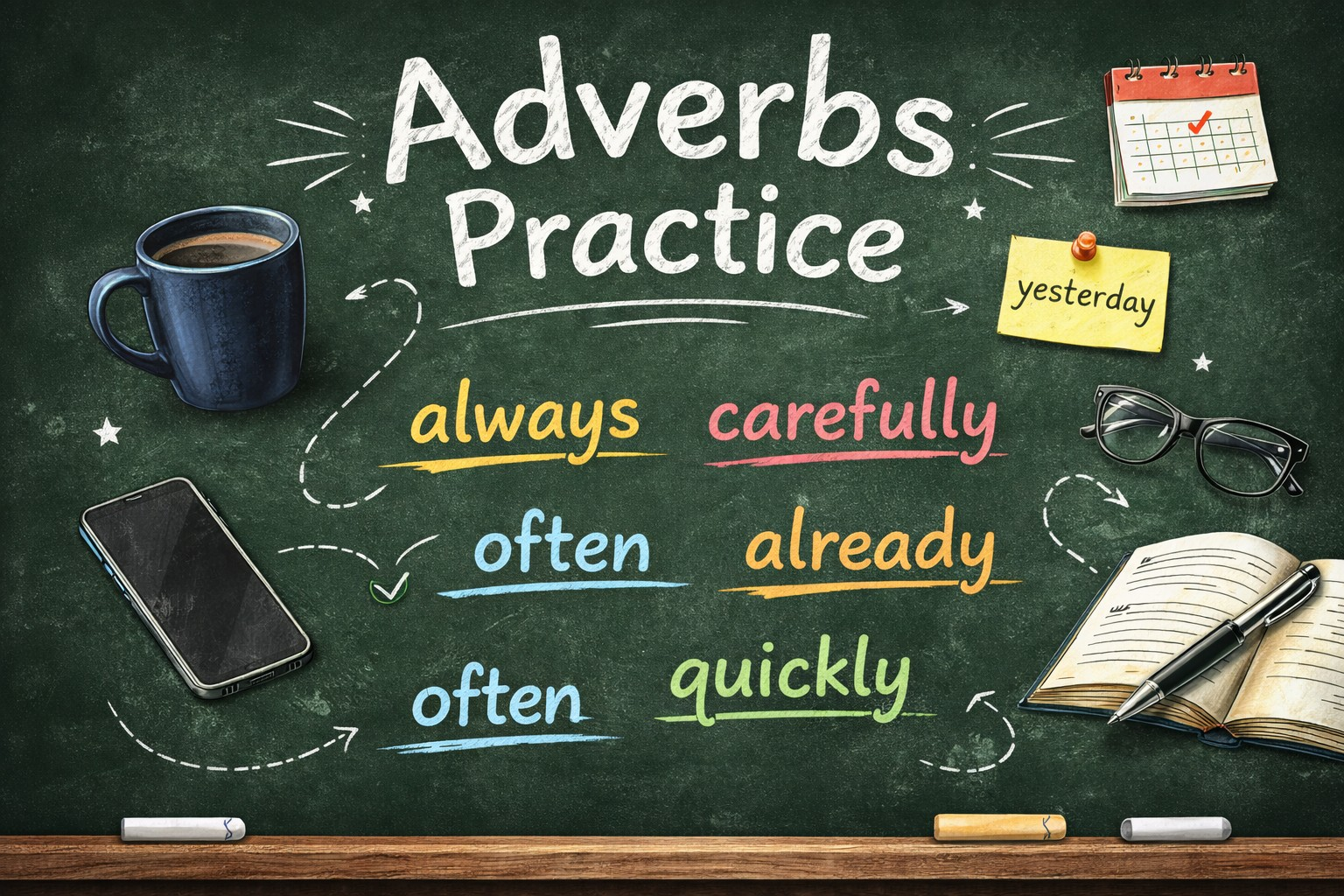
    Adverbs in English: Practical Rules, Examples, and Practice

    Adverbs in English add detail to verbs, adjectives, and even entire sentences. They answer questions like:

    • How? (slowly, carefully)
    • When? (yesterday, now)
    • How often? (always, usually)
    • How much? (very, too)
    • Where? (here, there)

    In this guide, we will focus on the most important A2-level adverbs:

    • Frequency
    • Time and sequence
    • Manner

    Other types — such as adverbs of place — will be covered in a separate lesson.

    1. Adverbs of Frequency

    Adverbs of frequency tell us how often something happens.

    Adverb Meaning
    always 100% (every time)
    usually most of the time
    often many times
    sometimes a few times
    never 0% (not at any time)

    📌 Placement of Adverbs of Frequency

    • Before the main verb → She usually studies.
    • After a Be verb → She is usually happy.
    • When a sentence has an auxiliary (have, will, can, etc.), the adverb goes: Subject + auxiliary + adverb + main verb

    Examples:

    • I always drink coffee in the morning.
    • She usually studies English at night.
    • We often visit family in Mexico.
    • They sometimes go dancing in Bogotá.
    • He never eats spicy food.
    • We are always on time for class.
    • Alejandra is never sad.
    🔁 For a complete review of Adverbs of Frequency, check out our guide here: Adverbs of Frequency and Time Expressions: Practical Rules, Examples, & Practice
    🚫 Common Mistakes with Adverbs of Frequency

    Incorrect Word Order

    ❌ I go always to class.
    ✅ I always go to class.

    Wrong Position with the Verb “To Be”

    ❌ She always is late.
    ✅ She is always late.

    Double Negatives

    ❌ I don’t never eat meat.
    ✅ I never eat meat.
    ✅ I don’t ever eat meat.

    Confusing “Usually” and “Normally” Placement

    ❌ I drink coffee usually in the morning.
    ✅ I usually drink coffee in the morning.

    Using Frequency Adverbs at the Beginning Too Often

    ❌ Always I study at night.
    ✅ I always study at night.

    2. Adverbs of Time

    Adverbs of time tell us when something happens. They help organize events clearly in the past, present, or future.

    Category Adverbs
    Points of Time (When?) now, today, tomorrow, tonight, yesterday
    Sequence / Order (In What Order?) first, then, next, last, finally
    Time Relationship to Present (When? – Indefinite) already, before, early, earlier, eventually, formerly, just, late, later, lately, previously, recently, since, soon, still, yet

    now

    • I am studying English now.
    • Many students in Bogotá are preparing for exams now.

    today

    • We have a meeting today.
    • Today, people in Mexico celebrate cultural traditions.

    yesterday

    • She finished her homework yesterday.
    • They watched a football match in Argentina yesterday.

    tomorrow

    • I will call you tomorrow.
    • We are flying to Lima tomorrow.

    tonight

    • We are going out tonight.
    • There is a concert in Santiago tonight.

    then

    • We studied grammar, and then we practiced speaking.
    • She visited Peru and then traveled to Chile.

    first

    • First, read the instructions carefully.
    • First, we visited the museum in Mexico City.

    next

    • Finish your homework and next check your answers.
    • We went to the market, and next we had lunch.

    finally

    • She worked very hard, and finally she passed the exam.
    • After many years, he finally opened his café in Colombia.

    already

    • I have already finished the report.
    • She has already visited Brazil twice.

    recently

    • I recently started a new job.
    • Many tourists have recently visited Costa Rica.

    soon

    • The class will begin soon.
    • We will travel to Guatemala soon.

    📌 Placement of Adverbs of Time

    1️⃣ At the End of a Sentence (Most Common)

    Most definite time adverbs go at the end of the sentence.

    Structure

    Subject + verb + object + time adverb

    Examples:

    • She traveled to Peru yesterday.
    • We have class today.
    • They are leaving tomorrow.
    • The concert starts tonight.

    2️⃣ At the Beginning of a Sentence (For Emphasis or Organization)

    Time adverbs can move to the beginning to highlight timing or organize writing.

    Structure

    Time adverb + comma + sentence

    Examples:

    • Yesterday, we visited the Frida Kahlo museum in Coyoacán.
    • Tomorrow, we will start a new project.
    • Today, many students are studying for exams.

    3️⃣ Sequence Adverbs (Usually Beginning or Middle)

    Adverbs that show order typically appear at the beginning.

    Examples:

    • First, read the instructions.
    • Then, complete the exercise.
    • Next, check your answers.
    • Finally, submit your work.

    They may also appear in the middle:

    • We studied grammar and then practiced speaking.

    4️⃣ In the Middle of a Sentence (Before Main Verb)

    Some indefinite time adverbs often go before the main verb.

    Common examples:

    already, recently, soon, still

    Structure

    Subject + adverb + main verb

    Examples:

    • I have already finished the report.
    • She recently started a new job.
    • We will soon begin the class.
    • He is still working.

    📌 With a Be verb, the adverb comes after the Be verb:

    • She is still here.

    5️⃣ Special Rule: “Yet”

    Yet usually appears at the end of negative or question sentences.

    • I haven’t finished yet.
    • Have you called her yet?

    Quick Reference Table

    Type Usual Position Example
    Definite Time (yesterday, tomorrow) End She arrived yesterday.
    Definite Time (emphasis) Beginning Yesterday, she arrived.
    Sequence (first, next) Beginning First, read the text.
    Already / Recently / Soon Before main verb She already finished.
    Yet End (negatives/questions) I haven’t eaten yet.
    🚫 Common Mistakes with Time Adverbs

    Incorrect Word Order with Definite Time

    ❌ She went yesterday to Peru.
    ✅ She went to Peru yesterday.

    Misplacing “Already”

    ❌ I finished already my homework.
    ✅ I already finished my homework.

    Using “Already” in Questions Instead of “Yet”

    ❌ Have you finished already?
    ✅ Have you finished yet?

    Forgetting Past Tense with “Yesterday”

    ❌ She travel to Mexico yesterday.
    ✅ She traveled to Mexico yesterday.

    Incorrect Position of Sequence Adverbs

    ❌ We went to the museum first and finally we ate.
    ✅ First, we went to the museum. Finally, we ate.

    💡If you need a refresher on other grammar topics, check out our Blog for more lessons.

    3. Adverbs of Manner

    Adverbs of manner tell us how something happens. They usually describe verbs.

    Common examples:

    slowly, quickly, carefully, easily, well, badly

    Structure

    adjective + -ly

    Adjective Adverb
    slow slowly
    quick quickly
    careful carefully
    easy easily
    🔁 Quick Review: How adjectives work in English and how they describe nouns before learning how adverbs modify verbs.

    ✅ Review here: Adjectives in English: Practical Rules, Examples, & Practice
    🔎 Adjectives vs. Adverbs: What’s the Difference?

    Adjectives Describe Nouns

    Adjectives tell us what kind or which one about a noun.

    ✔ She is a careful driver.
    ✔ It was a slow game.
    ✔ He gave a quick answer.

    Adverbs Describe Verbs

    Adverbs tell us how an action happens.

    ✔ She drives carefully.
    ✔ The team played slowly.
    ✔ He answered quickly.

    Key Pattern

    Many adverbs of manner are formed by adding -ly to an adjective:
    slow → slowly
    careful → carefully
    quick → quickly

    Important Exception

    good → well

    ❌ She speaks English very good.
    ✅ She speaks English very well.

    Spelling Changes

    Drop the y → add -ily

    • easy → easily
    • happy → happily
    • simple → simply

    Adverbs of Manner – Position in a Sentence

    Adverbs of manner usually go at the end of the sentence.

    Structure

    Subject + verb + object + adverb

    Examples:

    • She drives carefully.
    • The students answered quickly.
    • He explained the lesson clearly.
    • The tourists walked slowly through the market in Oaxaca.
    • The team played badly in the match in Buenos Aires.

    Sometimes manner adverbs can appear before the main verb for emphasis:

    • She carefully opened the door.
    🚫 Common Mistakes with Adverbs of Manner

    Using the Adjective Instead of the Adverb

    ❌ She sings beautiful.
    ✅ She sings beautifully.

    Confusing “Good” and “Well”

    ❌ He speaks English very good.
    ✅ He speaks English very well.

    Incorrect Word Order

    ❌ She carefully drives.
    ✅ She drives carefully.

    Forgetting Spelling Changes (-y → -ily)

    ❌ She answered easyly.
    ✅ She answered easily.

    Adding -ly to Irregular Forms

    ❌ He works hardly.
    ✅ He works hard.

    ⭐Key Differences for Spanish Speakers

    1️⃣ Frequency Adverbs – Word Order Difference

    Spanish:

    • Yo voy siempre a clase.
    • Ella llega nunca tarde. (structure allowed in Spanish)

    Incorrect English (direct translation):
    ❌ I go always to class.
    ❌ She arrives never late.

    Correct English:
    ✔ I always go to class.
    ✔ She never arrives late.

    📌 In English, frequency adverbs go before the main verb, not after it.

    2️⃣ Time Adverbs + Verb Tense

    Spanish:

    • Ayer viajo a Perú. (present form sometimes used conversationally)
    • Mañana voy a estudiar.

    Incorrect English (literal transfer):
    ❌ She travel yesterday.
    ❌ We go tomorrow.

    Correct English:
    ✔ She traveled yesterday.
    ✔ We will go tomorrow.

    📌 In English, the time word must match the verb tense strictly.

    Adverb Time Reference Typical Tense
    now present moment present continuous
    today current day present or future
    yesterday past simple past
    tomorrow future will / going to
    then sequence past or narrative

    3️⃣ Already vs Yet (Different Usage)

    Spanish:

    • ¿Ya terminaste?
    • Ya terminé.
    • No he terminado todavía.

    Incorrect English:
    ❌ Have you finished already?
    ❌ I finished already.

    Correct English:
    ✔ Have you finished yet?
    ✔ I have already finished.
    ✔ I haven’t finished yet.

    📌 English separates:

    • already → affirmative
    • yet → questions & negatives

    Spanish uses “ya” for both contexts.

    4️⃣ Adjective vs Adverb (Form Difference)

    Spanish (informal speech):

    • Ella canta hermoso.
    • Él conduce cuidadoso.

    Incorrect English:
    ❌ She sings beautiful.
    ❌ He drives careful.

    Correct English:
    ✔ She sings beautifully.
    ✔ He drives carefully.

    📌 English requires the -ly form to describe verbs.

    5️⃣ Good vs Well

    Spanish:

    • Ella canta muy bien.

    Incorrect English:
    ❌ She sings very good.

    Correct English:
    ✔ She sings very well.

    📌 “Good” describes nouns.
    📌 “Well” describes verbs.

    6️⃣ Double Negatives

    Spanish:

    • No voy nunca.
    • No he terminado todavía nada.

    Incorrect English:
    ❌ I don’t never go.
    ❌ I haven’t finished nothing yet.

    Correct English:
    ✔ I never go.
    ✔ I haven’t finished yet.

    📌 English uses only one negative.

    Let’s Practice!!

    Exercise A

    Choose the correct answer.

    1. I ______ go to the gym on Saturdays.
      A) go always
      B) always go
      C) go usually
      D) usually am
    2. She traveled to Colombia ______.
      A) tomorrow
      B) already
      C) yesterday
      D) soon
    3. We haven’t finished the project ______.
      A) already
      B) yet
      C) still
      D) finally
    4. He drives very ______.
      A) careful
      B) carefully
      C) care
      D) carefuly
    5. ______, we studied for the test. Then we practiced speaking.
      A) Already
      B) Soon
      C) First
      D) Yesterday
    6. I have ______ visited Mexico City twice.
      A) yet
      B) tomorrow
      C) already
      D) never
    7. She sings very ______.
      A) good
      B) well
      C) nicely good
      D) best
    8. They will call you ______.
      A) yesterday
      B) soon
      C) already
      D) first
    9. I don’t ______ eat spicy food.
      A) never
      B) often
      C) rarely
      D) sometimes
    10. The students answered the questions ______.
      A) quick
      B) quickly
      C) quickness
      D) quickest

    Exercise B

    Each sentence has one mistake. Rewrite the sentence correctly.

    1. I go always to the gym on Mondays.
    2. She arrived to Mexico City yesterday morning.
    3. We haven’t finished already the project.
    4. He drives very careful in traffic.
    5. First we went to the museum and next we ate lunch.
    6. She sings very good at concerts.
    7. I don’t never drink coffee at night.
    8. They will arrive yesterday evening.
    9. He quickly speaks Spanish.
    10. I have visited already Peru twice.

    Scoring & Feedback

    🔵 17 – 20 Correct

    Excellent work! 🎉 You really understand how to use adverbs. Keep using it in your everyday conversations and writing.

    🟢 14 – 16 Correct

    Great job! ✅ You have a good understanding of adverbs. Review the ones you missed.

    🟡 12 – 13 Correct

    Good effort! 💪You’re learning, and that’s what matters. Take a moment to review the examples and do the quiz again.

    🔴 0 – 11 Correct

    No worries! 🌱 Adverbs can be tricky at first. Go back and review the examples in the lesson.

    📚 Want more reading, writing, listening, and speaking practice? Check out the Essential English series on Amazon!

    Conclusion

    Adverbs help you speak and write with precision and clarity. At the A2 level, the most important goals are:

    • Placing frequency adverbs correctly (always, usually, often)
    • Matching time adverbs with the correct verb tense (yesterday → past, tomorrow → future)
    • Using sequence words to organize ideas (first, then, finally)
    • Choosing between already and yet correctly
    • Forming adverbs of manner with -ly (careful → carefully)
    • Avoiding double negatives

    For Spanish speakers, most mistakes come from translating directly or using Spanish word order. Once you adjust placement and tense agreement, your English becomes much more natural.

    Remember:

    • Frequency → before the main verb
    • Definite time → usually at the end
    • Sequence → often at the beginning
    • Manner → usually at the end
    • Good → adjective
    • Well → adverb

    Adverbs are not just grammar rules — they help you tell clearer stories, explain events in order, and describe actions more precisely.

    Remember! Learning a language is not about perfection—it’s about progress. Keep practicing, stay curious, and trust the process. You are moving beyond English to more opportunities, connections, and self-expression!

    💡Need personalized help using these grammar structures? Explore my ESL lessons and services for individual and group support.