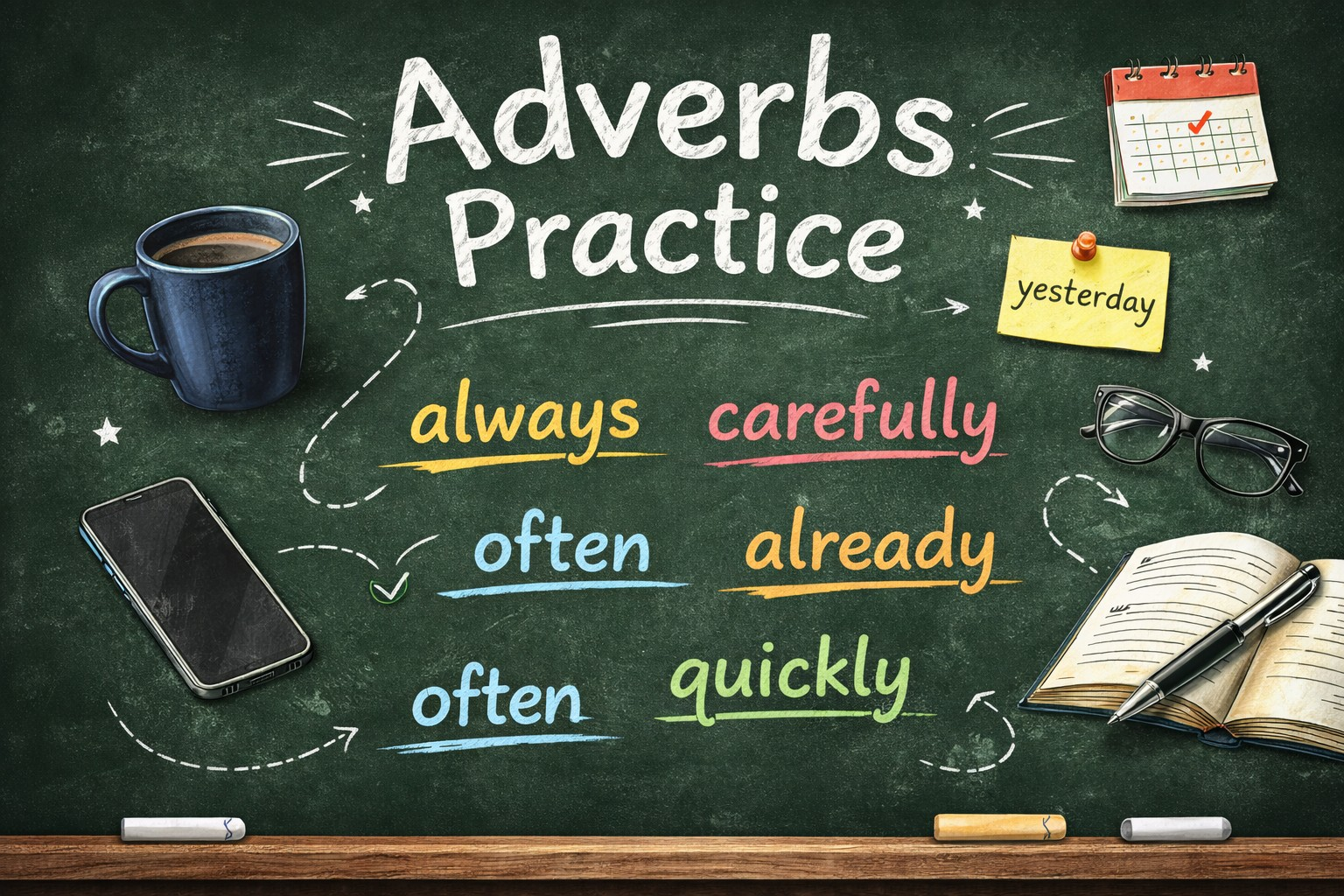
Adverbs in English add detail to verbs, adjectives, and even entire sentences. They answer questions like:
- How? (slowly, carefully)
- When? (yesterday, now)
- How often? (always, usually)
- How much? (very, too)
- Where? (here, there)
In this guide, we will focus on the most important A2-level adverbs:
- Frequency
- Time and sequence
- Manner
Other types — such as adverbs of place — will be covered in a separate lesson.
1. Adverbs of Frequency
Adverbs of frequency tell us how often something happens.
| Adverb | Meaning |
|---|---|
| always | 100% (every time) |
| usually | most of the time |
| often | many times |
| sometimes | a few times |
| never | 0% (not at any time) |
📌 Placement of Adverbs of Frequency
- Before the main verb → She usually studies.
- After a Be verb → She is usually happy.
- When a sentence has an auxiliary (have, will, can, etc.), the adverb goes: Subject + auxiliary + adverb + main verb
Examples:
- I always drink coffee in the morning.
- She usually studies English at night.
- We often visit family in Mexico.
- They sometimes go dancing in Bogotá.
- He never eats spicy food.
- We are always on time for class.
- Alejandra is never sad.
Incorrect Word Order
❌ I go always to class.
✅ I always go to class.
Wrong Position with the Verb “To Be”
❌ She always is late.
✅ She is always late.
Double Negatives
❌ I don’t never eat meat.
✅ I never eat meat.
✅ I don’t ever eat meat.
Confusing “Usually” and “Normally” Placement
❌ I drink coffee usually in the morning.
✅ I usually drink coffee in the morning.
Using Frequency Adverbs at the Beginning Too Often
❌ Always I study at night.
✅ I always study at night.
2. Adverbs of Time
Adverbs of time tell us when something happens. They help organize events clearly in the past, present, or future.
| Category | Adverbs |
|---|---|
| Points of Time (When?) | now, today, tomorrow, tonight, yesterday |
| Sequence / Order (In What Order?) | first, then, next, last, finally |
| Time Relationship to Present (When? – Indefinite) | already, before, early, earlier, eventually, formerly, just, late, later, lately, previously, recently, since, soon, still, yet |
now
- I am studying English now.
- Many students in Bogotá are preparing for exams now.
today
- We have a meeting today.
- Today, people in Mexico celebrate cultural traditions.
yesterday
- She finished her homework yesterday.
- They watched a football match in Argentina yesterday.
tomorrow
- I will call you tomorrow.
- We are flying to Lima tomorrow.
tonight
- We are going out tonight.
- There is a concert in Santiago tonight.
then
- We studied grammar, and then we practiced speaking.
- She visited Peru and then traveled to Chile.
first
- First, read the instructions carefully.
- First, we visited the museum in Mexico City.
next
- Finish your homework and next check your answers.
- We went to the market, and next we had lunch.
finally
- She worked very hard, and finally she passed the exam.
- After many years, he finally opened his café in Colombia.
already
- I have already finished the report.
- She has already visited Brazil twice.
recently
- I recently started a new job.
- Many tourists have recently visited Costa Rica.
soon
- The class will begin soon.
- We will travel to Guatemala soon.
📌 Placement of Adverbs of Time
1️⃣ At the End of a Sentence (Most Common)
Most definite time adverbs go at the end of the sentence.
Structure
Subject + verb + object + time adverb
Examples:
- She traveled to Peru yesterday.
- We have class today.
- They are leaving tomorrow.
- The concert starts tonight.
2️⃣ At the Beginning of a Sentence (For Emphasis or Organization)
Time adverbs can move to the beginning to highlight timing or organize writing.
Structure
Time adverb + comma + sentence
Examples:
- Yesterday, we visited the Frida Kahlo museum in Coyoacán.
- Tomorrow, we will start a new project.
- Today, many students are studying for exams.
3️⃣ Sequence Adverbs (Usually Beginning or Middle)
Adverbs that show order typically appear at the beginning.
Examples:
- First, read the instructions.
- Then, complete the exercise.
- Next, check your answers.
- Finally, submit your work.
They may also appear in the middle:
- We studied grammar and then practiced speaking.
4️⃣ In the Middle of a Sentence (Before Main Verb)
Some indefinite time adverbs often go before the main verb.
Common examples:
already, recently, soon, still
Structure
Subject + adverb + main verb
Examples:
- I have already finished the report.
- She recently started a new job.
- We will soon begin the class.
- He is still working.
📌 With a Be verb, the adverb comes after the Be verb:
- She is still here.
5️⃣ Special Rule: “Yet”
Yet usually appears at the end of negative or question sentences.
- I haven’t finished yet.
- Have you called her yet?
Quick Reference Table
| Type | Usual Position | Example |
|---|---|---|
| Definite Time (yesterday, tomorrow) | End | She arrived yesterday. |
| Definite Time (emphasis) | Beginning | Yesterday, she arrived. |
| Sequence (first, next) | Beginning | First, read the text. |
| Already / Recently / Soon | Before main verb | She already finished. |
| Yet | End (negatives/questions) | I haven’t eaten yet. |
Incorrect Word Order with Definite Time
❌ She went yesterday to Peru.
✅ She went to Peru yesterday.
Misplacing “Already”
❌ I finished already my homework.
✅ I already finished my homework.
Using “Already” in Questions Instead of “Yet”
❌ Have you finished already?
✅ Have you finished yet?
Forgetting Past Tense with “Yesterday”
❌ She travel to Mexico yesterday.
✅ She traveled to Mexico yesterday.
Incorrect Position of Sequence Adverbs
❌ We went to the museum first and finally we ate.
✅ First, we went to the museum. Finally, we ate.
3. Adverbs of Manner
Adverbs of manner tell us how something happens. They usually describe verbs.
Common examples:
slowly, quickly, carefully, easily, well, badly
Structure
adjective + -ly
| Adjective | Adverb |
|---|---|
| slow | slowly |
| quick | quickly |
| careful | carefully |
| easy | easily |
✅ Review here: Adjectives in English: Practical Rules, Examples, & Practice
Adjectives Describe Nouns
Adjectives tell us what kind or which one about a noun.
✔ She is a careful driver.
✔ It was a slow game.
✔ He gave a quick answer.
Adverbs Describe Verbs
Adverbs tell us how an action happens.
✔ She drives carefully.
✔ The team played slowly.
✔ He answered quickly.
Key Pattern
Many adverbs of manner are formed by adding -ly to an adjective:
slow → slowly
careful → carefully
quick → quickly
Important Exception
good → well
❌ She speaks English very good.
✅ She speaks English very well.
Spelling Changes
Drop the y → add -ily
- easy → easily
- happy → happily
- simple → simply
Adverbs of Manner – Position in a Sentence
Adverbs of manner usually go at the end of the sentence.
Structure
Subject + verb + object + adverb
Examples:
- She drives carefully.
- The students answered quickly.
- He explained the lesson clearly.
- The tourists walked slowly through the market in Oaxaca.
- The team played badly in the match in Buenos Aires.
Sometimes manner adverbs can appear before the main verb for emphasis:
- She carefully opened the door.
Using the Adjective Instead of the Adverb
❌ She sings beautiful.
✅ She sings beautifully.
Confusing “Good” and “Well”
❌ He speaks English very good.
✅ He speaks English very well.
Incorrect Word Order
❌ She carefully drives.
✅ She drives carefully.
Forgetting Spelling Changes (-y → -ily)
❌ She answered easyly.
✅ She answered easily.
Adding -ly to Irregular Forms
❌ He works hardly.
✅ He works hard.
⭐Key Differences for Spanish Speakers
1️⃣ Frequency Adverbs – Word Order Difference
Spanish:
- Yo voy siempre a clase.
- Ella llega nunca tarde. (structure allowed in Spanish)
Incorrect English (direct translation):
❌ I go always to class.
❌ She arrives never late.
Correct English:
✔ I always go to class.
✔ She never arrives late.
📌 In English, frequency adverbs go before the main verb, not after it.
2️⃣ Time Adverbs + Verb Tense
Spanish:
- Ayer viajo a Perú. (present form sometimes used conversationally)
- Mañana voy a estudiar.
Incorrect English (literal transfer):
❌ She travel yesterday.
❌ We go tomorrow.
Correct English:
✔ She traveled yesterday.
✔ We will go tomorrow.
📌 In English, the time word must match the verb tense strictly.
| Adverb | Time Reference | Typical Tense |
|---|---|---|
| now | present moment | present continuous |
| today | current day | present or future |
| yesterday | past | simple past |
| tomorrow | future | will / going to |
| then | sequence | past or narrative |
3️⃣ Already vs Yet (Different Usage)
Spanish:
- ¿Ya terminaste?
- Ya terminé.
- No he terminado todavía.
Incorrect English:
❌ Have you finished already?
❌ I finished already.
Correct English:
✔ Have you finished yet?
✔ I have already finished.
✔ I haven’t finished yet.
📌 English separates:
- already → affirmative
- yet → questions & negatives
Spanish uses “ya” for both contexts.
4️⃣ Adjective vs Adverb (Form Difference)
Spanish (informal speech):
- Ella canta hermoso.
- Él conduce cuidadoso.
Incorrect English:
❌ She sings beautiful.
❌ He drives careful.
Correct English:
✔ She sings beautifully.
✔ He drives carefully.
📌 English requires the -ly form to describe verbs.
5️⃣ Good vs Well
Spanish:
- Ella canta muy bien.
Incorrect English:
❌ She sings very good.
Correct English:
✔ She sings very well.
📌 “Good” describes nouns.
📌 “Well” describes verbs.
6️⃣ Double Negatives
Spanish:
- No voy nunca.
- No he terminado todavía nada.
Incorrect English:
❌ I don’t never go.
❌ I haven’t finished nothing yet.
Correct English:
✔ I never go.
✔ I haven’t finished yet.
📌 English uses only one negative.
Let’s Practice!!
Exercise A
Choose the correct answer.
-
I ______ go to the gym on Saturdays.
A) go always
B) always go
C) go usually
D) usually am -
She traveled to Colombia ______.
A) tomorrow
B) already
C) yesterday
D) soon -
We haven’t finished the project ______.
A) already
B) yet
C) still
D) finally -
He drives very ______.
A) careful
B) carefully
C) care
D) carefuly -
______, we studied for the test. Then we practiced speaking.
A) Already
B) Soon
C) First
D) Yesterday -
I have ______ visited Mexico City twice.
A) yet
B) tomorrow
C) already
D) never -
She sings very ______.
A) good
B) well
C) nicely good
D) best -
They will call you ______.
A) yesterday
B) soon
C) already
D) first -
I don’t ______ eat spicy food.
A) never
B) often
C) rarely
D) sometimes -
The students answered the questions ______.
A) quick
B) quickly
C) quickness
D) quickest
Exercise B
Each sentence has one mistake. Rewrite the sentence correctly.
- I go always to the gym on Mondays.
- She arrived to Mexico City yesterday morning.
- We haven’t finished already the project.
- He drives very careful in traffic.
- First we went to the museum and next we ate lunch.
- She sings very good at concerts.
- I don’t never drink coffee at night.
- They will arrive yesterday evening.
- He quickly speaks Spanish.
- I have visited already Peru twice.
Scoring & Feedback
🔵 17 – 20 Correct
Excellent work! 🎉 You really understand how to use adverbs. Keep using it in your everyday conversations and writing.
🟢 14 – 16 Correct
Great job! ✅ You have a good understanding of adverbs. Review the ones you missed.
🟡 12 – 13 Correct
Good effort! 💪You’re learning, and that’s what matters. Take a moment to review the examples and do the quiz again.
🔴 0 – 11 Correct
No worries! 🌱 Adverbs can be tricky at first. Go back and review the examples in the lesson.
Conclusion
Adverbs help you speak and write with precision and clarity. At the A2 level, the most important goals are:
- Placing frequency adverbs correctly (always, usually, often)
- Matching time adverbs with the correct verb tense (yesterday → past, tomorrow → future)
- Using sequence words to organize ideas (first, then, finally)
- Choosing between already and yet correctly
- Forming adverbs of manner with -ly (careful → carefully)
- Avoiding double negatives
For Spanish speakers, most mistakes come from translating directly or using Spanish word order. Once you adjust placement and tense agreement, your English becomes much more natural.
Remember:
- Frequency → before the main verb
- Definite time → usually at the end
- Sequence → often at the beginning
- Manner → usually at the end
- Good → adjective
- Well → adverb
Adverbs are not just grammar rules — they help you tell clearer stories, explain events in order, and describe actions more precisely.
Remember! Learning a language is not about perfection—it’s about progress. Keep practicing, stay curious, and trust the process. You are moving beyond English to more opportunities, connections, and self-expression!